

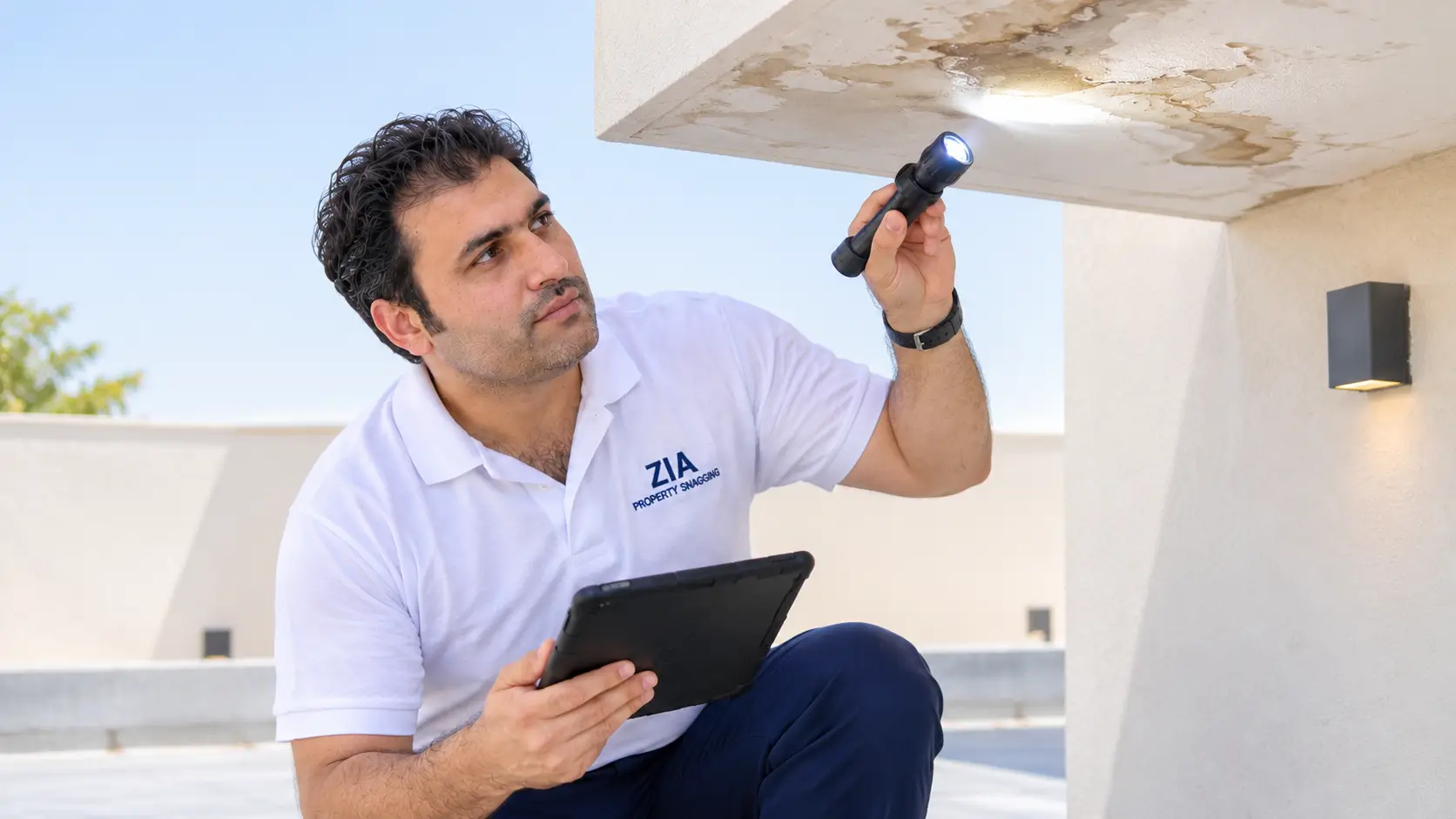
Roof Leak Inspection Villa Dubai | Fast & Accurate Detection
A brown stain on the ceiling after rain is easy to see and hard to explain. Water rarely drops straight down from the place it got in. A roof leak inspection villa Dubai owners book before repairs start with a simple idea: find where the water really enters, instead of patching where it shows. This guide explains why villa roofs leak, how engineers trace the source with moisture meters and thermal cameras, and what to do in the meantime.
Quick answer: a roof leak inspection in Dubai involves checking the roof surface, drains, parapets, joints, and pipe and AC penetrations, then tracing moisture through the ceiling and walls with a moisture meter and a thermal camera. Some inspections add a water test. The aim is to find the entry point, which can be metres away from the stain, and to rule out other sources like AC condensation, tanks, or pipes. Patching above the stain without that step often fails.
What Is a Roof Leak Inspection for a Villa in Dubai?
It’s an investigation, not a repair. An inspector looks for how water gets in, where it travels, and how much damage it has done. The result is a report with photos and readings that tells you what to fix and in what order. That gives you evidence to take to a waterproofing contractor, your landlord, your developer, or your insurer.
It’s different from a roofer’s quote. A contractor often sells a fix. An independent inspection tells you what’s wrong first, so you don’t pay to repair the wrong thing.
Why Do Dubai Villa Roofs Leak?
Dubai doesn’t get much rain, but when it comes, it comes hard, and the roof has been working against the sun for months. Roofing contractors point to a handful of causes again and again:
- Heat cycles: Roof surfaces can get extremely hot in summer, reportedly around 80°C, and cool sharply at night. The slab expands and contracts daily, and waterproofing can’t move cracks.
- UV exposure: Sunlight makes some membranes and coatings brittle over time.
- Ageing waterproofing: Contractors say original waterproofing on a villa roof often reaches the end of its life after 10 to 15 years, though it depends on the system and the quality of the work.
- Weak details: Leaks often start at parapets, pipe openings, AC bases, skylights, and drains, because they’re the hardest places to seal.
- Drainage problems: Blocked outlets, or drains placed too high or poorly sloped, leave water standing, which finds every weak spot.
- Damage from other work: Fixing an AC unit or cable can puncture the waterproof layer.
- Workmanship: Rushed or inconsistent work during construction, especially in new communities.
New villas aren’t immune. Our guide on why waterproofing fails in new homes explains what goes wrong in the first years and why the defect period is the time to act.
Leave your phone, We’ll call you in 15 min
Signs of a Roof Leak
What you see | What it can mean | What to check |
|---|---|---|
Brown or yellow ceiling stain that grows after rain | Water getting through the roof or a joint | Roof surface, parapets, drains, joints |
Bubbling or flaking paint on the top floor | Moisture behind the finish | Moisture meter readings, source above |
Musty smell, strongest in the morning | Damp in the ceiling or wall | Hidden damp, thermal scan |
Standing water a day after rain | Poor fall or blocked drain | Drain outlets and roof slope |
Cracked, chalky or blistered roof surface | Ageing or failed membrane | Condition of the whole waterproofing layer |
Stain near a pipe or AC point | Failed seal around a penetration | Penetrations and AC bases |
Stain that appears with no rain | AC condensation, tank, irrigation, or pipe | Non-roof sources |
Notice that most signs show up below the roof, not on it. That’s why a stain is a clue and not a diagnosis.
How Does a Roof Leak Inspection Work?
A thorough inspection usually works from the inside out and the outside in. Here’s the typical process:
- History: The inspector asks when the leak appears: after rain, irrigation, peak AC use, or all the time. Timing is a strong clue.
- Inside check: Ceilings, walls, and cornices are examined for stains, bubbling paint, salts, and cracks, and photographed.
- Moisture readings: A moisture meter maps where the damp is and how far it has spread. This shows the wet area, not just the visible stain.
- Thermal imaging: A thermal camera shows temperature differences that can reveal wet insulation or slab, which look different from dry areas. It’s a guide, so it’s checked against moisture readings.
- Roof survey. The roof surface, membrane, joints, drains, parapets, AC bases, and pipe openings are checked for cracks, blisters, open seams, and ponding.
- Rule out other sources. AC condensation lines, water tanks, irrigation spray on parapets, and bathroom pipes in the slab can all look like a roof leak.
- Water test, if needed. In some cases, a controlled water test on a suspect area confirms the entry point.
- Report. You get findings, photos, readings, and a recommended repair in order of urgency.
Civil inspection by our engineers covers the building fabric, including roofs, walls, and waterproofing, so a leak is checked in the context of the whole structure. The Zia team is RERA-approved, DED-licensed, and InterNACHI-certified, and every report comes with photos delivered within 24 hours. We inspect and report. We don’t carry out waterproofing work, so we have no interest in selling you a bigger repair.
What Should the Report Tell You?
A useful report doesn’t stop at “leak found.” It should tell you:
- Where the water is entering, with photos and a marked plan or roof sketch.
- How far the moisture has spread, using meter readings or thermal images.
- The most likely cause, such as a failed joint, a blocked drain, or an ageing membrane.
- What damage already exists, including ceilings, insulation, electrics, and finishes.
- What to repair first, and what can wait.
- What to ask a waterproofing contractor, so quotes cover the same scope.
Keep the report with your property file. It’s also a baseline: if the leak returns after a repair, you can compare readings and show what’s changed.
Inspection, Leak Detection, and Repair: What's the Difference?
- Inspection: an independent assessment of the roof and the damage, ending in a report. It’s the first step.
- Leak detection: a more focused search for a hidden leak, sometimes using special equipment. An inspection may include it or lead to it.
- Repair or waterproofing: the work itself, done by a contractor. It’s best done after the cause is known.
Separating the steps protects you. The person who finds the problem isn’t the one selling the fix, and you can compare several quotes against the same report.
What to Do Right Now If Your Villa Roof Leaks
- Stay safe: If water is near sockets, lights, or the distribution board, switch off the power to that area.
- Contain the water: Catch drips and move furniture and electronics.
- Photograph and note the timing: Record the stain, the date, and whether it followed rain, irrigation, or AC use.
- Don’t paint over it: Paint hides the evidence and traps moisture.
- Stay off a wet roof: It’s slippery, and the surface can be damaged.
- Get it inspected before repairs: Patching the wrong spot wastes money.
Why Patching Over the Stain Often Fails
Water follows the slab, the pipes, and the cracks. It can travel a long way before it shows, so the entry point may be well away from the stain. A patch over the stain treats the symptom. The water keeps coming in and shows up somewhere else, often after the next rain.
Roofing contractors also note that once a membrane has failed across a whole roof, patches pile up and add new seams that become weak points. In that case, a full repair may be better than repeated small ones. An inspection tells you which situation you’re in, so you can ask contractors for the right solution and compare quotes properly.
Who Pays for a Roof Leak?
It depends on who’s responsible for the building. In a new villa still under the developer’s defects period, the developer is usually the first call. In a resale villa, you pay as the owner. In a rented villa, the usual starting point is that the landlord deals with defects, but the contract decides. Whoever pays, a dated report with photos and readings makes the conversation easier, and it supports an insurance claim if you have one.
A Simple Roof Routine for Villa Owners
You can’t replace an inspection, but a few checks twice a year help you catch problems early:
- Clear leaves, sand, and debris from roof drains and outlets before the rainy season.
- Walk the roof a day or two after rain, safely and with care, and look for standing water in the same spots.
- Look for cracks, blistering, chalky patches, and open seams on the surface.
- Check the edges where the roof meets parapets, pipes, and AC bases.
- Look at the top-floor ceilings for new stains or bubbling paint.
- Ask anyone working on the roof to avoid damaging the waterproofing, and photograph the area before and after.
If roof access is unsafe, don’t climb up. Use binoculars or a camera from a safe point, or ask a professional.
When Should You Inspect the Roof?
- As soon as you see a stain, bubbling paint, or a damp smell.
- Before buying a villa, especially an older one.
- Before the rainy season, as part of regular maintenance.
- After heavy rain or storms.
- After AC, solar, or other works on the roof.
- Before the developer’s defects period ends on a new villa.
Frequently Asked Questions
What is a roof leak inspection in Dubai?
An investigation to find where water enters a villa roof, how far it has spread, and what caused it, using visual checks, moisture meters, and thermal imaging.
Can a thermal camera find a roof leak by itself?
Not reliably. It shows temperature patterns that suggest moisture, so inspectors confirm with moisture readings and a physical check.
How much does a roof leak inspection villa Dubai owners book cost?
It depends on the size of the villa and what’s included. Contact us for a quote based on your property.
Why does my ceiling stain appear far from the roof edge?
Water travels along the slab and pipes before it shows, so the entry point can be meters away from the stain.
Could the leak come from somewhere other than the roof?
Yes. AC condensation lines, tank overflows, irrigation spray, and pipes in the slab can all cause stains that look like roof leaks.
Seeing Stains After Rain?
Tell us where the stain is, when it appears, and how old the villa is, and we’ll explain how a roof leak inspection works. Villa Dubai owners rely on people who will work for your property. Get in touch, and we’ll take it from there.
