
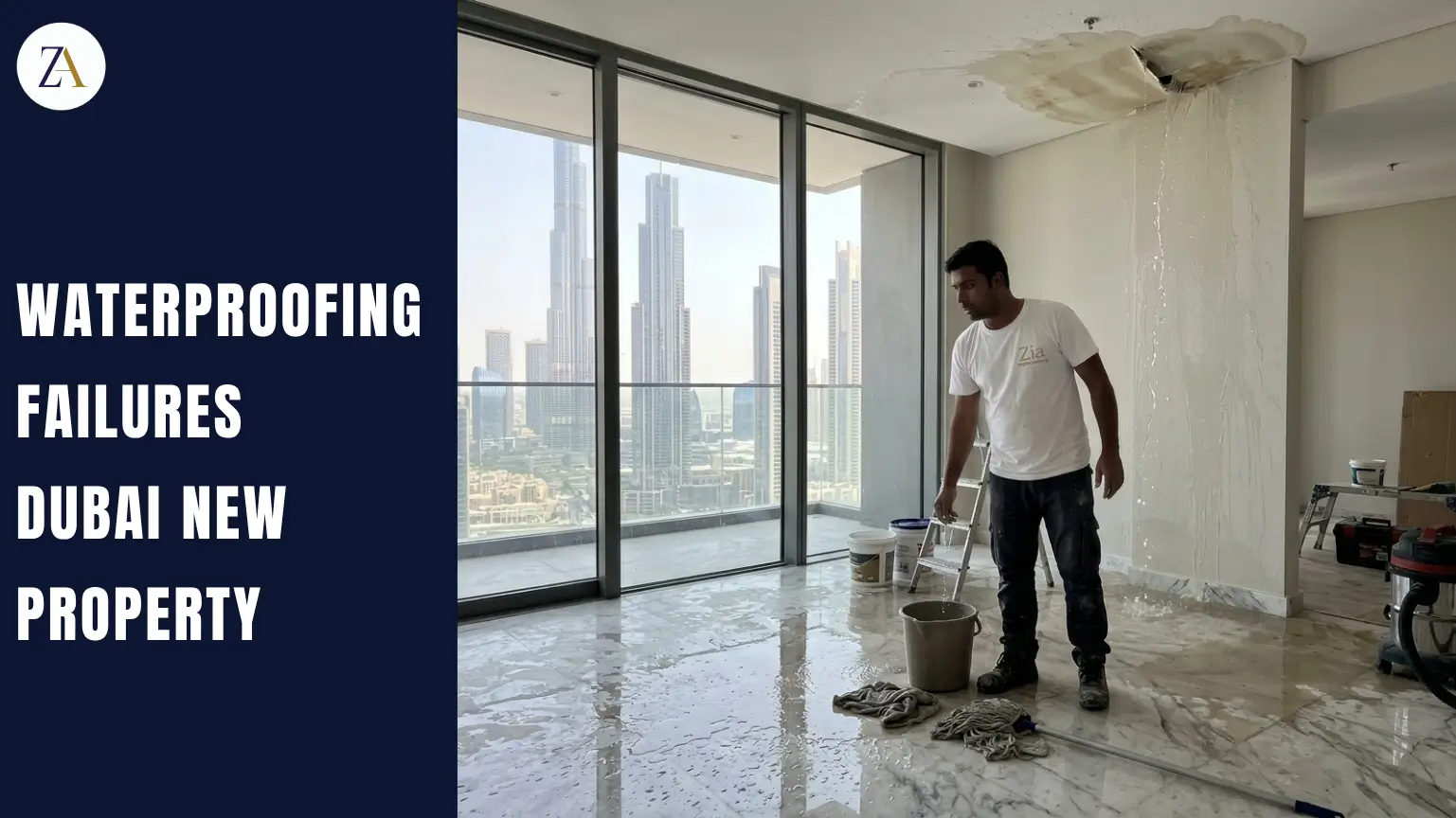
Waterproofing Failures in Dubai New Properties Fix Now
Thousands of new properties are sold in Dubai’s real estate market each year, including off-plan apartments, luxury villas, high-rise towers, and more in communities such as Dubai Marina, Business Bay, JVC, and Dubai Hills Estate. However, one of the most costly and neglected fault areas in many new homes silently lurks behind the shiny new walls and flooring—waterproofing failure.
The breakdown of the waterproofing is not a rare defect in Dubai’s fresh properties, it is one of the most common ones that occur in an expert snagging inspection. The reason they are so harmful is they are almost always not visible at the handover. Tiles look perfect. Walls appear dry. But hidden underneath, a waterproofing membrane that was incorrectly applied or not suited to Dubai’s extreme climate is already beginning to degrade.
This guide explains why waterproofing fails in Dubai’s new properties, what the warning signs look like, what your legal rights are during the Defect Liability Period (DLP), and why a professional snagging inspection is your single most powerful tool for catching these defects before they become your financial responsibility.
Why Waterproofing Failures Are So Common in Dubai's New Properties
Dubai’s climate is one of the most demanding building environments on the planet. Surface temperatures on the roofs are frequently 80–85°C in summer. Day and night temperature ranges can be as high as 30°C, which results in the constant expansion and contraction of concrete. The amount of UV radiation is one of the highest on Earth, and during heavy rainfall events, like the storms in April of 2024, the waterproofing systems are subjected to sudden and extreme pressures.
However, most waterproofing products used in Dubai’s new developments are tested in the European or North American lab environment, which is very different from reality in the UAE. The outcome is systematic gaps between the climate’s requirements and the materials’ actual performance.
Add to this the delivery pressure on developers—completing thousands of units under tight timelines — and it becomes easy to understand why waterproofing application is frequently rushed or completed with substandard materials chosen for cost rather than performance.
Types of Waterproofing in Dubai Properties — and Where They Fail
A new Dubai property contains multiple waterproofing systems, each presenting a different failure risk.
Leave your phone, We’ll call you in 15 min
Roof and Flat Terrace Waterproofing
Most of Dubai’s flat roofs are structurally required, but waterproofing is a big issue. These surfaces are constantly exposed to UV radiation, as well as to harsh thermal cycling and the possibility of standing water (ponding) that exerts pressure against any surface, especially if the surface is crack-prone. If a flat roof membrane fails, water can flow horizontally across the screed layer, often as damp patches or stains on the ceilings, well away from the point of failure—resulting in a tough diagnosis and expensive repair.
Bathroom and Wet Area Waterproofing
Among the most expensive defects in Dubai’s new buildings (and completely hidden at handover) are bathroom waterproofing failures. Tiles are spotless, grout is level, and silicone has been applied properly. In the case that the membrane underneath the tiles has been incorrectly installed or has not been cured properly before tiling, the water used for showering regularly gradually seeps through the screed and slab under the tiles. This usually only becomes apparent after 6 to 18 months after handover, as the result of peeling paint, damp patches, or mould forming on the ceiling of the room below.
Podium Slabs, Balconies, and Below-Grade Areas
A frequent spot for balcony waterproofing failure is the interface between the balcony membrane and the sliding door threshold, especially in mid-rise and high-rise constructions. Waterproofing below grade will also help to prevent water from leaking into a basement car park; the most prevalent type of soil in Dubai is extremely salty and aggressive.
Top Causes of Waterproofing Failures in Dubai New Properties
Wrong Material Specification
The most fundamental cause of waterproofing failure is using materials designed for temperate climates. Systems that perform well in Europe fail within 2–3 years in Dubai’s UV-intense, high-temperature environment. The waterproofing system for Dubai should have a minimum elongation capacity of 300% after aging, meaning that it must remain flexible enough to accommodate the movement of the structure during its entire service life.
Poor Surface Preparation
No waterproofing membrane will bond as well as it will to a good surface. The substrate is dusty, damp or uneven when applied and the membrane will not adhere to the surface, leaving tiny pathways for water migration that are not visible to the naked eye but can easily be detected by professional moisture meters.
Rushed Application Under Deadline Pressure
There is a set period of curing that waterproofing membranes must go through before the next trade can start. These curing windows are often ignored when developers make hard deadlines for handover. When screeds and tiles are installed prior to the membrane being cured, bond failure occurs, leading to failure of the waterproofing system as a whole.
Weak Detailing at Critical Junctions
The majority of active leaks in new Dubai properties originate not from the membrane field area but from poorly reinforced junctions — drains, pipe penetrations, AC condensate outlets, and expansion joints. These locations require specialist reinforcement, but this detail is frequently omitted during rushed construction.
Inadequate Drainage on Flat Surfaces
Flat roofs and terraces that accumulate standing water (ponding) after rainfall place sustained hydrostatic pressure on the membrane. Even a compliant membrane will eventually fail under these conditions if drainage outlets are insufficient, blocked, or incorrectly positioned.
Substandard Materials Chosen for Cost Savings
Developer procurement under price pressure frequently results in waterproofing systems specified for cost rather than performance. The short-term saving on membrane grade typically translates into repair costs three to five times higher within the first five years of occupation.
Warning Signs of Waterproofing Failure in a New Dubai Property
Many waterproofing failures are invisible at handover but become visible within months. Key indicators include the following:
- Damp patches, water stains, or discolouration on ceilings—especially below bathrooms or rooftop terraces
- White powdery mineral deposits (efflorescence) on external walls or other structures on the basement.
- Bubbling or peeling paint on inside walls, especially bathrooms or laundry rooms
- Cracks or blistering in the roofing waterproofing on the roof or terrace surfaces
- Mould growing in bathrooms, on walls, ceilings or wardrobes next to external walls
- Standing water on flat roofs or terraces more than 48 hours after rainfall
- Mouldy smell in rooms with tiled floors, even though no water is visible
- High moisture levels on the rear of tiled walls (which can only be adequately identified by a trained inspection tool)
The absence of visible signs at handover does not mean waterproofing is performing correctly. The most damaging failures remain invisible until significant structural saturation has already occurred—by which point remediation costs are substantially higher.
Your Legal Rights: Defect Liability Period and Waterproofing in Dubai
According to UAE Property Law and RERA regulations, Defects liable to correction as a result of workmanship and materials and/or improper installation are to be corrected by the developer within the Defect Liability Period (DLP). The DLP for most residential properties in Dubai is 1 year from the date of handover and can be longer for structural defects.
Waterproofing failures are classified as serious defects under UAE property law. However, enforcing your DLP rights requires documented evidence. A developer cannot be held responsible for a defect that you cannot prove existed at handover.
If a buyer moves in and finds the waterproofing is a problem after three months, their legal situation is much different from one who submits a dated, photographed snagging report to the developer on day one of the DLP window. The Defect Liability Period clock starts at the time of handover. Any defects that are recorded before that time are the developer’s responsibility. Any defects found after the window is closed are your problem.
How a Professional Snagging Inspection Detects Waterproofing Failures
The reason waterproofing failures are so frequently missed by buyers doing their own walkthroughs is that looking at tiles, running taps, and checking for obvious drips does not penetrate below the surface. Professional snagging inspectors use specialist tools that reveal what the eye cannot see.
Moisture Meters: Measure moisture content behind tiled walls, under screed, and within ceiling substrates. Elevated readings indicate membrane failure even when tiles and paint appear visually perfect.
Thermal Imaging Cameras: Detect temperature differentials caused by water-saturated materials. In Dubai’s climate, thermal anomalies reveal waterproofing failures that would remain invisible for months under standard observation.
Critical Junction Inspection: Systematic examination of all high-risk waterproofing junctions—drain surrounds, pipe penetrations, AC condensate points, expansion joints, and balcony thresholds — checking for correct reinforcement and membrane continuity.
400-Checkpoint Review: Waterproofing is assessed as part of a comprehensive inspection covering structural elements, MEP systems, and finishing—identifying interconnected defects that a single-focus inspection would miss.
How Zia Property Snagging Protects You from Waterproofing Failures
Zia Property Snagging is a fully independent, RERA-approved snagging company in Dubai. We are DED Licensed and InterNACHI Certified, and every inspection is conducted by a qualified civil engineer—not a general handyman or trainee technician.
Our waterproofing assessment covers:
- Moisture meter testing behind all bathroom walls, wet area floors, and ceiling substrates below bathrooms
- Visual inspection of all waterproofing junctions across the rooftop, terrace, balcony, and below-grade areas
- Identification of ponding risk areas on flat roofs and terraces
- Assessment of all critical penetration points — drains, AC outlets, pipe entries, and expansion joints
- Photographic documentation of every identified failure point, severity-rated and ready for developer submission
Your full snagging report is delivered within 24 hours of inspection. A free re-inspection is included after the developer completes rectifications. We work exclusively for buyers — never for developers. Book from AED 999. Call or WhatsApp: +971 56 901 9343.
Frequently Asked Questions
How do I know if my new Dubai property has a waterproofing defect?
A snagging list is a detailed report of all the defects found during a property snagging inspection. It includes photos, defect descriptions, severity ratings, and recommendations for rectification.
Is the developer responsible for fixing waterproofing failures in my new Dubai property?
Yes—under RERA regulations, waterproofing failures fall within the developer’s responsibilities during the Defect Liability Period. However, you must document the defect with a professional snagging report. Without documentation, the developer can dispute liability, and the cost falls on you.
Can waterproofing failures be fixed without breaking tiles?
In most cases, no. Bathroom waterproofing remediation typically requires full tile removal to reapply the membrane, costing AED 15,000 to AED 40,000 or more. This is exactly why early detection during the DLP — when the developer carries the cost — is so critical.
How much does a snagging inspection cost, and is it worth it?
Inspections with Zia start from AED 999. A single undetected bathroom waterproofing failure costs AED 15,000 to AED 40,000 to repair. A roof membrane replacement can exceed AED 100,000. The inspection cost is not a fee — it is protection against repair bills that are many times higher.
Conclusion
Waterproofing failures are the hidden epidemic of Dubai’s new property market — invisible at handover, expensive to fix, and entirely preventable with the right inspection. A professional snagging inspection before handover is the only reliable way to catch these defects while the developer is still legally responsible.
Zia Property Snagging is RERA-approved, DED Licensed, and InterNACHI Certified. Book from AED 999 — call or WhatsApp +971 56 901 9343 — and get your full 400+ checkpoint report within 24 hours.