

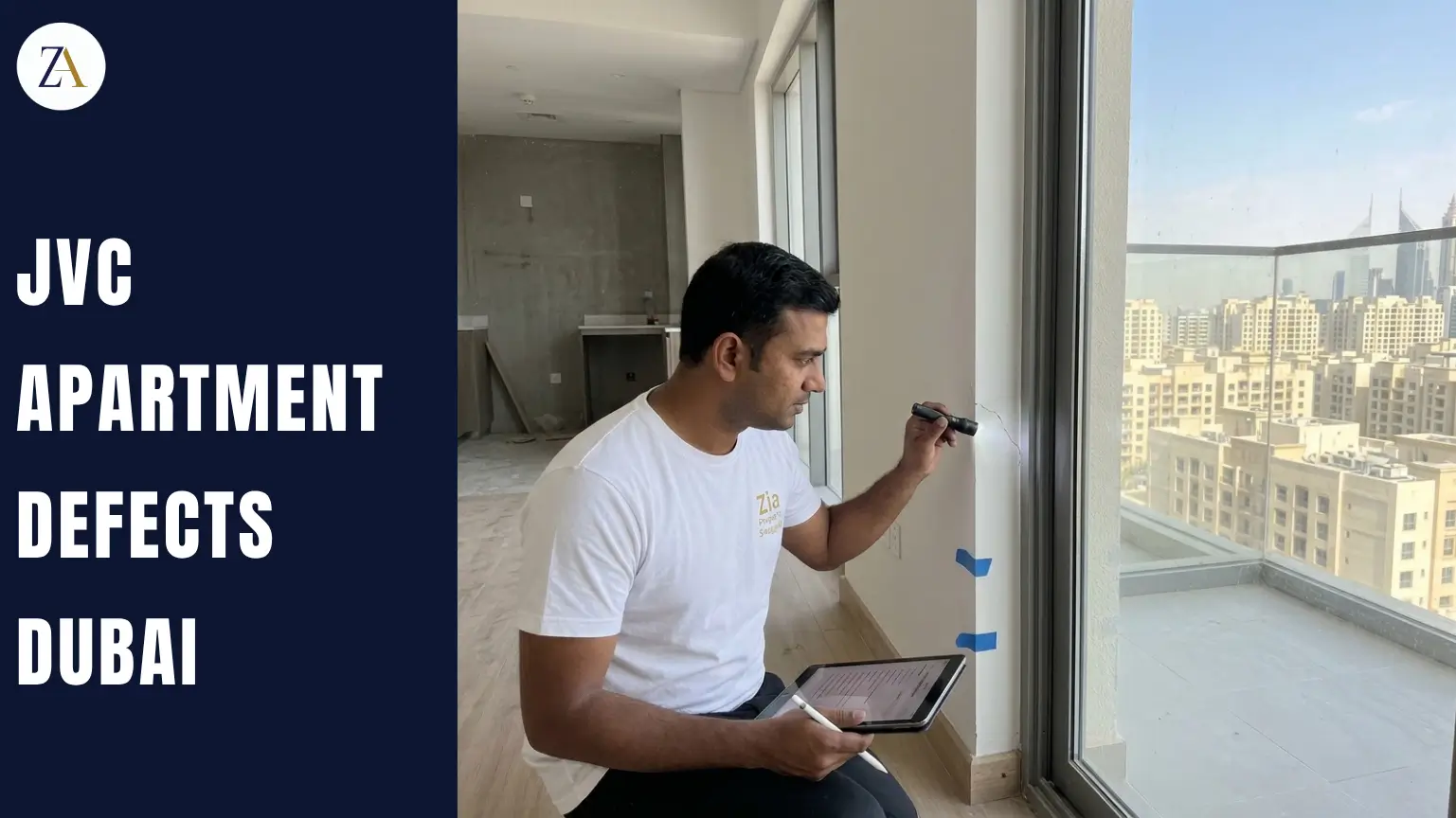
JVC Apartment Defects Dubai 2026: What Buyers Must Know
Jumeirah Village Circle (JVC) is a dynamic residential area in Dubai. Thousands of apartments are handed over annually, and JVC is the choice for investors who are interested in acquiring modern and cost-effective apartments and also for end users and tenants who are seeking to live in apartments that are modern to their habit requirements. However, there’s a growing worry among many JVC buyers—that they are suffering from something behind the fancy brochures and smooth show homes: high defect rates.
Our experience with snagging inspections on the ground at Zia Property Snagging has seen hundreds of snagging inspections across JVC and our data shows there is one of the highest numbers of defects per unit in JVC apartments compared to other communities in Dubai. This blog explains why this is the case, what the most frequent defects are, and what you can do as the buyer to safeguard your investment.
Understanding JVC: A Community Built at Speed
JVC opened in 2005 and covers more than 870 hectares, with its six districts. It is a combination of villas, townhouses, and high-rise apartments, and dozens of developers are building in the same master community, following different methods of construction and management of their contractors.
JVC’s differentiator and risk is development volume and velocity. JVC is poised to be the community that keeps on rising in 2026 and continues to be the best market for new handovers. This results in tight and sometimes overly aggressive construction schedules, multiple projects on the sub’s books, and inconsistent quality control on site.
The result? It is common for units to be purchased with numerous defects that the developer will have to fix, unless these defects are identified and reported properly within the Defects Liability Period (DLP).
The Most Common Defects Found in JVC Apartments
Based on hundreds of snagging inspections we have completed in JVC, here are the most frequently reported defect categories:
Leave your phone, We’ll call you in 15 min
Plumbing & Waterproofing Issues
This is the number one defect category in JVC. Our inspectors regularly find poor waterproofing in bathrooms, unsealed shower trays, and incorrectly sloped floor traps that lead to water pooling. Left unchecked, these issues cause long-term water damage to the unit below and expensive remediation costs.
Common plumbing defects we find include:
- Unsealed shower trays and floor drains
- Incorrectly sloped wet area floors causing standing water
- Leaking under-sink connections and basin waste pipes
- Poor joint sealing around bathtubs and vanity units
- Low or inconsistent water pressure in one or more outlets
Hollow Tiles and Poor Tiling Quality
Hollow tiles are extremely common in JVC apartments. When a tile is not fully bonded to the substrate beneath it, it creates an air pocket — making the tile structurally weak and prone to cracking under normal use. Our snagging inspectors use a sounding rod to tap every single tile during an inspection.
In mid-range JVC developments, we frequently find that 20–30% of floor and wall tiles are hollow. This is not just a cosmetic issue — hollow tiles in wet areas can lead to serious waterproofing failure and costly repairs if not fixed before handover.
- Hollow floor tiles throughout living areas and bedrooms
- Loose or poorly grouted bathroom wall tiles
- Uneven tile surfaces with lippage (one tile edge higher than the adjacent one)
- Cracked tiles near doorways and corners
AC System Failures and Duct Sealing Problems
In Dubai’s climate, a properly functioning AC system is not a luxury — it is a necessity. In JVC apartments, we commonly find that AC ducts are not properly sealed, leading to air leakage, reduced cooling efficiency, and higher DEWA bills from day one.
Our thermal imaging technology often reveals cold bridges in walls and ceilings caused by missing or incomplete insulation. These defects are completely invisible to the naked eye but can result in energy losses costing thousands of dirhams annually.
- Improperly sealed AC duct joints
- Missing or incomplete ceiling insulation causing heat transfer
- AC units running at maximum capacity but failing to cool the room effectively
- Fan coil units installed at incorrect angles causing condensation drip
- Poor DEWA unit integration with building AC systems
Electrical Installation Defects
Electrical defects are among the most critical findings in any snagging inspection because they are a direct safety risk. In JVC apartments, we consistently find issues with distribution boards, incomplete wiring connections, and socket installations that do not comply with UAE electrical standards.
- Loose or improperly terminated wiring in the distribution board (DB)
- Non-functional power sockets or switches
- Missing earth connections on sockets
- Exposed wiring near wet areas
- Doorbell, intercom, or smart home panel failures
Finishing and Paint Defects
While finishing defects may seem cosmetic, they are also an indicator of the overall care taken during construction. Poor paint quality and sloppy finishing work are very prevalent in the JVC area, especially if the multiple trades of various subcontractors are on the same floor of the building.
- Rough or peeling paint on the ceiling and walls
- Clean up overspray on floor tiles, skirting boards and windows
- Cracks in plaster around door frames and window reveals
- Skirting boards and architraves are not aligned
- Silicone sealant that is not fully installed around kitchen and bathroom fixtures or is bubbling.
Why JVC Has Higher Defect Rates Than Other Dubai Areas
Several structural reasons explain why JVC consistently produces more defects per unit than premium communities like Dubai Marina or Downtown Dubai:
- Multiple Developers, Multiple Standards – JVC is not a development with a single developer overseeing a single quality standard, such as Emaar’s Downtown Dubai or Dubai Hills. These are dozens of small-to-mid-sized developers who have their own contractors resulting in the building’s construction varying within the building.
- Cost-Cutting in Mid-Range Segment — Most JVC apartments are priced in the mid-market segment, which sometimes results in lower quality finishing materials, less experienced subcontractors, and less investment in quality control of MEP (Mechanical, Electrical, Plumbing).
- Rushed Handovers to Meet Delivery Deadlines — Developers face financial pressure to hand over units on time. Rushed finishing work is common in JVC, such as uneven paint, hollow tiles, wet and unsealed areas, and lack of caulking.
- Constructed in a Dense Area — When multiple buildings are being built at once in a close area, it increases the strain on common resources like the labor force, supervision, and resources used for materials.
- Multiple smaller builders — JVC has multiple smaller developers, so the quality of the main contractor and the subcontractors varies from building to building.
Real Case Study: The Hidden Humidity Trap in a JVC Apartment
One of the most serious faults that our team found in a JVC apartment is a thermal imaging inspection of a seemingly perfect apartment. The outside of the walls appeared to be painted recently, and there were no visible cracks or damage. Our FLIR thermal camera did, however, show a very large cold bridge in the interior of the bedroom wall where insulation was not applied at all during construction.
Had the buyer moved in without a professional snagging inspection, the hidden moisture buildup would have caused black mold to appear within approximately three months. The developer was required to reinsulate the external wall beforehand—saving the client an estimated AED 12,000 in future remediation costs.
This case is not an exception. It is representative of the type of invisible defects that exist in a significant percentage of JVC apartments we inspect.
Your Legal Rights as a Property Buyer in Dubai
Under Dubai Land Department (DLD) regulations, developers are legally obligated to rectify defects under the following warranty periods:
- 10 years for structural defects (foundations, load-bearing elements, structural systems)
- 1 year for non-structural defects (finishing, MEP systems, fixtures) — also called the Defects Liability Period (DLP)
The critical point is this: your rights under the DLP begin from the date of handover. If you sign the Handover Certificate without documenting the defects, you may lose your leverage to have them fixed at the developer’s expense. A professional snagging report from a RERA-approved company like Zia Property Snagging gives you a legally supported, photographed, and severity-rated document to present to your developer.
Without this report, developers can — and do — dispute claims that defects existed at handover. With it, you have clear evidence that shifts the responsibility back where it belongs.
Why You Should Book a JVC Snagging Inspection Before Signing
The most important time to get a snagging inspection done is before you sign the Handover certificate—not after. Once you have signed, the developer’s urgency to fix issues drops significantly. Before signing, you have maximum leverage because the developer is still waiting for the final payment instalment.
A professional snagging inspection by Zia Property Snagging includes:
- 400+ checkpoint inspection covering structural, MEP, and finishing elements
- Thermal imaging to identify hidden defects not visible to the naked eye
- Moisture meter readings to detect water ingress and dampness
- Tile sounding tests for every floor and wall tile
- Full electrical safety checks including distribution board testing
- Plumbing pressure tests and water flow analysis
- Detailed photographic evidence for every defect identified
- Professional PDF snagging report delivered within 24 hours
- Free re-inspection after the developer rectification
Our inspections are conducted by RERA-approved civil engineers — not general handymen or real estate agents — giving you a truly independent and technically accurate assessment of your property.
Frequently Asked Questions
What are the most common defects found in JVC apartments in Dubai?
The most prevalent problems with JVC apartments are waterproofing, hollow tiles, unsealed AC ductwork, electrical issues, and substandard finishing work like cracked plaster and uneven paintwork. However, these problems are primarily due to the lack of time for construction and the uneven quality of the various contractors in the community.
Is a snagging inspection mandatory in Dubai before handover?
We strongly recommend that you have a snagging inspection before you sign the Handover Certificate, this is not a legal requirement. If you don’t seek a professional inspection, you could end up with a house that has latent problems that the developer is not legally obliged to rectify after you’ve signed.
How long does a JVC apartment snagging inspection take?
The average time for an apartment snagging inspection is 2-3 hours, based on the size of the unit. We have more than 400 checkpoints and provide a complete photographic snagging report within 24 hours of the inspection.
Can the developer refuse to fix defects identified in a snagging report?
According to DLD, the developer is legally obliged to fix any defects during the Defects Liability Period. A snagging report by a company accredited by the RERA is the documentation required to impose this duty. If the developer does not agree, then it can be brought up to the Dubai Land Department.
How much does a snagging inspection cost in JVC Dubai?
The cost of apartment inspection services from Zia Property Snagging is AED 999 for JVC. A snagging inspection will typically uncover repairs that cost AED 10,000 – AED 30,000, meaning the return on investment for a professional snagging inspection is often 10 to 30 times the amount of the inspection.
Conclusion
JVC is one of the most popular residential communities in Dubai, with outstanding connectivity, modern amenities, and high rental yields. It is rapidly developed, and construction standards are not uniform, however, which causes it to be vulnerable to property defects.
Prior to signing a lease on an apartment, it’s important to have an expert apartment snagging inspection. We offer independent RERA approved inspection with 400+ checkpoints, thermal imaging, and detailed reports within 24 hours for Zia Property Snagging.
Protect your investment. Please book your JVC snagging inspection in time before signing your Handover Certificate at AED 999.
