

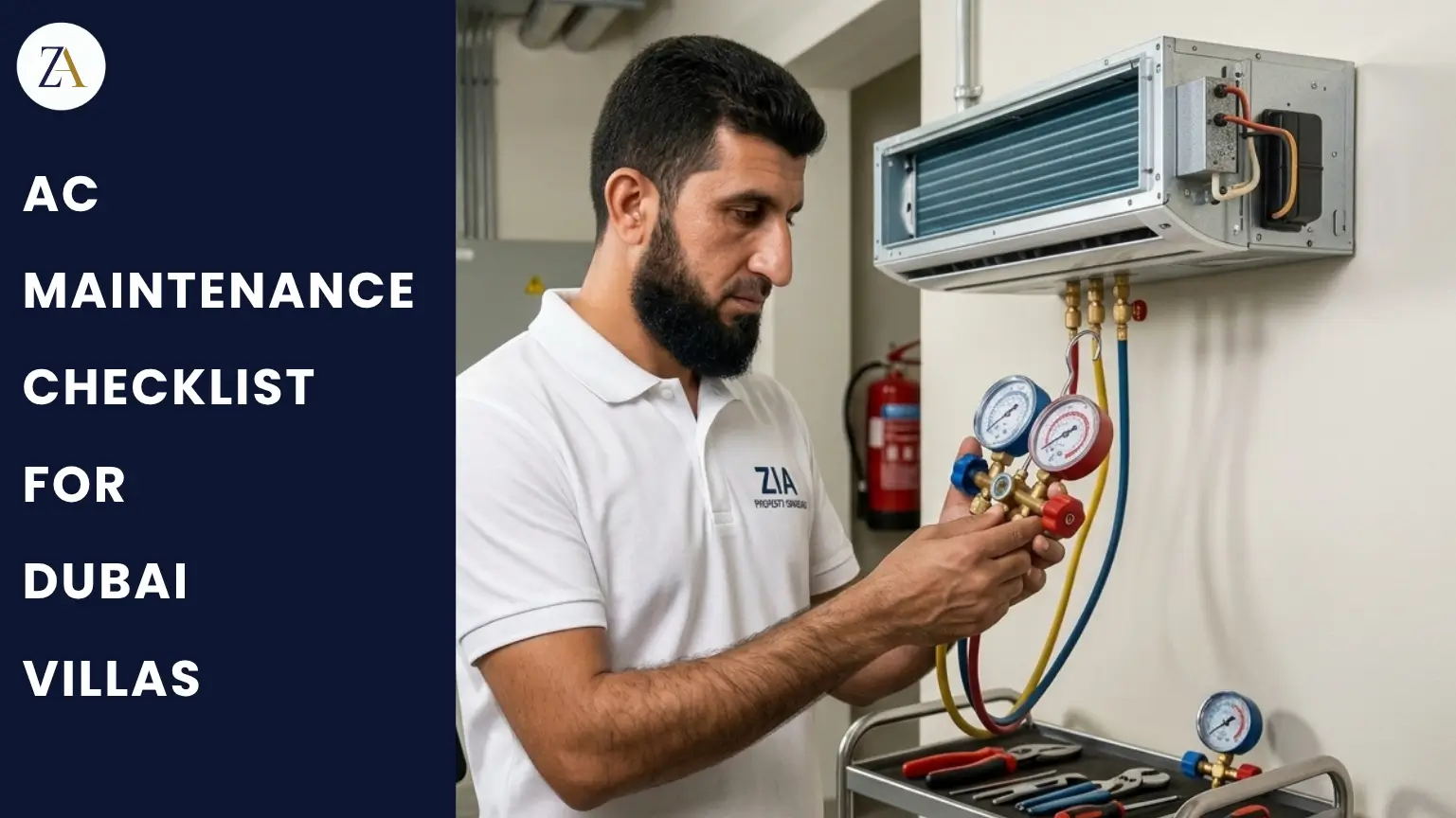
AC Maintenance Checklist for Dubai Villas After Summer
Dubai summers are hard on a villa’s AC. The units run almost non-stop for months, sand and dust clog the coils, and the drains work overtime. This AC maintenance checklist for Dubai villas covers the ten checks to do now that the heat is easing, so small faults get fixed before they turn into a breakdown next spring. For a full picture of every unit in the house, an AC inspection for villas covers it in one visit.
Most of these checks take a few minutes and need no tools. A few are for a technician, and we’ll tell you which.
Quick answer: a good AC maintenance checklist for Dubai villas covers this after summer: Check the outdoor units and coils, clean the filters, test the airflow at every indoor unit, look at the drain lines, inspect the ducts and pipe insulation, check the thermostat, and include the units in the maid’s room and annex. Anything that smells, drips, or cools badly should go to a technician.
Why Check a Villa's AC After Summer?
Villas ask more of their AC than apartments do. There are usually several units, sometimes more than six once you count the maid’s room, annex, and majlis, and each one has its own outdoor unit, filters, and drain. After months of heavy use, three things tend to build up:
- Dust and sand on the coils and filters, which cuts airflow and makes the unit work harder.
- Slow or blocked drains, because every AC makes water, and it has to go somewhere.
- Wear and loose connections, from running hard for months.
Dubai adds its own problems. Fine sand gets into everything, including the fins on outdoor units and the filters inside. High humidity in the warmer months means more water running through the drain lines. And in a villa, a unit that’s quietly struggling in one corner of the house often goes unnoticed until it stops altogether.
October is a good time to look. The load is lighter, so it’s easier to spot a unit that’s struggling, and repairs are done before you need the system again.
Leave your phone, We’ll call you in 15 min
AC Maintenance Checklist for Dubai Villas: 10 Checks After Summer
Go through every unit in the house, not just the main one.
Clear the area around the outdoor units
Walk around each outdoor unit. Remove leaves, dust and anything stacked against it, cut back plants, and check it’s sitting level. The unit needs clear space on every side to breathe. One that’s boxed in by a hedge or a pile of storage runs hotter and works harder.
Look at the coils and fins
Check the metal fins on the outdoor unit for dust, sand and bent sections. A gentle rinse with a garden hose can wash off loose dust. Don’t use a pressure washer, because it flattens the fins. A proper coil clean is a technician’s job, and once a year is a sensible habit.
Clean or replace the filters
Filters are the easiest win. One Dubai guide suggests washing reusable filters monthly through the summer. A dirty filter cuts airflow, and the same guide, citing the US Department of Energy, puts the energy difference between a dirty and a clean filter at 5 to 15 percent. If a filter is torn, bent or still grubby after washing, replace it.
Test the airflow and smell at every indoor unit
Switch each unit on and hold your hand at the vent. The air should feel strong and cold. Listen for rattling or grinding. Sniff for musty or damp smells, which often mean moisture in the unit or a problem with the drain.
Check the drain lines and pans
Look for water stains on the ceiling or wall near each indoor unit, drips from the unit itself, or a drain line that’s slow or blocked. A slow drain can overflow into the ceiling, and by the time you see a stain, the water has usually been there a while. Flushing the drain is a quick job for a technician, so don’t leave a wet patch to see if it dries.
Inspect ducts and pipe insulation
Where you can see ductwork, such as in the roof space or the AC cupboard, look for loose joints, gaps and sagging sections. Outside, check the insulation on the refrigerant pipes. Sun-cracked or missing insulation wastes cooling and can make the pipes sweat.
Check the thermostats
Make sure each thermostat responds, shows a sensible reading and holds the temperature you set. DEWA’s guidance is to set the AC at 24°C, and one Dubai guide says each degree lower can add up to 5 percent to consumption. If a room never reaches the temperature you set, note it for the technician.
Listen for electrical problems
A breaker that keeps tripping, a burning smell, or a unit that hums but won’t start needs a technician. Don’t open the panels yourself. Testing the electrical connections is professional work.
Compare the cooling with how it was in May
If a unit runs but doesn’t cool like it used to, write down which one. Weak cooling, ice on the pipes, or a unit that keeps switching on and off can point to low refrigerant, a dirty coil, or a failing part. A technician can measure the refrigerant pressure. Guessing won’t tell you.
Don't forget the forgotten units
The maid’s room, annex, garage room, and outdoor majlis are easy to miss because they’re used less or by someone else. Put every unit on your list. Small units that nobody thinks about are the easiest to leave off the service list year after year.
How to use this list: take 30 to 45 minutes on a cool morning and walk through the whole villa with your phone. Write down each unit and its location, tick off the checks as you go, and take a dated photo of anything odd, such as a stain, a damaged pipe or a unit that’s making noise. Those notes make life easy for whoever you call, and they give you a record if the problem comes back.
DIY, Technician or Inspector: Who Does What?
It helps to know who does what, so you don’t pay for the wrong thing.
Task | You | AC technician | Independent inspector |
|---|---|---|---|
Clear around outdoor units, check filters, look for drips and smells | Yes, monthly | Part of a service | Records what it finds |
Deep coil cleaning | No | Yes | Checks the result |
Drain flushing and refrigerant checks | No | Yes | Flags problems |
Condition check of every unit, with photos | No | Sometimes | Yes |
Written report for a landlord or developer | No | Rarely | Yes |
A technician cleans and fixes. An inspector looks, tests, and reports and doesn’t sell you the repair. For most villa owners, the two work well together.
How Often Should a Villa AC Be Serviced?
Dubai guides disagree on this. The advice runs from once a year to every two or three months, and one villa guide says every four months for family homes. There’s no single answer, because it depends on how many units you have, how dusty your area is, and how old the system is.
As a rule of thumb for most villas: a quick DIY check every month, a professional service at least twice a year, and one of those visits right after summer. Technicians get much busier as the heat returns, so booking in the cooler months is easier.
What if Your Villa Uses District Cooling?
Some communities use district cooling instead of individual outdoor units. There’s no condenser in your garden or on the roof. Chilled water from a central plant runs through the indoor units instead. Your checks change a little: keep the filters and indoor units clean, check the drains, and look for water around each unit. The central plant is the provider’s responsibility, not yours. If cooling is weak and you suspect the supply, our guide to district cooling problems explains the common faults and what to do about them.
Warning Signs Your Villa's AC Needs Attention Now
- Weak cooling, or a room that never reaches the set temperature
- Ice on the indoor unit or the pipes
- Water dripping or stains on the ceiling near a unit
- A musty or burning smell
- Rattling, grinding, or squealing noises
- A DEWA bill that has jumped without any change in how you use the AC
- Breakers that keep tripping
One or two of these mean calling someone this week. If you smell burning, switch the unit off first.
When Should You Call a Professional?
Anything on the warning list, and anything the checklist turns up that you can’t fix with a hose and a filter. An inspection looks at the whole system, not just the unit that’s complaining. It usually works like this:
- You tell us about the villa: how many units it has and anything you’ve noticed.
- Our specialist inspects every unit, tests what can be tested and photographs each issue.
- You get a written report with photos and findings ranked by urgency within 24 hours. After the repairs, we come back for a free re-inspection.
Zia’s inspection specialists are RERA-approved, DED-licensed, and InterNACHI-certified, and every report comes with photos you can hand to a technician, landlord or developer.
If your villa is new and still under its Defect Liability Period (DLP), AC faults are worth reporting to the developer in writing as soon as you spot them. A dated inspection report with photos shows exactly what was found and when, which makes a repair much harder to dispute.
FAQ's About AC Maintenance Checklist for Dubai Villas
How often should a villa's AC be serviced in Dubai?
Guides range from once a year to every two or three months. A monthly DIY check and a professional service at least twice a year suits most villas.
Can I clean my AC filters myself?
Yes. Washable filters can be cleaned at home, and one Dubai guide suggests doing it monthly in summer. Replace any that are torn or bent.
Why is my AC leaking water inside the villa?
Most often, the drain line is blocked or slow, or the drain pan is damaged. Switch the unit off and call a technician, because the water can damage the ceiling.
What's the difference between an AC service and an AC inspection?
A service cleans and adjusts the unit. An inspection checks the condition of every unit, tests it and reports what it finds, without selling you the repair.
Will maintenance lower my DEWA bill?
It can. A clean filter and clear coils let the unit cool with less effort, and one guide puts the savings from a clean filter at 5 to 15 percent of AC energy use.
Ready to Get Your Villa's AC Checked?
Tell us how many units your villa has and what you’ve noticed, and we’ll explain what an inspection would cover before you commit to anything. Working through this AC maintenance checklist for Dubai villas is a good start, but a specialist catches what a checklist can’t. Request a quote and we’ll take it from there.
