District Cooling Problems in Dubai Homes: Causes & Solutions
If you live in a district-cooled building in Dubai — Downtown, Business Bay, Dubai Marina, JLT, DIFC, or any of the 120+ communities served by providers like Empower, Emicool, or Tabreed—you’ve probably run into at least one district cooling headache. Maybe it’s a bill that jumped without warning. Maybe it’s an FCU vent blowing warm air in the middle of July. Or maybe you’re a buyer trying to figure out what “chiller-free” versus “district cooling” even means before you sign.
One of Dubai’s smartest pieces of infrastructure is district cooling, but as they say, there are strings attached, and a maintenance chain that wasn’t properly communicated to most residents. This guide explains the real issues, why they occur, and how you can safeguard yourself if you already have a district cooling connection or are planning to purchase one.
What Is District Cooling and How Does It Work in Dubai Homes?
District cooling is an industrial-scale system of cooling that replaces the AC compressor on your balcony with a common system. Water is cooled in a central plant and is piped through an insulated underground line to your building. Within your apartment, a Fan Coil Unit (FCU), typically concealed in the ceiling, circulates air over that cold water to chill your room.
The energy use of the system is very efficient. Central plants employ larger compressors and free cooling in cooler weather, and reduce total cooling energy consumption compared to split units. This is why almost every new development in Dubai, whether it is in Downtown Dubai or in Dubai Hills Estate, is built on district cooling instead of conventional AC.
Plant-level efficiency, however, doesn’t necessarily guarantee no problems at the unit level. This is where it typically goes wrong.
Leave your phone, We’ll call you in 15 min
Most Common District Cooling Problems in Dubai Homes
Weak or No Cooling From the Vents
This is the most common complaint, especially during peak summer. Warm air blowing from vents despite the system running usually points to blocked strainers, a faulty actuator valve, or a failing blower motor inside the FCU—not the central plant itself.
Water Leaks and Ceiling Stains
FCUs collect condensation, and that water needs to drain properly. When drain lines are blocked, or the chilled water pipes aren’t insulated correctly, you’ll see:
- Water dripping directly from the FCU unit
- Wet or discoloured patches on ceilings and walls
- A musty smell in rooms with poor ventilation
Left unchecked, this kind of leak can quietly damage gypsum ceilings, paint, and even electrical fittings above them.
Unusually High or Confusing District Cooling Bills
This is the problem most residents don’t see coming—and it’s rarely a “fault” in the technical sense. Your district cooling bill is separate from your DEWA bill, and it’s made up of two very different charges:
- Consumption charge — what you actually use, billed per Refrigeration Ton-Hour (RTh). Roughly 0.568 fils/RTh with Empower.
- Capacity (demand) charge — a fixed monthly fee based on the cooling capacity assigned to your unit, charged whether you’re home or not and whether you use the AC or not.
A 1-bedroom apartment in a building like Business Bay or JLT can see combined bills of AED 700–1,300 a month in peak summer, with the fixed capacity portion continuing even in an empty unit. Many new buyers and tenants are genuinely shocked to discover this second bill exists at all—it’s rarely flagged clearly during viewings or handover.
Noisy or Vibrating FCU Units
A rattling or humming FCU is usually a sign of a loose fan blade, worn bearings, or a unit that wasn’t mounted correctly during construction — a common finding in newer, rapidly built towers.
Delayed or Incomplete District Cooling Connection at Handover
Some purchasers may buy the unit and then discover that it is not ready for the district cooling network or that the capacity provided is not the same as the one that had been promised. This is a developer problem that should be identified before handover, not after moving in.
Why These Problems Happen
Most district cooling issues in Dubai homes trace back to one of three root causes:
- Installation shortcuts during construction — FCUs, strainers, and drain lines installed quickly to meet handover deadlines, without proper testing under real load
- Lack of independent pre-handover verification — buyers relying on the developer’s own snagging checks instead of an independent inspection
- No clarity on billing structure at point of sale — capacity charges and provider details (Empower vs. Emicool vs. Tabreed) often aren’t disclosed clearly in the sales or rental process
How District Cooling Issues Show Up During a Snagging Inspection
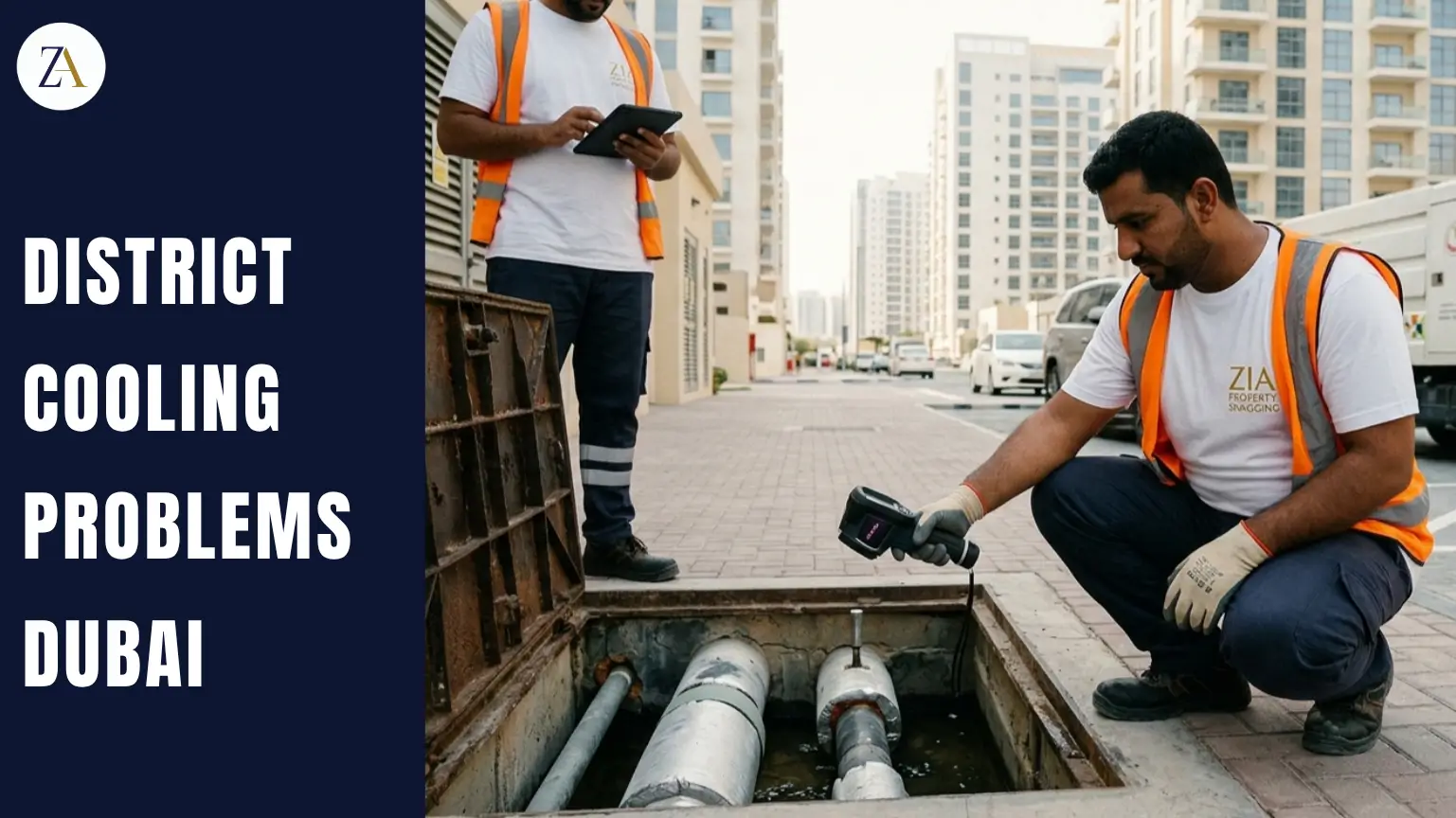
This is exactly where a professional snagging inspection earns its cost back many times over. At Zia Property Snagging, our RERA-approved civil engineers check district cooling-related components as part of the 400+ checkpoint inspection we run before you accept handover, including:
- FCU airflow and temperature output testing in every room
- Thermal imaging to detect insulation gaps around chilled water pipes
- Moisture detection around FCU drain lines and ceiling voids
- Visual and functional checks on valves, strainers, and drain trays
- Verification that the unit’s cooling capacity matches what’s documented in your contract
Because we’re fully independent and never work for developers, our findings go straight into your snagging report—with photographic evidence—so the developer is obligated to fix the issue before you take possession, not after.
Solutions and Fixes for District Cooling Problems
Short-term fixes (already living in the property):
- Book professional coil and filter cleaning every 3–6 months, more often during peak summer
- Report leaks immediately—don’t wait for a small drip to become a ceiling stain
- Check your provider’s app (Empower, Emicool, and Tabreed all have one) monthly to catch usage spikes early
Long-term fixes (pre-handover or ongoing disputes):
- Get an independent snagging inspection before signing the handover documents—this is your strongest legal position under RERA
- Request the FCU and district cooling components be added to your formal snagging report so the developer is contractually bound to rectify them
- If your capacity charge seems mismatched to your unit, request the connection documentation from the developer or provider directly
How to Protect Yourself Before You Sign
Whether you’re buying off-plan or a ready unit, run through this checklist before handover:
- Confirm which provider serves the building — Empower, Emicool, or Tabreed — since you cannot switch providers once you own the unit
- Ask for a recent cooling bill from a comparable unit in the same building to understand real monthly costs
- Verify the assigned RT capacity matches what’s stated in your sales contract
- Get an independent snagging inspection that specifically checks FCU performance, insulation, and drainage
- Don’t accept keys until district cooling is fully connected and tested in every room
Frequently Asked Questions
Why is my district cooling bill separate from my DEWA bill?
District cooling is provided by a separate company—Empower, Emicool, or Tabreed—not DEWA. You’ll always receive two bills: one for electricity and one for chilled water cooling.
Can I switch my district cooling provider if I think the rates are too high?
No, the provider is fixed to your building and decided by the developer, not the resident. The only way to change providers is to move to a different building.
Why am I still being charged even when I'm not using the AC?
This is the capacity (demand) charge—a fixed monthly fee based on the cooling capacity reserved for your unit, charged regardless of actual usage. Only the consumption portion of your bill reflects how much you actually use.
Can a snagging inspection really catch district cooling problems before handover?
Yes — a proper inspection test of FCU airflow checks for leaks and insulation gaps using thermal imaging and verifies your unit’s cooling capacity against the contract. Catching these before handover means the developer must fix them at no cost to you.
How often should district cooling components like FCUs be serviced?
FCU filters and coils should ideally be cleaned every 3–6 months, with more frequent checks during peak summer months. Regular servicing prevents most leaks, noise, and weak-cooling complaints.
Conclusion
District cooling is one of the best things about living in modern Dubai—until a bad FCU, a hidden leak, or a billing surprise turns it into a source of stress. The positive news is that nearly all of these problems are avoidable if they are detected before you take handover. The one thing that is the most certain to ensure that your district cooling system—and everything in your new home—is just right before you sign off is an independent, RERA-approved snagging inspection.
Ready to move in with confidence? Book your snagging inspection with Zia Property Snagging today—RERA-approved engineers, 400+ checkpoints, and a full report delivered within 24 hours, from AED 999.