
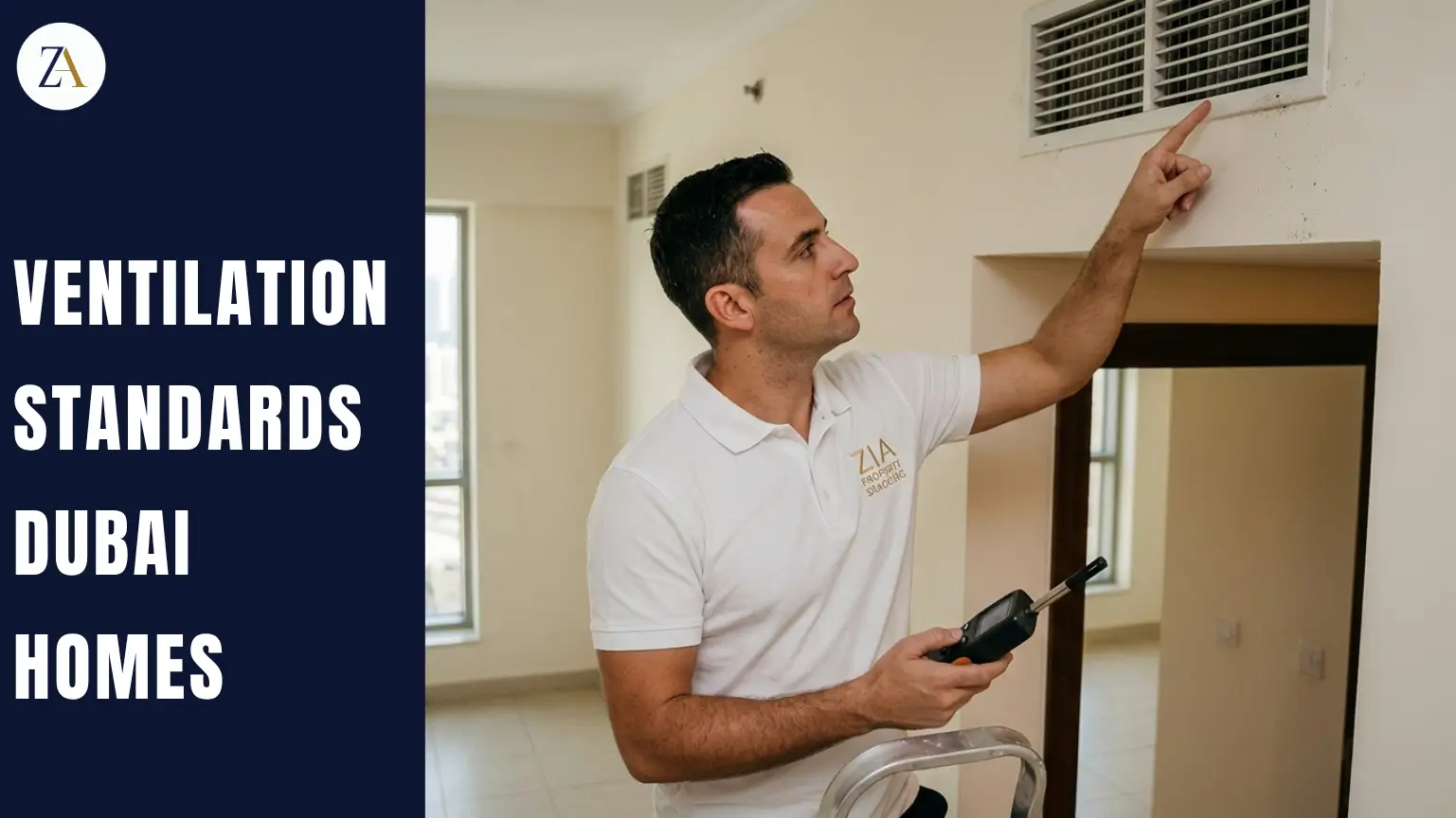
Ventilation Standards Dubai Homes | Requirements
When it comes to ventilation, there’s nothing much left to guess at in Dubai’s climate. All homes are air-conditioned and locked up for nine months of the year, so the air inside your apartment or villa is only as clean as its ventilation system can maintain. Do it right, and you have warm, dry, pleasant rooms with clear windows and an air conditioner that works efficiently because it didn’t have to struggle to get cold air through the smog that can be created by mold.
This checklist will take you through the meaning of “ventilation standards,” what they require for various types of properties, and what to look for—room by room—before making a handover or acceptance of a rental in Dubai.
What do "ventilation standards" actually mean in Dubai?
While for some markets, ventilation is only a builder’s choice, Dubai has a formal procedure in place. Al Sa’fat, Dubai Municipality’s green building rating system, has been mandated for all new building projects in the emirate since 2020, with the minimum rating requirement of Silver for new residential projects, and ventilation performance being one of the rating categories for Indoor Environmental Quality (IEQ).
In practice, this would translate to
- For new buildings, the capacity to supply adequate outdoor air and air exchange rates is required, and not just cooling capacity.
- Higher-rated buildings (Gold and Platinum) take it further and must have some elements such as CO₂ monitoring and demand-controlled ventilation.
- There should be working exhaust systems in kitchens, baths, and the like, as a minimum standard and not an additional luxury.
Except for Al Sa’fat, most Mechanical, Electrical, and Plumbing (MEP) consultants in Dubai will be designing the ventilation systems according to ASHRAE 62.1, which is an international guideline for acceptable levels of indoor air quality, setting the minimum outdoor air rates according to room type and occupancy. It’s not law in the way RERA snagging rights is, but it’s the technical backbone most developers’ engineers reference when sizing extract fans and duct systems.
The “short version” is that, for homes constructed after 2020, they were supposed to have a documented level of ventilation, but whether that goal was met when they were built and installed is the issue.
Natural vs. mechanical ventilation: what's required for villas vs. apartments?
The two sources of ventilation in Dubai homes are a combination of which depends on the type of property.
Feature | Villas | Apartments |
Primary ventilation source | Natural (windows, vents) plus mechanical exhaust | Almost entirely mechanical |
Kitchen exhaust | Ducted range hood venting outside | Ducted range hood tied into building exhaust riser |
Bathroom ventilation | Extractor fan, sometimes with natural window backup | Extractor fan tied into central exhaust shaft (no windows in most bathrooms) |
Fresh air source | Openable windows in most rooms | Fresh air often supplied through the AC/FCU system only |
Common failure point | Blocked or disconnected roof vents | Shared exhaust risers blocked or backdrafting from neighboring units |
Villas have more flexibility because they can rely on cross-ventilation and roof-level extraction. Apartments, especially in high-rise towers, are almost entirely dependent on mechanical systems working correctly—if a shared exhaust riser is blocked somewhere in the building, it can affect ventilation performance on your floor even if your own unit is fine.
Leave your phone, We’ll call you in 15 min
Room-by-room ventilation checklist
If you are having trouble with air quality problems, use this as a walkthrough for a new handover, resale purchase, or for your own home.
- Kitchen: Ensure the range hood is vented to the outside of the house and not just to a charcoal filter inside the room. Operate it at full speed and look for true suction at the hood, not fan sound.
- Bathrooms: All enclosed bathrooms must have an extractor fan functioning. While the fan is operating, keep a tissue close to the vent grille; if the tissue does not move towards the vent, the fan or ducting is not working.
- Bedrooms / Living areas: Ensure that AC supply and return grills remain clear of furniture/curtains, and that at least one window in each room opens easily for natural ventilation as necessary.
- Laundry and storage rooms: These small, often-overlooked spaces are common humidity traps. Confirm there’s either a window or a mechanical vent; a sealed laundry room with no airflow is a mold risk waiting to happen.
- Maid’s room (if possible): Often the room with the least ventilation in a villa or larger apartment. Look for a working window (or exhaust vent), as many maid’s rooms are inside without an external window.
- Balconies and enclosed terraces: If a balcony was enclosed (typical in older buildings), check to see if it was closed off in such a way that it cut off the flow of air that the original design depended on.
- AC supply and return balance: Ventilation and cooling are linked systems. If return air grilles are undersized or blocked, the AC recirculates stale air instead of properly exchanging it, even if the unit itself is working fine.
How does poor ventilation affect your AC — and your health?
Ventilation is not a separate system from air conditioning, and when it fails to operate, the air conditioning takes the blame it doesn’t deserve. If the ventilation is poor or if the exhaust is clogged, moisture may accumulate in the house, and the AC is less effective at maintaining moisture and temperature. This humid air eventually settles on the cooler surfaces, like ceiling corners, behind wardrobes, and around window frames, and mold begins to grow.
The health factor is also important. The lower the ventilation, the more humidity and dust that will be present, and the less ventilation will result in fewer air changes, and this will have a direct impact on allergy and respiratory symptoms, especially in children and people with asthma. If a house gets stuffy one hour after the AC is turned off, it is likely that the AC is not contributing to the problem at all, but that more air needs to be exchanged in the house.
What are the signs your home doesn't meet ventilation standards?
A few practical red flags worth watching for:
- Persistent condensation on windows or AC vents, especially in the mornings
- A musty smell in bathrooms, laundry rooms, or closets that returns even after cleaning
- Visible mold spotting on ceiling corners, grout lines, or behind furniture pushed against exterior walls
- Weak or no airflow from bathroom and kitchen extractor fans
- Windows that won’t open or that were sealed shut during a previous renovation
Any one of these on its own might be minor. Several together usually point to a genuine ventilation design or installation issue rather than a one-off cleaning problem.
How does a snagging inspection check ventilation compliance?
This is exactly the kind of defect that’s easy to miss on a casual walkthrough but shows up clearly in a proper inspection. As part of our 400+ checkpoint snagging reports, our RERA-certified engineers specifically test:
- Extractor fan airflow and duct connection in every bathroom and kitchen
- Whether exhaust systems vent externally or simply recirculate air
- AC return-air grille sizing and blockages
- Visible early signs of humidity damage before they turn into mold
- Whether ventilation provisions match what should have been installed under the building’s design standard
Because we’re fully independent and never work for developers, our findings go straight into your snagging report as documented defects the developer is obligated to fix during the Defect Liability Period—not a maintenance suggestion you’re left to pay for yourself later.
Frequently Asked Questions
Is mechanical ventilation mandatory in Dubai apartments?
Yes, in enclosed bathrooms and most kitchens, mechanical extraction is required since these spaces usually have no operable windows. Building design must account for this under Dubai’s green building framework.
Can I request ventilation checks as part of a standard snagging inspection?
Yes, ventilation and extractor fan performance are already included in our 400+ checkpoint inspection. You don’t need to request it separately.
How do I know if my bathroom extractor fan is actually working properly?
Place your hand or paper near the vent grille as the fan is operating. If it does not move towards the grille, the fan or ducting is not working correctly.
Does poor ventilation void any part of my building warranty?
No, ventilation defects usually are within the Defect Liability Period, for which the developer will pay if reported within that time frame.
Are older Dubai buildings held to the same ventilation standards as new ones?
However, for properties built before 2020, the requirement of No Al Sa’fat does not apply, meaning that some properties may be less well ventilated—and that is why it is even more essential to have them inspected before purchase or rental.
Conclusion
Ventilation is one of the things that you will only realize is a problem when it has already been a problem—a musty bedroom, the mould patch that you cannot seem to remove, your AC bill that continues to mount without much reason. In Dubai’s climate, it is not just a cosmetic problem; it is a design and compliance problem and must be strictly compliant with a regulatory standard.
If you’re buying, renting, or unsure whether your current home’s ventilation is doing its job, a proper inspection settles it with evidence, not guesswork. Book a snagging inspection with Zia Property Snagging and get a documented, developer-ready report within 24 hours—starting from AED 999.