

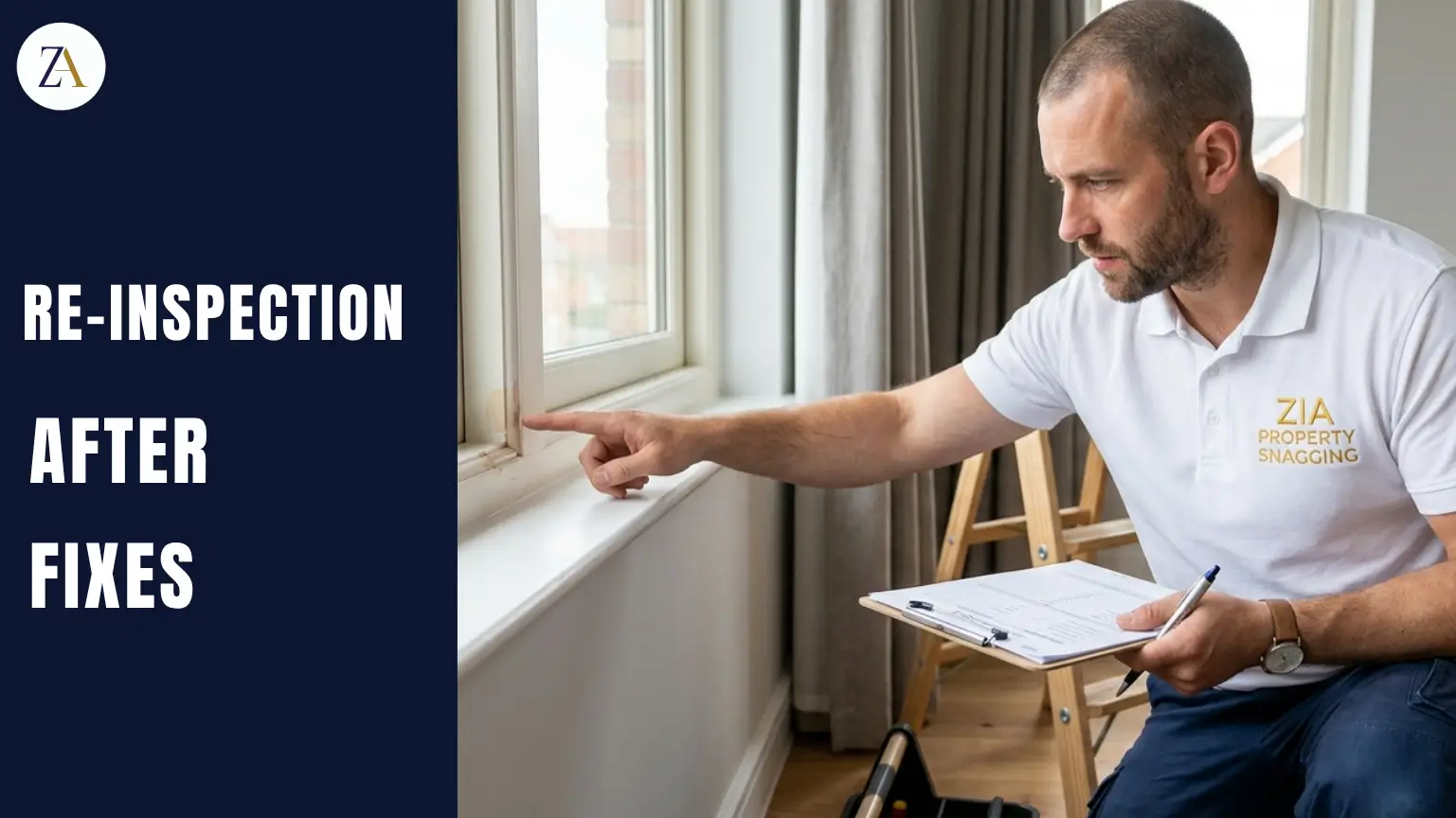
Re-Inspection After Fixes | UAE Property Snagging
Getting a snagging inspection is only half the battle. The real test comes after the developer claims all defects have been fixed — because in the UAE property market, “fixed” does not always mean properly fixed.
Re-inspection after fixes is a certified follow-up visit to your property, where a qualified engineer cross-checks every defect from your original snagging report against the actual repairs completed. It confirms what passed, what failed, and whether new damage was introduced during the repair process itself.
For UAE property buyers, this step is not a formality — it is the final layer of protection before your legal rights under RERA expire.
Why Re-Inspection After Developer Fixes Is Non-Negotiable in the UAE
The "Fixed" Claim Is Not Always What It Seems
Most buyers assume that once the developer sends a rectification notice, the problems are resolved. In practice, developers across the UAE are under pressure to close snagging lists quickly—and that pressure leads to shortcuts. A cracked wall gets painted over. A plumbing leak gets tightened temporarily. An underperforming AC unit gets recharged with gas instead of the faulty component being properly replaced.
The Financial Risk of Skipping Re-Inspection
These are the trends observed in communities such as JVC, Business Bay, Dubai Hills, and Palm Jumeirah. If you don’t re-inspect, you risk a major financial hit—anything repaired after the RERA Defect Liability Period is over is at your expense. A certified re-inspection report, produced within the DLP window, is your documented proof that issues remain and your strongest tool to force proper rectification before those rights close permanently.
Leave your phone, We’ll call you in 15 min
When Should You Schedule a Re-Inspection in the UAE?
Book Immediately After the Developer's Rectification Notice
The moment the developer sends official confirmation that all fixes are complete, book your re-inspection within the same week. Every day of delay is a day lost inside your DLP window.
Know Your RERA Defect Liability Period
Under Dubai’s RERA framework, the DLP runs on three timeframes. Finishing defects—tiles, paint, joinery, and doors—are covered for one year from handover. MEP systems including plumbing, electrical, and AC, carry a three-year DLP. Structural elements such as load-bearing walls, slabs, and foundations are protected for ten years.
The Ideal Re-Inspection Timing Window
Schedule your re-inspection at least 30 to 60 days before the relevant DLP window closes. This leaves enough time to escalate unresolved issues through RERA or the Dubai Land Department if the developer does not respond adequately.
What Does a Professional Re-Inspection Cover in UAE Properties?
Structural Repair Verification
Cracks are checked to confirm the root cause was addressed — not simply filled with surface filler and repainted. Hairline cracks that return within months are almost always the result of a surface-only fix that ignored the underlying settlement or thermal movement issue.
MEP Systems — Mechanical, Electrical, and Plumbing
Each system is individually retested. Electrical sockets are verified for live current and earthing. Plumbing lines are pressure-tested for leak recurrence. AC systems are measured for airflow balance across every room — not just switched on to confirm cold air.
Finishing Quality Room by Room
Replaced tiles are tapped for a hollow drum sound, indicating failed adhesive underneath. Recently painted surfaces are checked for smoothness and colour uniformity. Windows and doors are checked for alignment, operation, and sealing.
Waterproofing and Moisture Detection
Bathrooms, balconies, and kitchens are particularly re-inspected with thermal and moisture meters. Repairs to water damage are by far the most likely to recur in new builds in the UAE, and are therefore a key re-inspection test.
New Defects Introduced During Repairs
Workers often make repairs, only to cause more damage when they return: cracked tiles, damaged sealant around plumbing rough-ins, and scuffs around the repair. A thorough re-inspection catches these before they become your financial responsibility.
Re-Inspection Process at Zia Property Snagging— Step by Step
Step 1: Original Snagging Report Review
Before the engineer’s visit, the original snagging report is carefully reviewed. Each defect on the list is a criterion to be checked during the re-inspection.
Step 2: Site Inspection, Defect by Defect
The visible defect is checked on-site using specialist equipment—a thermal imaging camera, moisture meter, hollow drum detector, voltage tester, digital anemometer (AC airflow), and endoscopy camera as needed.
Step 3: Pass or Fail for All Defects
Each fix is either a Pass or a Fail, with photographic proof. Either the repair is acceptable or it isn’t.
Step 4: Reinspection Report within 24 Hours
The re-inspection report contains before-and-after photos to help the developer see exactly which defects have been fixed and which are still outstanding.
Step 5: Developer Escalation Support for Remaining Issues
If the repair fails, Zia Property Snagging offers escalation support—helping you to communicate any remaining issues in a RERA-compliant format that is professionally and legally verifiable.
Re-Inspection vs. New Snagging — Key Differences
What a Full Snagging Inspection Covers
A full snagging inspection treats the property afresh—covering the complete 400+ point checklist across all systems, areas, and finishes. It is the ideal service for a property being professionally inspected for the first time or for a pre-purchase check before resale.
What Re-Inspection Covers
Re-inspection is targeted and reference-based. It evaluates specifically whether the previously documented defects have been properly rectified and checks for any new damage introduced during repairs. It requires the original snagging report as its foundation.
Why the Same Company Must Conduct Both
Re-inspection must be done by the same company that performed the original snagging. Developers can challenge documentation gaps when different companies are involved. A single unbroken chain of evidence—an original report and a re-inspection report from the same RERA-approved company—is the strongest legal position a UAE buyer can hold.
RERA Rules and Your Legal Rights for Re-Inspection in Dubai
What RERA's DLP Framework Means for You
Under UAE law, developers carry mandatory defect liability obligations that cannot be waived. One year for finishing defects. Three years for MEP systems. Ten years for structural elements. These are enforceable legal obligations — not goodwill gestures from the developer.
How a Re-Inspection Report Protects You Legally
A certified re-inspection report from a RERA-approved company is one of the most powerful documents a UAE property buyer can hold. It proves that defects were formally identified, that re-inspection was conducted within the DLP window, and that the developer was allowed to rectify them. If a dispute escalates to RERA or the Dubai Land Department, this report is your primary evidence.
Never Give Verbal Acceptance
Walking through a repaired property and verbally agreeing it looks fine can be treated as informal acceptance under UAE property law. A written, certified re-inspection report removes all ambiguity and fully protects your legal position.
Common Issues Found During Re-Inspections in UAE Properties
Surface-Only Crack Repairs
The crack is filled and repainted, but the underlying cause—settlement, thermal movement, or structural stress — is not addressed. The crack reappears within months. This is the most common re-inspection failure found across UAE new builds.
Partial Plumbing Repairs
One leaking joint gets resealed while adjacent joints showing early failure signs are left untouched. A different joint then fails shortly after move-in—a pattern especially common in bathroom plumbing across Dubai apartment handovers.
AC System Workarounds
Rather than replacing a faulty component, technicians top up the refrigerant gas for a temporary performance improvement. AC airflow measurement during re-inspection identifies the gap between what was reported as fixed and what was actually repaired.
Incomplete Tile Replacements
Only the visibly cracked tile is replaced while adjacent tiles with a hollow drum sound—failed adhesive underneath—are left in place. These tiles crack or lift under foot traffic within months of move-in.
These four failure patterns repeat consistently across JVC, Business Bay, Dubai Hills, Sobha Hartland, Downtown Dubai, and Arabian Ranches, which is why Zia Property Snagging engineers treat them as priority verification points on every re-inspection.
How to Choose the Right Company for Re-Inspection in UAE
Choosing the wrong company for re-inspection can quietly cost you your legal rights. Here is what actually matters.
Same Company That Did Your Original Snagging
The re-inspection must be conducted by the same company that performed your original snagging. Without the original defect history, documentation continuity breaks, and developers can challenge any report that does not connect directly to the initial snagging record.
Valid UAE Credentials
The company must hold active RERA approval, InterNACHI certification, and DED licensing. These credentials give your re-inspection report legal standing before developers, RERA, and the Dubai Land Department if a dispute arises.
Developer-Ready Report Format
The report must include annotated photographs, defect-specific references, and a clear Pass/Fail status for every item. A generic summary will not support escalation if the developer pushes back.
Free Re-Inspection Included
Some companies charge separately for follow-up visits. At Zia Property Snagging, re-inspection is included free with every package — because confirming your defects were properly fixed is part of the job, not an add-on.
Zia Property Snagging is RERA-approved, InterNACHI-certified, and DED licensed — covering all 7 UAE Emirates with certified civil engineers and 24-hour report delivery.
Frequently Asked Questions
Is Re-Inspection Free or Does It Cost Extra?
At Zia Property Snagging, re-inspection is included free with every snagging package. Some companies charge separately for follow-up visits — confirm the re-inspection policy before booking any snagging service in the UAE.
How Long Does a Re-Inspection Take?
For apartments, the typical duration is 45 to 90 minutes. For villas and townhouses, it takes between 1.5 and 3 hours depending on the number of original defects and the scale of repairs completed.
What If the Developer Refuses Access for Re-Inspection?
Denying access to an independent inspector during the DLP by a developer is a violation of your buyer’s rights under UAE law. Document the refusal in writing immediately and file a formal complaint with RERA.
Can I Do Re-Inspection Myself?
You can check obvious visible items, but you cannot replicate thermal imaging, moisture detection, AC airflow measurement, or hollow tile testing without specialist equipment. Only a certified re-inspection report carries legal weight with a developer or before RERA.
How Many Rounds of Re-Inspection Are Typically Needed?
For most Dubai properties, one re-inspection resolves the majority of defects—confirming proper fixes or flagging remaining items for further developer action. Properties with significant structural or MEP issues may require a second re-inspection after an additional rectification round.
Conclusion
Re-Inspection After Fixes UAE Property Snagging is not an extra step — it is the step that determines whether your UAE property investment is genuinely protected or quietly compromised. The initial snagging report opens the door. The re-inspection closes it properly.
Developers in the UAE work to deadlines, not perfection. Without independent verification by a certified engineer, surface-level repairs get accepted, DLP windows expire, and the cost of unresolved defects quietly transfers from the developer to you.
Book your re-inspection before that window closes. Make sure it is documented, certified, and RERA-aligned — because in the UAE property market, a verbal assurance is worth nothing and a certified report is worth everything.
