

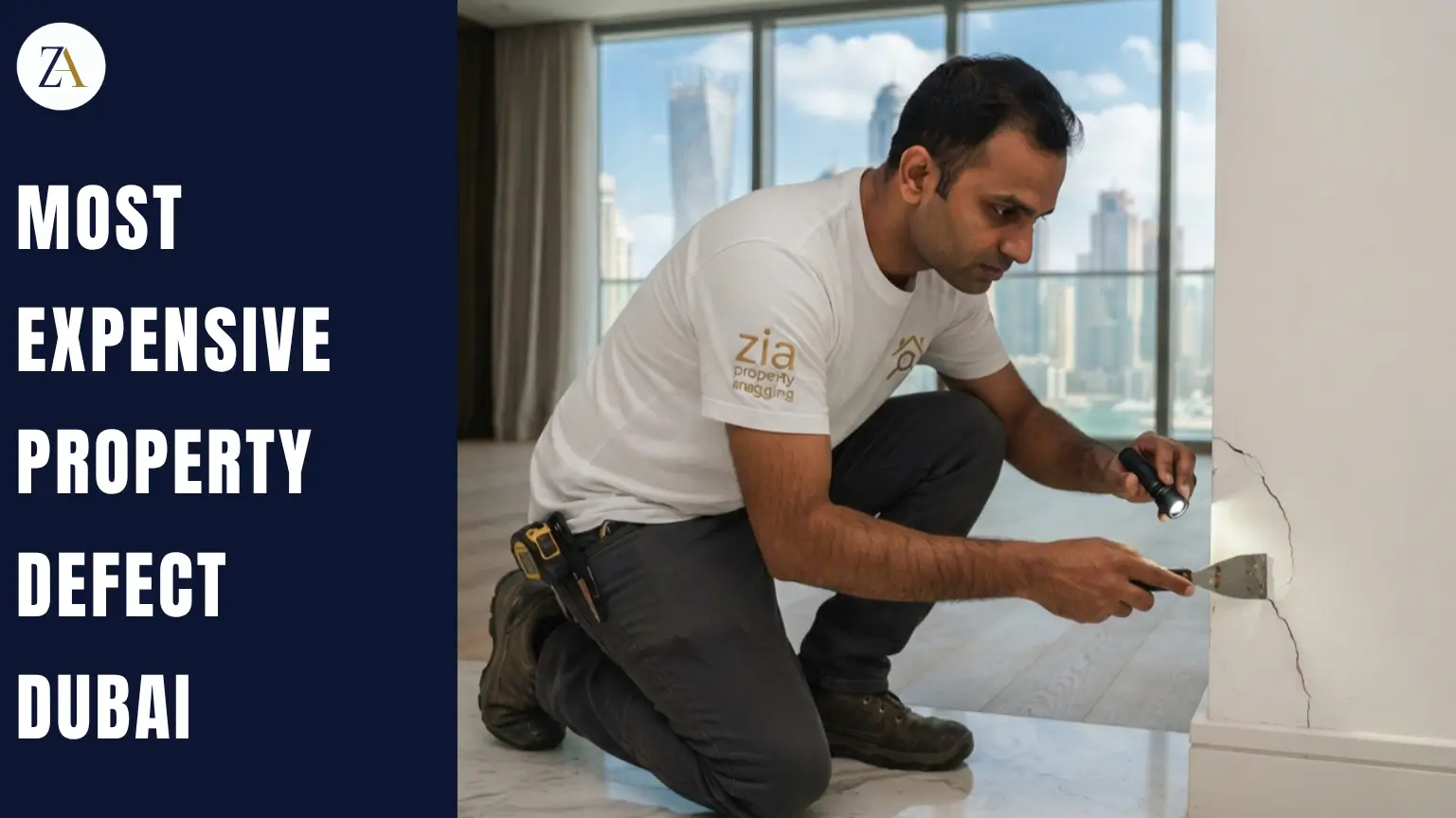
Most Expensive Property Defect Dubai – What to Know
The Dubai property market is fast-moving: handovers are scheduled in a narrow window of time, the buyer is in a rush to receive his keys, and the developer is keen to finish up a project. One thing that goes amok in all the rush is what actually lies behind the walls, under the tiles, or in the ceiling voids.
At Zia Property Snagging, we’ve checked out everything from a small apartment in JVC to a large villa in Palm Jumeirah. We have inspected hundreds of units literally, and found all kinds of things that a buyer could see: cracked tiles, misaligned doors, paint touch-ups, etc. But now and then, you’ll find something a lot more serious, a defect that could have ended up costing the owner hundreds and hundreds of thousands of dirhams or even the security of the whole home.
This is the tale of the costliest defect that our team has ever discovered — and how it can help all Dubai buyers, investors, and homeowners understand the importance of a proper inspection.
What Actually Makes a Defect "Expensive"
Not all defects are created equal. A scratched countertop is annoying. A structural issue is a different story altogether. When we talk about the “cost” of a defect, we’re really looking at four separate layers of financial exposure:
- Direct repair cost – What it takes to physically fix the problem
- Valuation impact – How much the defect drags down the resale or rental value of the unit
- Legal and dispute cost – What it costs in time, documentation, and possibly legal fees to hold the developer accountable
- Downstream damage cost – What happens if the defect isn’t caught early and causes secondary damage over time
A defect that seems minor on day one can quietly compound into all four categories by the time it’s discovered—usually well after the Defects Liability Period (DLP) has expired, when the cost falls entirely on the owner.
The Case File: The Most Expensive Defect We've Ever Found
The property in question was a high-end villa in one of Dubai’s premium waterfront communities, inspected shortly before handover. On the surface, everything looked immaculate — polished finishes, high-spec fittings, the kind of presentation that makes buyers feel confident signing off without a second thought.
Our inspection process doesn’t rely on what’s visible to the eye. Using thermal imaging cameras and moisture detection equipment as part of our 400+ checkpoint process, our engineers picked up an abnormal moisture reading behind a bathroom wall shared with an exterior-facing structure. Visually, there was no sign of a problem — no staining, no bubbling paint, nothing a typical walkthrough would ever catch.
Further investigation revealed a waterproofing membrane failure at the wall-floor junction, allowing water to seep gradually into the substrate. Left undetected, this kind of leak doesn’t just stay contained. Over time, it leads to:
- Deterioration of structural elements behind the wall
- Mould growth and air quality issues
- Damage to adjoining rooms and flooring
- Eventually, costly demolition and rebuild work to fully resolve it
Because the issue was caught before handover — while the unit was still within the developer’s responsibility — the buyer wasn’t the one footing the bill. The estimated cost of remedying this defect if it had surfaced two or three years post-handover, after the DLP had lapsed, was estimated in the range of AED 150,000–200,000, factoring in structural repair, refinishing, and potential relocation during work. Caught in time, through the developer’s own DLP obligations, it cost the buyer nothing.
That’s the real story here — not just the size of the number, but who ends up paying it, depending on when the defect is found.
Leave your phone, We’ll call you in 15 min
Why This Defect Was So Costly
Breaking down the financial exposure of a defect like this shows exactly why waterproofing failures rank among the most expensive issues in Dubai real estate:
- Repair scope – Waterproofing failures usually require breaking into finished walls or floors, which means redoing tiling, painting, and sometimes structural patching
- Hidden spread – Moisture problems rarely stay in one spot; by the time they’re visible, they’ve often spread to adjoining areas
- Valuation hit – A documented history of water damage can significantly affect resale value and buyer confidence
- Timing risk – If discovered after the DLP window closes, the entire cost shifts from the developer to the owner
This is why waterproofing, structural, and MEP defects consistently top the list of the most financially damaging issues we encounter—far more than cosmetic snags that get all the attention during a quick walkthrough.
Other High-Cost Defects Dubai Buyers Should Watch For
While this case involved waterproofing, it’s far from the only defect category that carries serious financial risk. Based on our inspection data across Dubai properties, these are the ones worth taking seriously:
- Foundation and structural settlement – Hairline cracks that look cosmetic but indicate movement in the building’s structure
- MEP (Mechanical, Electrical, Plumbing) faults – Incorrect wiring, poor pipe installation, or faulty connections that surface as expensive failures later
- AC and chiller system defects – Undersized or poorly installed systems that lead to high running costs and premature system failure
- Facade and cladding issues – Improperly sealed external panels that allow water ingress, especially relevant in Dubai’s climate
- Poor drainage and slope defects – Incorrect flooring gradients that cause water pooling, especially in bathrooms and balconies
Each of these can sit completely unnoticed during a standard handover walkthrough, which typically lasts under an hour and relies solely on visual inspection.
How a Snagging Inspection Prevents These Costly Surprises
This is exactly the gap a professional snagging inspection is designed to close. As a RERA-approved, DED-licensed, and InterNACHI-certified inspection company, our process goes well beyond what a buyer or even a developer’s own handover team typically checks.
Our inspections cover over 400 checkpoints per property, utilizing thermal imaging, moisture meters, and other diagnostic tools to identify precisely the kind of hidden issue described above—before the property is legally transferred and before the developer’s liability period begins to expire.
The value isn’t just in finding problems. It’s in the timing. Catching an AED 150,000 defect before handover means the developer fixes it. Catching it two years later means the owner does.
What to Do If You Suspect a Costly Defect Post-Handover
If you’ve already taken handover and you’re noticing signs of a potential issue—unexplained dampness, cracks, unusual odors, or inconsistent AC performance—here’s the right way to approach it:
- Check your DLP status – Most Dubai developers offer a Defects Liability Period, typically 12 months from handover, sometimes longer for structural issues
- Document everything – Photos, dates, and written correspondence with the developer strengthen your position
- Request a professional re-inspection – An independent assessment gives you unbiased evidence to present to the developer
- Escalate through RERA if needed – If the developer is unresponsive, RERA provides a formal channel for dispute resolution
Acting quickly matters. The earlier a defect is documented, the stronger your case for developer accountability—and the lower your financial exposure.
Frequently Asked Questions
What is the most common expensive defect found in Dubai properties?
Waterproofing failures and structural settlement issues tend to carry the highest financial risk. They’re often invisible during a standard walkthrough but expensive to fix once discovered.
Who pays for defects found after handover in Dubai?
If the property is still within its Defects Liability Period (DLP), the developer is responsible. After the DLP expires, repair costs typically fall on the owner.
How long is the Defects Liability Period in Dubai?
Most developers offer a 12-month DLP, though some structural elements may carry longer coverage. It’s worth checking your Sales and Purchase Agreement (SPA) for specifics.
Can a defect be hidden behind finished walls or flooring?
Yes. Issues like waterproofing failures or MEP faults are often completely invisible without tools like thermal imaging and moisture detection equipment.
How much does a professional snagging inspection cost in Dubai?
Zia Property Snagging inspections start from AED 999, covering 400+ checkpoints with a full report delivered within 24 hours and a free re-inspection included.
Conclusion
The most expensive defects in Dubai real estate are rarely the ones you can see. They’re the ones hiding behind polished finishes, waiting to surface long after the excitement of handover has worn off. A thorough, independent snagging inspection isn’t just a box-ticking exercise — it’s the difference between a developer covering a six-figure repair bill and an owner paying for it out of pocket years later.
If you’re approaching handover on a new property in Dubai, don’t rely on a quick walkthrough. Book a professional inspection with Zia Property Snagging and get a full 400+ checkpoint report within 24 hours — starting from AED 999, with a free re-inspection included.
