Luxury Tower Defects in UAE: Hidden Issues Guide 2026
The skyline of Dubai is redefining luxury living. The UAE luxury real estate market facilitated the crossing of AED 100 billion in transactions in 2024 alone, with waterfront towers on Palm Jumeirah and sky-high penthouses in Downtown Dubai. Consumers are paying high prices and demanding perfection at delivery.
However, this is the truth: the default of luxury towers in the UAE is much more widespread than developers would have it appear.
A high price does not mean a property that has no defects. Indeed, the complexity of luxury towers, such as high-quality materials, smart homes, and other complicated MEP installations, in fact, increases the likelihood of any hidden problems remaining unnoticed. Hasty handover schedules, several subcontractors and the need to complete a unit on time all provide ideal conditions for letting the defects pass through the quality check.
It does not matter whether you are a first-time luxury client or an experienced UAE real estate investor, this guide will provide you with the full picture of what you should avoid in the purchase as a defect, what your legal rights are in the UAE and how you may secure your investment before being handed the keys.
What Are Luxury Tower Defects in the UAE?
In the UAE property context, a defect is any deviation from the agreed design, specification, or construction standard that affects the functionality, safety, or appearance of a property. The defects in luxury towers include obvious cosmetic defects such as broken marble or poor joinery and hidden structural and systems defects that do not become apparent until months after the towers are handed over.
According to UAE Law No. 6 of 2019 and the RERA, all developers have the legal obligation of a Defect Liability Period (DLP) in which they are required to correct all defects reported by the buyer freely. This causes professional inspection prior to and during handover to be among the most costly things a luxury buyer can undertake.
Defects vs. Snagging Issues: Key Difference
A snag is a minor finishing issue—a scratched surface, a loose hinge, or a paint touch-up. A defect is a more serious fault — a leaking pipe, a cracked structural element, or a malfunctioning electrical system. Both must be documented and reported. However, structural and MEP defects carry far greater financial and safety implications and require immediate attention during the DLP window.
Leave your phone, We’ll call you in 15 min
Top Hidden Luxury Tower Defects Found Across the UAE
Based on thousands of professional snagging inspections carried out across Dubai, Abu Dhabi, and Ras Al Khaimah, these are the most critical luxury tower defects in the UAE that buyers consistently miss at handover.
Façade and Cladding Failures
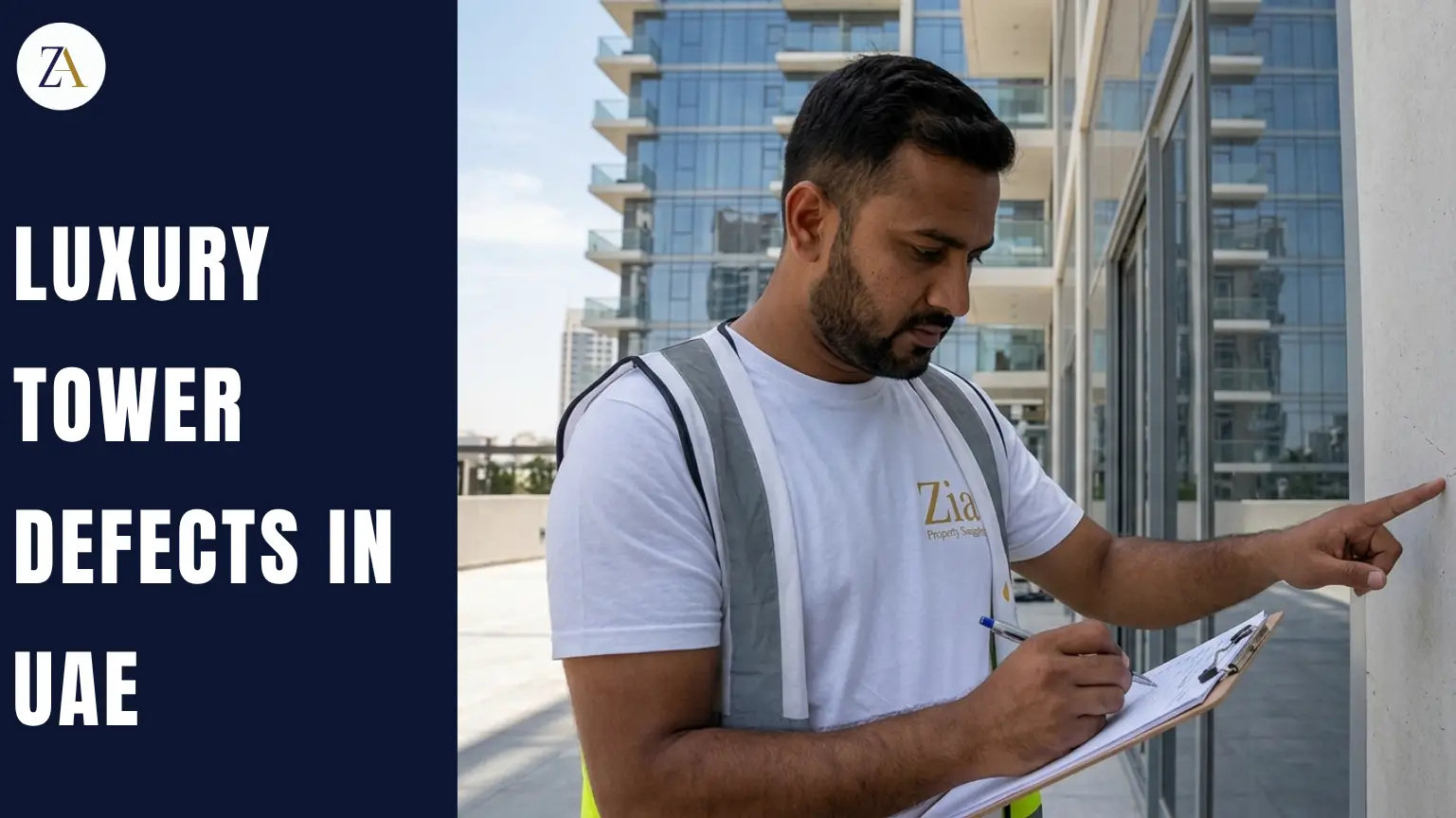
One of the first areas in which to find hidden defects is the glass curtain wall systems and high-quality stone cladding of luxury towers. Penetration behind the facade by water and dust occurs through cracks in the hairline of cladding panels, broken silicone sealants, and holes in the curtain wall system. This degradation is enhanced in Dubai by extreme temperatures, which cause it to expand and contract faster in summer when temperatures surpass 45°C.
Facade failures lead to interior wall dampness, plaster damage and ultimately mold in the luxury apartments, which cannot be seen by the untrained eye during a normal buyer walkthrough.
MEP (Mechanical, Electrical, and Plumbing) System Defects
MEP defects are the most financially damaging category of luxury tower defects in the UAE. These include hidden pipe leaks behind walls and under slabs, incorrect wiring in smart home electrical panels, faulty HVAC ducting concealed above false ceilings, and plumbing connections with improper pressure ratings.
Because luxury towers feature highly complex MEP installations — underfloor heating, chilled water fan coil units, home automation wiring, and centralized BMS systems — the margin for error during installation is significant. Many MEP defects only manifest 6 to 12 months after handover, by which point buyers mistakenly believe they have accepted a defect-free unit.
Waterproofing Failures in Podium and Basement Levels
In Dubai and Abu Dhabi, luxury towers are generally equipped with podium-level swimming pools, landscaped terraces, and multi-story basement parking. All these demand waterproofing membranes of high performance. Failure of these membranes (poor application, mismatch of materials, and construction joint failures) results in seepage to lower units, reinforcement steel corrosion, and long-term structural degradation.
Waterproofing issues are especially hard to identify without special thermal imaging and moisture testing devices, so it is necessary to have a professional check it.
Structural Slab and Column Cracks
The polished marble floors and the designer wall finish of the UAE luxury towers are covered with concrete slabs and columns which are at times undermined in construction. Problems with post-tensioning cables, cracks in slabs caused by shrinkage, and cracks in columns at an early stage are all reported flaws in the high-quality towers in the UAE.
These structures are concealed under costly finishing and they cannot be seen easily during a normal inspection by the purchaser. A certified structural snagging assessment involves the use of special tools and methodology that is used to identify these problems before they develop into significant safety concerns.
Smart Home and Automation System Failures
This category of defect is almost exclusive to the luxury segment. UAE luxury towers increasingly feature pre-installed smart home systems—integrated lighting control, automated blinds, centralized AC management, video intercom, and security systems. These systems require careful commissioning before handover.
In practice, buyers frequently discover at move-in that automation panels are unresponsive, sensors are incorrectly calibrated, or smart systems are installed but never properly activated. Resolving these issues post-handover without a documented defect report becomes a costly dispute between the buyer and the developer.
Premium Finishing Defects: Marble, Joinery, and Imported Fixtures
Luxury buyers pay for premium finishes—Italian marble, custom joinery, and European-imported fixtures. Yet finishing defects are among the most common luxury tower defects in the UAE. These include lippage in large-format marble tiles (uneven edges creating trip hazards), misaligned kitchen and wardrobe joinery, chipped or stained imported sanitaryware, and poorly sealed stone surfaces that will stain permanently within months of use.
While these may appear cosmetic, they directly impact resale value and tenant satisfaction — both critical factors for UAE luxury property investors.
Balcony and Terrace Waterproofing and Railing Issues
Balconies and terraces are premium selling points for UAE luxury towers, yet they are frequently the source of serious hidden defects. Incorrect drainage slopes cause standing water, leading to tile lifting and waterproofing membrane failure. Missing or incorrectly installed expansion joints allow structural movement to crack terrace finishes.
Most critically, loose balcony railings and improperly anchored glass balustrades represent direct safety hazards—particularly in high-rise towers where wind loads on balconies are significantly higher. These structural fixing defects must be identified and rectified before handover, not discovered by a resident months later.
Why Luxury Towers in UAE Are More Prone to Hidden Defects
There is a widely held assumption that paying more guarantees better quality. In UAE real estate, this assumption can be dangerously misleading. Luxury tower construction involves a larger number of specialist subcontractors—curtain wall specialists, smart home integrators, marble installers, and MEP contractors—each working within tight deadlines set by the developer’s handover schedule.
Dubai’s construction boom between 2023 and 2026 has placed enormous pressure on contractors to deliver projects on time. This speed-to-market approach increases the probability that certain works are insufficiently tested or inspected before keys are handed over. The result is that luxury towers — with their greater complexity — carry a disproportionately high defect risk compared to standard residential buildings.
Additionally, the premium finishes used in luxury towers can effectively conceal defects that would be immediately visible in a standard property. Marble hides slab cracks. False ceilings conceal MEP failures. Designer joinery masks structural issues. This is precisely why expert snagging inspections—using thermal cameras, moisture meters, and MEP testing equipment—are non-negotiable for luxury property buyers in the UAE.
UAE Defect Liability Period: What Luxury Buyers Must Know
Under UAE law, every property buyer is protected by a legally mandated Defect Liability Period. The DLP structure for UAE residential properties is as follows:
- 1 Year — Finishing and cosmetic defects (paint, tiling, joinery, fixtures)
- 3 Years — MEP systems (plumbing, electrical, mechanical, HVAC)
- 10 Years — Structural elements (slabs, columns, foundation, core walls)
These timelines begin from the date of the handover certificate, not the date you move in. This means that buyers who delay their snagging inspection lose critical months of their defect claim window.
For luxury tower buyers, the 3-year MEP and 10-year structural DLP provisions are particularly valuable, given that MEP and structural defects represent the most expensive rectification costs. A professionally documented snagging report is essential evidence to support any DLP claim submitted to your developer or to RERA.
How to Raise a Defect Claim with Your Developer in UAE
Submit all defects in writing, supported by a certified snagging report. Send your defect list via formal communication to the developer’s customer care team and retain all correspondence. If the developer fails to respond or rectify within a reasonable period, buyers can escalate their case to RERA’s Rental Dispute Settlement Centre or the relevant emirate’s real estate regulatory authority.
How a Professional Snagging Inspection Protects Your Luxury Investment
A certified professional snagging inspection is the single most effective tool available to a luxury property buyer in the UAE. Qualified inspectors use thermal imaging cameras to detect moisture and MEP issues invisible to the naked eye, conduct pressure tests on plumbing systems, test all electrical circuits and smart home systems, audit every surface finish against the developer’s specification, and document all defects with photographic and written evidence in a formal report.
For ZIA Property Snagging clients, this comprehensive process is completed and delivered as a detailed report within 24 hours—giving buyers the documented evidence they need to raise formal defect claims with developers before the handover certificate is signed.
With over 1,200 inspections completed across UAE luxury towers, ZIA’s inspection team consistently identifies an average of 60 to 200+ individual snags and defects per luxury unit — issues that buyers accepting keys without inspection would have been entirely responsible for rectifying at their own cost.
Protecting a multi-million dirham luxury investment begins with one professional inspection. It is not optional. It is essential.
Frequently Asked Questions
What are the most common luxury tower defects in the UAE?
Common defects include MEP issues, façade cracks, waterproofing failures, and finishing flaws like marble misalignment. Most require professional snagging to detect.
Does UAE law cover luxury property defects?
Yes. The UAE Defect Liability Period covers 1 year for finishes, 3 years for MEP, and 10 years for structural defects, all to be fixed by the developer.
Can I claim defect repairs from my developer for free in the UAE?
Yes. If reported within the DLP, developers must fix defects at no cost. A snagging report strengthens your claim.
Are smart home system failures covered under UAE snagging?
Yes. Smart system defects fall under the 3-year MEP coverage and are checked during snagging inspections.
How long does a luxury tower snagging inspection take in Dubai?
Typically 3–6 hours, depending on the property. A detailed report is usually delivered within 24 hours.
Conclusion
The UAE luxury property market offers some of the world’s most spectacular homes. But behind the marble, glass, and premium finishes, hidden defects are a documented reality — not an exception. Luxury tower defects in the UAE range from minor finishing snags to serious MEP and structural issues that can cost buyers hundreds of thousands of dirhams if missed at handover.
Your legal rights under the UAE’s Defect Liability Period are powerful—but only if you use them before the window closes. A professional snagging inspection with ZIA Property Snagging gives you the documented evidence, the expert analysis, and the peace of mind to accept your luxury property with complete confidence.
Book your professional snagging inspection today at snagginginspection.ae — and protect your investment before you accept the keys.