

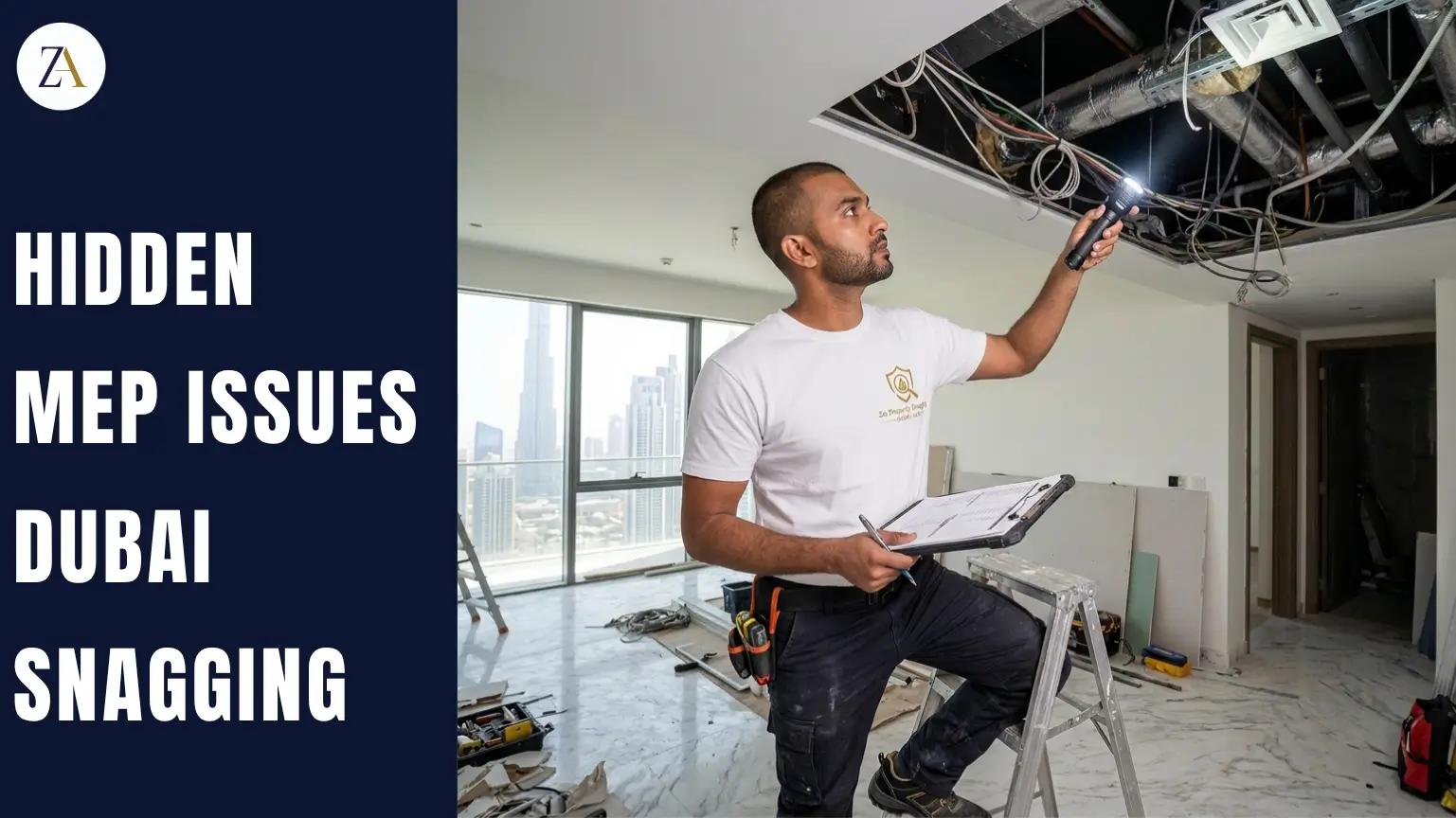
Hidden MEP Issues Dubai Snagging Guide 2026
When you buy a property in Dubai, your attention goes to the view, the finishes, and the location. But the most expensive defects are the ones you cannot see—and they live inside your walls, ceilings, and floors.
MEP stands for Mechanical, Electrical, and Plumbing—the three core systems that make your property actually livable. In Dubai’s fast-paced construction environment, these are the most commonly defective parts of any new property at handover.
Under Dubai Law No. 6 of 2019, developers carry a mandatory 2-year defect liability period for MEP issues. You have a legal window to get these problems fixed at zero cost — but only if you catch them in time.
What Are MEP Systems in a Dubai Property?
Before understanding the defects, it helps to understand what MEP actually covers in your property.
Mechanical Systems — HVAC and Ventilation
The mechanical component is your air conditioning system, ventilating ducts, fans and any pump systems within the building. In a city like Dubai, with temperatures of over 45 °C in summer, the improperly installed or undersized HVAC system becomes not only uncomfortable but also a severe operational and financial issue, even a few months after moving in.
Leave your phone, We’ll call you in 15 min
Electrical Systems — Wiring, DB Panels, and Earthing
The electrical component includes all wiring inside your walls, your distribution board (DB panel), circuit breakers, sockets, light fittings, load balancing across phases, and the earthing or grounding of the system. These elements are completely invisible once the property is finished and handed over.
Plumbing Systems — Water Supply, Drainage, and Pressure
Plumbing includes your water supply lines, drainage pipes, water pressure regulators, sewage connections, hot water systems and all other related fixtures. A great deal of this is embedded in walls and under floors so that it cannot be easily viewed without professional equipment.
7 Most Common Hidden MEP Issues Found During Dubai Snagging
These are the defects that our certified engineers find most frequently across Dubai’s residential properties — from JVC apartments to Dubai Hills villas.
Improper Electrical Earthing
This is one of the most dangerous hidden defects in any property. Improper earthing means that in the event of a fault, there is no safe discharge path for electricity. The result can be electric shock, appliance damage, or in serious cases, fire. It is completely invisible without testing equipment and is found far more frequently than most buyers expect.
Overloaded or Unbalanced DB Panels
During a pre-handover inspection of a Dubai Hills 5-bedroom villa, our team found an overloaded distribution board with no phase balancing. This kind of defect does not show up immediately — it causes progressive failures, tripping breakers, overheating components, and eventually a very expensive repair that the developer would have been responsible for had it been caught in time.
Hidden Plumbing Leaks Behind Walls
Slow leaks inside walls are among the costliest defects in Dubai properties. They are not visible to the naked eye and can take three to six months to be detected with any visible effect, which may be a wet patch, a stuffy smell, or a swollen floor panel. At that stage, the development of molds and structural damage has already set in, and the cost of repair amounts to tens of thousands of dirhams.
Low Water Pressure in Upper-Floor Bathrooms
This is a common pump sizing or pressure regulator fault found in mid-rise and high-rise properties. On the ground floor everything seems fine. But residents on the upper floors deal with frustrating water pressure issues from day one. It is a minor inconvenience but is actually a systemic MEP failure that the developer is fully liable to fix within the DLP.
Faulty or Improperly Insulated Refrigerant Lines
Poor insulation of AC refrigerant lines, improper routing, etc., have instant and costly results. Your AC will have to work harder to accomplish the same level of cooling, your power bills will be considerably higher, and the most costly part of the system, the compressor, will have reached the end of its useful life years sooner. In the above inspection of a villa in Dubai Hills, two ill-insulated refrigerant lines were found.
Drainage Slope Errors
All the drains should be fitted at the right angle to enable free flow of water. Even a slight miscalculation of this slope will result in standing water, slow drainage, and the possibility of backflow, and ultimately blockages, which will need cutting into walls or floors to rectify. It is a naked installation fault that must not be left on the construction site but frequently is.
Unsealed MEP Entry Points from the Exterior
At every property, MEP services come in and out of it, such as water mains, electrical feeds, and drainage connections. These entry points are not sealed appropriately, and you will have moisture intrusion, pest intrusion, and energy loss. One of the most significant findings was in a JVT townhouse where the main MEP entry point was improperly sealed, causing serious moisture accumulation behind the ground-floor electrical panel—a defect that would have cost the owner the entire panel replacement had it not been caught within the DLP.
Why MEP Issues Stay Hidden — The Dubai Climate Factor
Dubai’s climate creates a unique set of risks that buyers from other countries often do not anticipate. The extreme heat and humidity do not just affect you — they affect your property’s MEP systems in ways that remain completely invisible until significant damage has already occurred.
- Condensation is a hidden risk due to UAE humidity, causing moisture inside conduits and walls.
- Poorly sealed MEP entry points make the problem worse.
- Moisture buildup can silently corrode electrical panels over time.
- AC duct sweating occurs when refrigerant lines lack proper insulation.
- This leads to condensation dripping behind walls and ceilings.
- Waterproofing failures are common in bathrooms and kitchens due to heavy use and temperature changes.
- Visual inspection alone is not enough.
- Thermal imaging and expert assessment are needed to detect hidden MEP defects.
How Professional Snagging Detects Hidden MEP Issues
Hidden MEP defects stay hidden because they need more than eyes to find them — they need certified engineers with the right tools.
Our inspectors use thermal imaging cameras that detect temperature anomalies behind walls and ceilings, revealing moisture pockets, electrical hotspots, and insulation failures that a standard visual check will completely miss. Every inspection follows a 400-point checklist covering all electrical, plumbing, and mechanical elements room by room.
Every defect is documented with high-resolution photographs, exact location tagging, and severity classification — producing a certified report delivered within 24 hours that is strong enough to submit directly to your developer or RERA.
Why Snagging Is the Only Real Solution
In 2026, snagging has become a necessity for every Dubai property buyer—but not all inspections are equal.
Your Legal Rights: MEP Defects and the 2-Year Snagging Period in Dubai
This is the section most buyers do not read until it is too late — and it may be the most important part of this entire guide.
Under Dubai Law No. 6 of 2019 and the UAE Civil Code (Federal Law No. 5 of 1985), developers in Dubai carry a mandatory 2-year defect liability period for MEP and finishing defects, starting from the date of your official handover. For structural defects, this extends to 10 years under decennial liability law.
What this means in practice is that any MEP issue you identify and formally report within that 2-year window is the developer’s legal responsibility to rectify at their own cost. The moment that window closes, every repair becomes yours to pay for.
If a developer refuses to act on a reported defect, you have the right to escalate formally to RERA or the Dubai Land Department. Your strongest asset in that process is a certified inspection report from a licensed company, which is exactly what we provide. Without that documented report, your legal position is significantly weakened.
When Should You Book an MEP Snagging Inspection in Dubai?
The best time to arrange an MEP snagging check is before the signature of a handover certificate, with the developer still obligated to rectify any shortcomings that you point out.
When you have already taken handover, you may book the inspection as soon as possible during the 2-year defect liability period (DLP). Most of the MEP problems are not realized until the property is fully occupied, such as continuous AC power, use of water pressure, and full electrical load.
It is still strongly advisable to carry out a post-handover inspection in the first 6 months to ensure that faults that develop early are caught. Re-inspection is also smart when there is any renovation or MEP work done because a new installation may have some underlying problems.
How Much Does MEP Snagging Cost vs. What You Actually Save
A professional snagging inspection is not a cost — it is the cheapest insurance you can buy for one of the biggest investments of your life.
ZIA Inspection Pricing:
- Apartments — starting from AED 999
- Villas — priced by property size
- 24-hour report included
- Free re-inspection after developer rectification
What You Save:
- Hidden plumbing leak left undetected → repairs can exceed AED 15,000
- Faulty DB panel + MEP defects caught in Dubai Hills villa → developer fixed AED 9,500 worth of repairs under warranty
- Missed within DLP → every dirham comes out of your own pocket
Why Choose ZIA for Hidden MEP Snagging in Dubai?
ZIA Property Snagging is Dubai’s fully independent, certified property inspection company. We work exclusively for you — we have zero commercial relationship with any developer, which means our findings are completely unbiased and entirely in your interest.
Every inspection is conducted by a certified civil engineer, not a trainee or generalist. We are DED Licensed, RERA Approved, and InterNACHI Certified — the credentials that matter in Dubai’s regulated real estate market. With over 1,200 inspections completed across all 7 UAE Emirates and a guaranteed 24-hour report delivery, we gives you the professional documentation you need to enforce your rights with confidence.
We also offer a free re-inspection after the developer’s rectification, so you never have to take the developer’s word that the defects have been fixed.
If you are approaching handover or are currently within your DLP, the time to act is now.
Frequently Asked Questions
What are common hidden MEP issues?
Improper electrical earthing, overloaded DB panels, hidden plumbing leaks, poor AC insulation, and drainage slope errors. These are not visible but can lead to costly repairs if ignored.
Is MEP inspection covered by Dubai law?
Yes. Developers are responsible for fixing MEP defects for 2 years after handover, as long as issues are reported within this period.
How long does an inspection take?
A standard apartment takes about 3–4 hours, while villas may need 5–6 hours. Very short inspections often miss critical hidden defects.
Can I inspect after moving in?
Yes, if you are within the 2-year defect liability period. It’s useful since some issues only appear after regular use.
Why is thermal imaging important?
It detects hidden moisture, electrical hotspots, and insulation failures inside walls and ceilings without causing damage.
Conclusion
Hidden MEP issues are the most financially dangerous defects in any Dubai property — not because they are rare, but because they are invisible until the damage is already done and the developer’s liability has expired. From faulty earthing and overloaded DB panels to hidden leaks and unsealed entry points, these defects are exactly what Dubai’s snagging laws exist to address. A professional MEP snagging inspection by ZIA gives you the technical evidence and the legal documentation to hold your developer accountable, protect your investment, and move into your Dubai property with complete confidence.
