

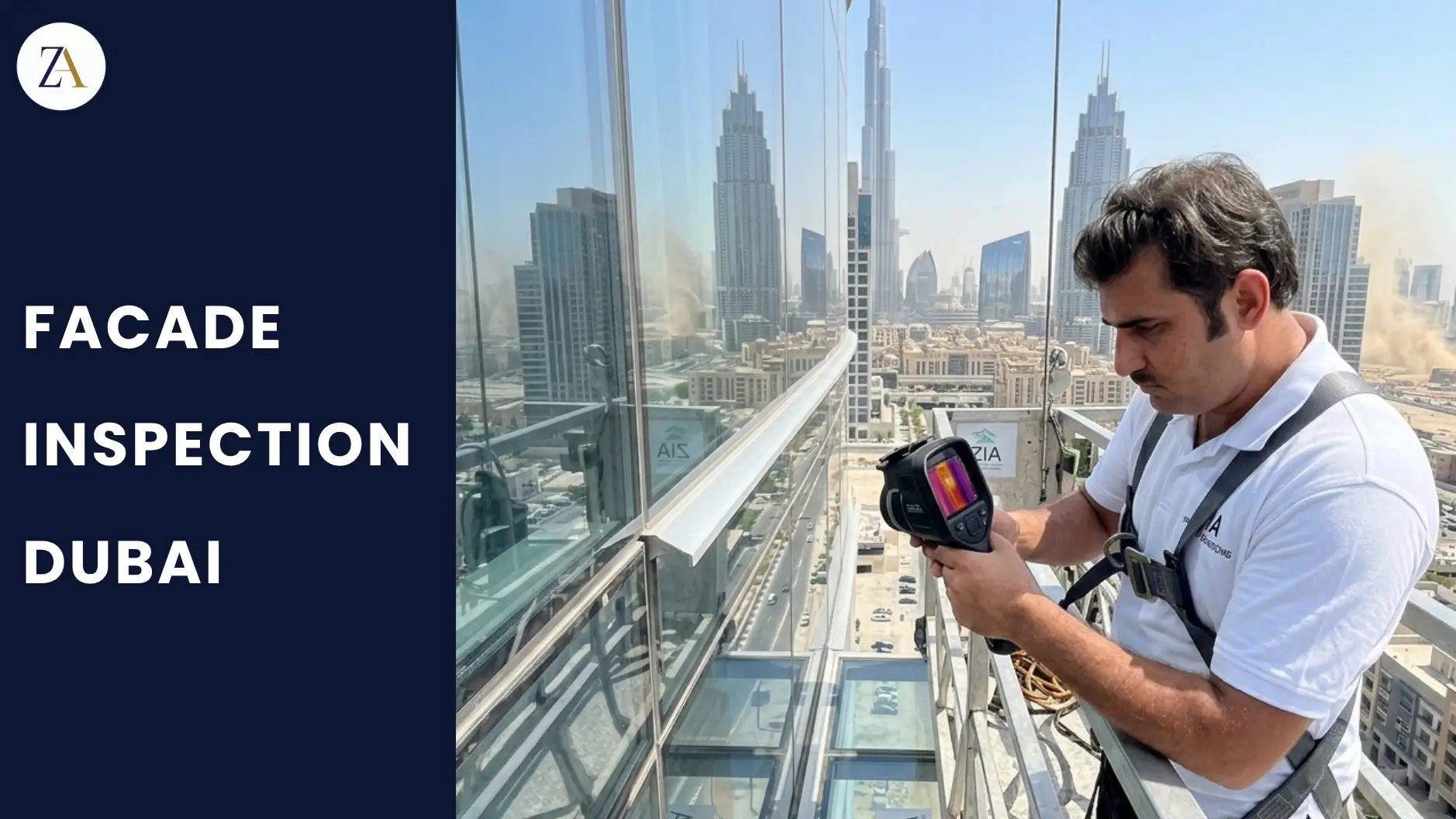
Facade Inspection Dubai: Compliance Rules for Building Owners
If you own or manage a building in Dubai, checking the facade is no longer just good practice. Dubai’s Law No. (3) of 2026 on the quality and safety of buildings puts the condition of exterior cladding, windows, and doors on the checklist for a legal safety certificate. This guide explains the facade inspection Dubai owners now need to understand: which buildings are covered, what gets checked, how long a certificate lasts, and what to do first. For routine condition checks and defect reports, our building inspection services in Dubai can help.
One note before we start. This is general information, not legal advice. We’ve worked from the official English text of the law, but the Arabic text prevails, so check the details with Dubai Municipality or a lawyer before you act.
Quick answer: under Law No. (3) of 2026, a building owner must get a Quality and Safety Certificate once the building is 20 years past its completion certificate. The technical report behind it has to cover the exterior cladding and the windows, doors, and security barriers on the external facades. The certificate lasts 10 years, or 5 years for buildings that are 40 or older. Younger buildings aren’t off the hook, because their owners must still carry out periodic maintenance.
What Is a Facade Inspection?
A facade inspection is a close check of a building’s outer shell: the cladding, glass, sealants, fixings, balconies and the joints where water can get in. Engineers look for damage you can see, like cracks and loose panels, and for faults you can’t, such as corroded fixings behind a panel.
Dubai’s climate makes this more important than it sounds. Heat, strong UV, and sand wear down sealants and coatings faster than in cooler places, and a small gap can let water in for years before anyone sees a stain.
Why Do Facade Problems Matter?
A loose panel or a failed seal can look like a cosmetic issue, but it isn’t always one. Loose cladding can fall onto people or cars below. Water that gets past a damaged joint can rot fixings, damage the structure behind the facade, and show up as damp and mould inside apartments. And in a tall building, problems on the outside are harder and more expensive to reach, which is a good reason to find them early.
For owners and associations, there’s also a plain money argument. A facade inspection Dubai owners arrange early means small repairs are found in a routine check, which cost far less than major remedial works ordered after a failed assessment.
Leave your phone, We’ll call you in 15 min
Facade Inspection Dubai: What the Law Says
Which buildings are covered?
The law applies to all buildings in the emirate, including those in free zones and special development zones. The Chairman of the Executive Council can exempt a building by decision, but that’s the exception.
What the law asks of you depends on age. Once a building is 20 years past the date of its completion certificate, the owner must obtain a Quality and Safety Certificate. Before that point, the owner must keep up periodic maintenance.
What must the technical report cover?
The assessment ends in a technical report, and Article 7 lists what it must include. Facade-related items are named directly:
- The structural integrity of the building
- The integrity of all types of exterior cladding
- The condition of windows, doors and security barriers on the external facades and in common areas
- The condition of electrical and mechanical installations in external and common areas
- Compliance with Dubai Civil Defence safety requirements and Security Industry Regulatory Agency CCTV requirements
How long does a certificate last?
Time since completion certificate | What the owner must do | Certificate validity |
|---|---|---|
Less than 20 years | Carry out periodic maintenance | No certificate required yet |
20 to under 40 years | Obtain a Quality and Safety Certificate | 10 years, renewable |
40 years or more | Obtain a Quality and Safety Certificate | 5 years, renewable |
Who can carry out the assessment?
The comprehensive assessment must be done by an engineering firm registered with Dubai Municipality, and the firm’s classification has to match the height of the building. Before you appoint anyone, ask to see their registration and the classification they hold. Any testing laboratory involved must be licensed in Dubai and accredited by the Emirates International Accreditation Centre.
Is There a Facade Inspection Every Five Years Rule?
You may have read that Dubai requires a facade inspection every five years. The law, as we read it, doesn’t say that. It doesn’t set a facade-specific interval at all. What it sets is how long the certificate lasts: 10 years for most buildings and 5 years for buildings that are 40 or older.
That’s a real difference. A 25-year-old tower doesn’t need a facade survey every five years under this law. It needs a certificate that has to be renewed after ten. That said, the Technical Checklist behind the report can be updated over time, so keep an eye on Dubai Municipality’s announcements.
What Do Engineers Look For in Cladding and Glazing?
The exact checklist comes from Dubai Municipality, but these are the problems facade engineers usually look for:
- Cladding panels: cracks, loose or missing panels, bulging, corroded or loose fixings
- Glazing: cracked glass, failed seals and gaskets, frames that have moved
- Sealants and joints: sealant that has shrunk, split or lost its grip, which lets water in
- Balconies, parapets, and projecting elements: cracks, rust staining, and loose railings
- Water signs: stains, efflorescence, peeling paint, and damp patches inside
- Attachments: signage, brackets, and anything else fixed to the facade
Cladding also has to meet fire and building rules. According to one Dubai engineering guide, the UAE Fire and Life Safety Code restricts combustible aluminium composite panels with polyethylene cores on taller buildings. Our overview of the Dubai Building Code basics covers where those rules come from.
What Can Owners Do Now, Before the Formal Assessment?
You don’t have to wait for the formal assessment to get started. A few jobs make it smoother and often cheaper:
- Walk each elevation from the ground and look for stains, cracks, loose panels, and damaged sealant.
- Photograph anything odd, with dates, so you can show how a problem has developed.
- Collect your records in one place: drawings, maintenance logs, earlier reports, and repair invoices.
- Ask your property manager what facade checks have already been done and when.
- Set a budget. Repairs found in the assessment have to be carried out within the timeframe the firm sets.
Who Is Responsible for Compliance?
- Owners: must obtain the certificate, follow the deadlines set for repairs and appoint the engineering firm.
- Owners’ associations and management entities: usually handle this day to day in jointly owned buildings. Individual owners still carry the cost and need to keep an eye on how it’s done.
- Contractors: carry out repairs under the engineering firm’s supervision.
- Occupants: must allow inspections and, where major works are needed, vacate the building when required.
Deadlines and Penalties
Owners, contractors, and engineering firms have one year from the date the law comes into force to comply, and the Chairman of the Executive Council can extend that by another year. The law comes into force 60 days after it is published in the Official Gazette, so check the publication date to work out your own deadline.
Fines run from AED 100 up to AED 1,000,000. A repeat violation within two years doubles the fine, up to AED 2,000,000. The authorities can also suspend building permits and lease attestations for the building until the problem is put right.
Facade Inspection Dubai: Step by Step
- Find your building’s completion certificate date: It decides whether you need a certificate now or periodic maintenance for the time being.
- Gather your records: Drawings, maintenance logs, earlier inspection reports, and any repair history.
- Appoint a registered engineering firm: It must be registered with Dubai Municipality and suit the height of your building.
- Fix what the report finds: The firm sets out the timeframe and methods, and a contractor does the work under its supervision.
- Get the certificate and keep the file: Store the report, the repair records and the certificate, and diarise the renewal date.
Reaching high facades is part of the job. Firms use building maintenance units, rope access and, increasingly, drones. Whichever method is used, the law puts the formal assessment in the hands of a registered engineering firm.
Where Does an Inspection Company Fit?
We should be clear about this. The Quality and Safety Certificate comes from the formal assessment by a registered engineering firm, and that isn’t something we issue. What we do is inspect the condition of a building, document the defects with photos, and give owners and associations a clear picture before the formal assessment happens.
That helps in a few ways. A facade inspection Dubai owners book ahead of the formal assessment shows you what’s likely to be flagged. You can fix problems quietly while there’s still time. You arrive at the formal assessment with a record instead of a guess. Our team at Zia Property Snagging is RERA-approved, DED-licensed and InterNACHI-certified, and every report comes with photos.
Frequently Asked Questions
Is facade inspection mandatory in Dubai?
Under Law No. (3) of 2026, the assessment behind the Quality and Safety Certificate must cover exterior cladding and external windows and doors. The certificate is required once a building is 20 years past its completion certificate.
How often must a facade be inspected in Dubai?
The law sets no facade-specific interval. A certificate lasts 10 years, or 5 years for buildings that are 40 or older, and younger buildings need periodic maintenance.
Who can carry out a facade inspection?
The formal assessment must be done by an engineering firm registered with Dubai Municipality and suited to the building’s height. Condition inspections by other companies don’t replace it.
What are the penalties for not complying?
Fines run from AED 100 to AED 1,000,000, doubling for a repeat offence within two years. Permits and lease attestations can also be suspended.
Does the law apply to buildings in free zones?
Yes. It covers all buildings in the emirate, including free zones and special development zones, unless the Chairman of the Executive Council exempts a building.
Ready to Check Your Building's Facade?
Tell us about your building and what you’ve noticed, and we’ll explain what an inspection would cover before you commit to anything. Getting a facade inspection Dubai that owners can rely on starts with knowing the real condition of the building. Schedule your inspection and we’ll take it from there.
