

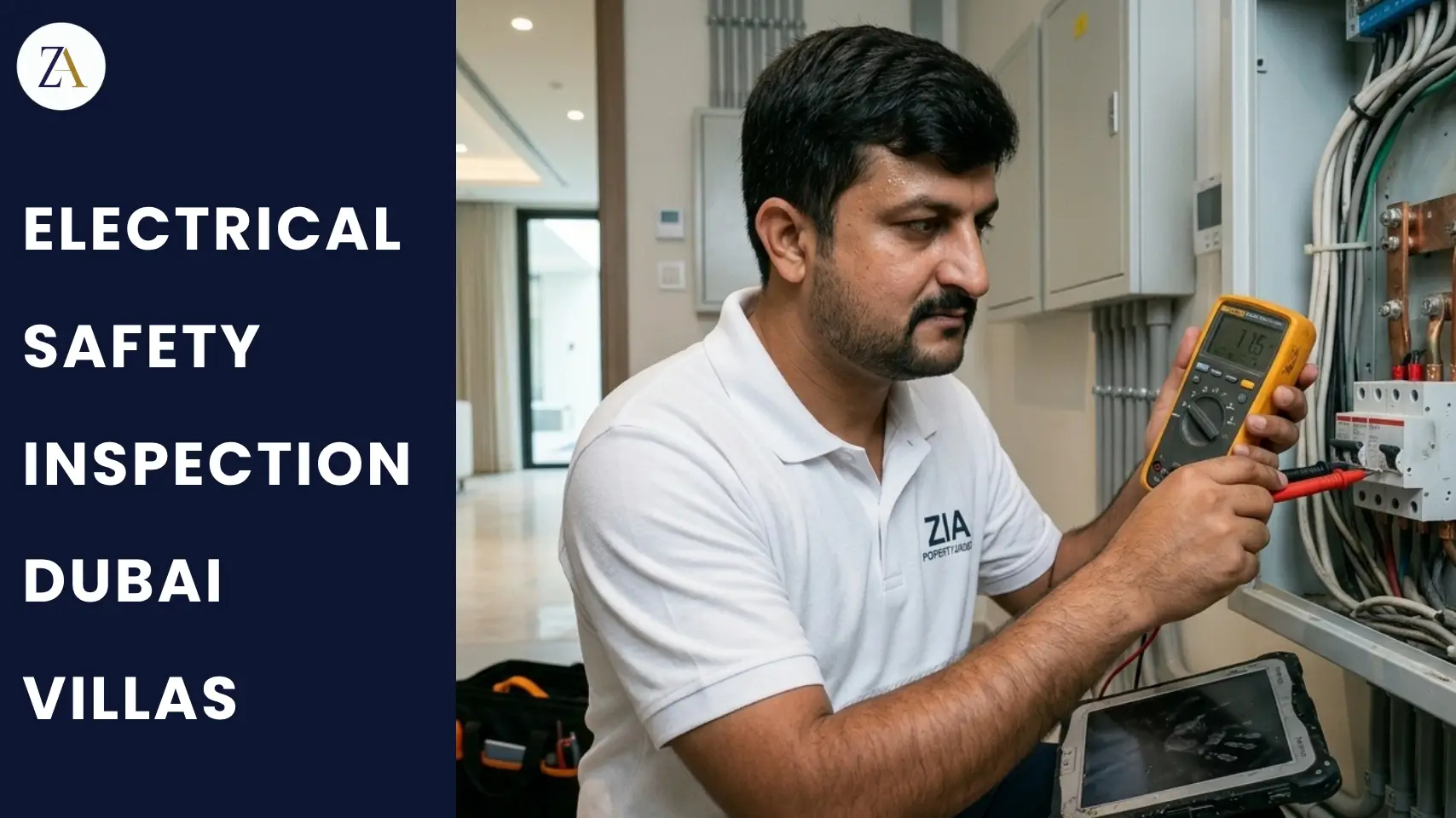
Electrical Safety Inspection for Dubai Villas: Checklist
A villa has more electrics than most people realise: a main board, sub-boards, outdoor lights, a pool pump, a garden socket, maybe a gate motor, and an AC unit in every room. Any one of them can fail. This guide is a practical checklist for electrical safety inspections for Dubai villa owners, covering the DB board, earthing, sockets, wiring, and outdoor circuits, and telling you which checks you can do yourself and which need a tester.
Quick answer: a proper electrical safety inspection for a Dubai villa checks the distribution boards, RCD protection, earthing and bonding, sockets and switches, wiring condition, AC and water heater circuits, and everything outdoors. You can look for warning signs yourself, but only a qualified inspector can test the RCDs, measure earthing, and find faults you can’t see. Book one before you move in, after any major works, and whenever you notice warning signs.
What Does an Electrical Safety Inspection Dubai Villa Check?
A visual look is the start, not the end. A full inspection has two parts: checking the installation by eye and testing it with instruments. Here’s the overview:
Area | What is checked | Visual or tested? |
|---|---|---|
Distribution boards | Condition, labels, breakers, heat marks, loose connections | Both |
RCD protection | Whether it trips, how fast, and which circuits it covers | Tested |
Earthing and bonding | Earth continuity, earth fault loop impedance, bonding of metal parts | Tested |
Sockets and switches | Damage, heat, loose fittings, overloaded leads | Both |
Wiring and circuits | Insulation, cable size, circuit condition | Mostly tested |
AC and water heaters | Dedicated circuits, breakers, connections | Both |
Outdoor, garden, pool | Weatherproofing, RCD protection, cable protection | Both |
Now let’s go through the villa, area by area.
Leave your phone, We’ll call you in 15 min
The Villa Electrical Safety Checklist
1. Main Board and Distribution Boards (DBs)
- Cover and labels: The cover should be fitted and undamaged, and every breaker should be clearly labelled. Unlabelled boards slow you down in an emergency.
- Signs of heat: Look for discoloured plastic, scorch marks, or a burning smell. These suggest loose connections.
- Breakers and fuses: Final distribution boards shouldn’t use rewirable fuses under DEWA’s regulations. If you see them, tell an electrician.
- Spare capacity: If the board is full and extra circuits have been squeezed in, the load may be too high.
- Moisture and dust: Boards in garages, store rooms, or outdoor cabinets shouldn’t show damp, rust, or insects.
2. RCDs (Trip Switches)
An RCD, also called an RCCB or ELCB, cuts the power in a fraction of a second if electricity leaks to earth, for example, through a person. It’s the main protection against electric shock.
- Find the RCDs on your board. Each has a test button.
- Press the test button. The RCD should trip straight away. If it doesn’t, it needs replacing.
- Check which circuits are protected. DEWA’s regulations call for 30 mA RCD protection on sockets rated 20 A or less, on outdoor mobile equipment circuits up to 32 A, and on water heater circuits.
- Never bypass or tape over an RCD that keeps tripping. It’s telling you something is wrong.
The test button only shows that the mechanism works. An inspector measures the actual trip time and current with a tester, which is a much better check.
3. Earthing and Bonding
Earthing gives faults a safe path to ground so breakers and RCDs can do their job. DEWA’s regulations expect each installation to have its own earthing system, with an earth electrode, an earth lead to the main earthing terminal, earth conductors for every circuit, and bonding of metal parts. You can’t verify this by eye. An inspector measures earth continuity and earth fault loop impedance. Ask for the readings, not just a pass.
4. Sockets and Switches
- Loose, cracked, or discoloured sockets.
- Plugs that feel warm or fall out of the socket.
- Sockets that spark, buzz, or smell of burning.
- Extension leads running through doors, under rugs, or carrying heavy loads such as heaters.
- Switches that crackle, stick, or feel hot.
In bathrooms and kitchens, sockets should be well away from water. Water heater switches belong outside the bathroom.
5. Wiring and Circuits
Most wiring is hidden in walls, so signs show up elsewhere: lights that flicker or dim when the AC starts, breakers that trip for no clear reason, or sockets that stop working. An inspector tests insulation resistance and circuit condition and checks whether the cable sizes suit the loads. Older villas that have had extensions and refits often have mixed wiring that’s worth a closer look.
6. AC Units and Water Heaters
Villas have heavy loads. Each AC and each water heater should run on its own proper circuit, with the right breaker and a clean, tight connection. Warm cables or a breaker that trips on hot afternoons are common signs of an overloaded circuit.
7. Outdoor Areas, Garden, and Pool
Outdoors is where electrics meet water, dust, and sun. Check these:
- Outdoor sockets and switches should be weatherproof (DEWA’s regulations call for IP55) with intact covers.
- Garden lights, pool pumps, and gate motors should be on RCD-protected circuits.
- Cables should be properly fixed and buried or protected, not lying across paths or in puddles.
- The meter cabinet in the compound wall should be closed, dry, and clear of blockages.
Anything with water and electricity together, such as a pool, needs a professional. Don’t test it yourself.
Why Dubai Villas Have Their Own Electrical Risks
Heat is the big one. Cables, breakers, and connections run warm in summer, and a connection that was slightly loose in winter can overheat when the AC load peaks. Dust and humidity get into outdoor boxes and old sockets. Sprinklers, pool equipment, and garden lighting add water to the mix. And many villas have been extended, with a majlis, a maid’s room, a roof room, or an extra kitchen, so the original board is asked to carry more than it was designed for.
Rented villas have a different problem: nobody is quite sure what has been done to them. Several tenants over several years can mean several small DIY changes. That’s one reason a rented or second-hand villa deserves a tested inspection and not just a quick look.
Before You Check Anything Yourself
- Don’t open a live board or remove covers. Look at the outside and the labels only.
- Never touch electrical fittings with wet hands or while standing in water.
- If you smell burning or see smoke, switch off at the main breaker if you can do so safely and call for help.
- Don’t repair anything unless you’re a qualified electrician. Use a licensed contractor.
Warning Signs You Shouldn't Ignore
- A burning smell near a board, socket, or appliance.
- Breakers or RCDs that trip often.
- Tingling or small shocks when touching taps, appliances, or metal fittings.
- Buzzing or humming from the board.
- Scorch marks or melted plastic.
- Flickering or dimming lights.
- Wet electrical fittings after rain or a leak.
If you notice any of these, switch off the affected circuit if it’s safe to do so, don’t use it, and call a qualified electrician or inspector.
What Do DEWA Rules Say?
DEWA publishes the Regulations for Electrical Installations, which set out how installations in Dubai should be designed, protected, and tested. The 2017 edition requires an installation to be inspected and tested before the supply is connected. It also notes that maintenance and periodic inspection depend on how the installation is used and what conditions it faces, and it sets at least a two-year interval for industrial and commercial installations. It doesn’t give a fixed interval for a villa in the sections we read. Our page on DEWA electrical standards explains the main points in plain language.
In practice, many owners choose an inspection every one to two years for an older villa and at handover, resale, after renovation, or after any electrical incident. That’s good practice rather than a rule.
Should You Book a Professional Inspection?
Your own checks help you spot problems, but they can’t replace testing. If the villa is more than a few years old, has been extended, has a pool, or you’re about to rent it out, buy it, or move in, an electrical inspection in Dubai gives you measured results instead of guesses.
The team at Zia is RERA-approved, DED-licensed and InterNACHI-certified. Every report comes with photos, and we deliver it within 24 hours.
A typical visit goes like this. The inspector walks the whole property, opens the boards, tests the RCDs and earthing, checks sockets and circuits, and photographs anything wrong. You get a report that lists each finding, how serious it is, and what to do about it. After the repairs are done, a re-inspection confirms the faults are fixed.
Keep the report. If you rent out the villa, it’s a record of the condition on a given date. If you buy, it gives you a basis for asking the seller to fix faults. If it’s a new villa, include it in your snagging before the defects period ends.
Frequently Asked Questions
How often should a villa have an electrical safety inspection in Dubai?
DEWA’s regulations don’t set a fixed villa interval in the text we read. Many owners inspect every one to two years, plus at handover, resale and after renovation.
What does an electrical safety inspection Dubai villa owners book usually include?
It covers the distribution boards, RCD testing, earthing and bonding, sockets and switches, wiring condition, AC and water heater circuits, and outdoor circuits.
Can I test my own RCD?
You can press the test button, and it should trip at once. But only an inspector can measure the real trip time and current.
Is an inspection the same as an electrician's repair?
No. An inspection finds and records faults. A licensed contractor does the repairs. Keeping them separate gives you an independent opinion.
Do I need an inspection for a new villa?
It’s wise. New villas can have wiring and earthing defects. Check it during snagging while the developer is still responsible.
Want Your Villa Checked Properly?
Tell us the size of the villa, its age, and any problems you’ve noticed, and we’ll explain what an electrical safety inspection Dubai villa owners need would cover. Contact our engineers, and we’ll take it from there.
