
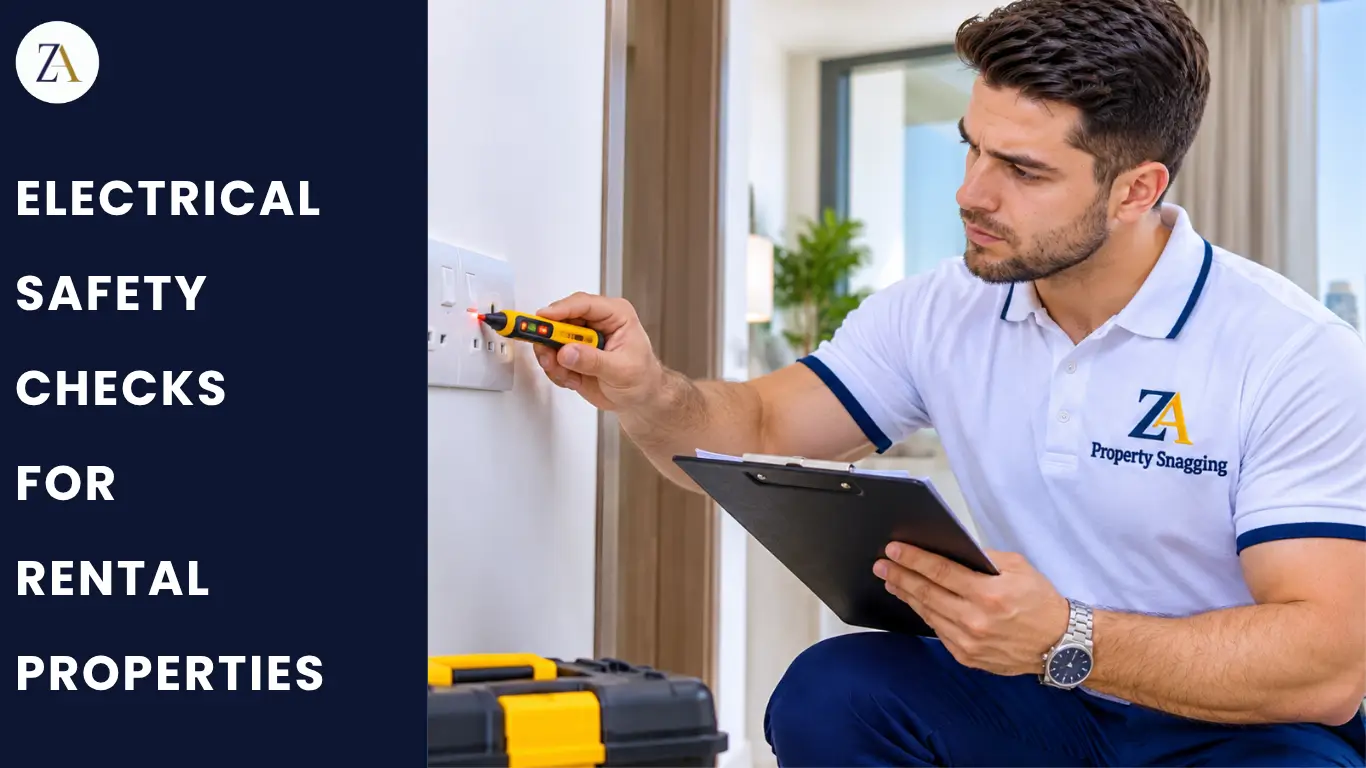
Electrical Safety Checks for Dubai Rentals: Landlord Duties
A tenant messages you at 11 pm: there’s a burning smell near the living room socket. You’re the landlord, so you’re the one who has to sort it out, and fast. Most of these calls can be avoided with a few planned checks. This guide covers the electrical safety checks for rental properties Dubai landlords should run, who’s responsible for what, and when to bring in a professional. If you’d rather hand it to an engineer, see our electrical inspection services.
Quick answer: Under Dubai’s tenancy law, the landlord maintains the property by default unless the contract says otherwise. Landlords should check the distribution board, sockets and switches, RCDs, earthing, and visible wiring before each new tenancy and after any fault. A licensed electrician or inspector should do the testing.
Who Is Responsible for Electrical Safety in a Dubai Rental?
In most cases, the landlord. The Dubai Land Department’s tenancy guide says the landlord handles maintenance and repairs during the lease “unless otherwise agreed by the parties” (Law No. 26 of 2007, Article 16). Article 17 adds that the landlord is responsible for defects and wear and tear not caused by the tenant. Wiring that has aged or a breaker that fails isn’t the tenant’s doing.
The tenant has duties too. Article 19 asks them to look after the property as an ordinary person would and to get the landlord’s permission before making changes. A tenant who rewires a socket without asking takes on the risk. Always read your own contract, because it can move small repairs to the tenant. For the technical side, see the DEWA electrical standards we follow.
Electrical Safety Checks for Rental Properties Dubai Landlords Should Run
Some of these you can do by eye. Others need testing equipment, so they’re for a licensed electrician or inspector. Go through them in this order:
Leave your phone, We’ll call you in 15 min
Distribution board and breakers
Open the board and look for scorch marks, loose wires, missing labels, or breakers that feel hot. Press the test button on the main trip switch and note whether any circuit trips on its own.
Sockets and switches
Check every socket for cracked faceplates, loose fittings, discolouration, and warmth. Plug in a lamp or tester to confirm each one works, and flag any buzzing or sparking straight away.
RCD test
An RCD cuts the power when current leaks to earth, which is what protects people from shock. The test button is a quick check, but an engineer should confirm it trips as it should under proper testing.
Earthing check
Earthing gives fault current a safe path away, which lowers shock and fire risk. You can’t judge it by looking, so ask your electrician to test sockets and fixed appliances like water heaters and AC units.
Wiring condition and DIY work
Look for signs of past amateur repairs, such as mismatched sockets, taped joints or cables running outside conduit. Unlicensed work is a common hidden fault in older flats, and it can cause trouble with insurance as well.
Quick Checks vs a Full Electrical Inspection
A walk-through catches the obvious problems. It can’t measure what you can’t see. This table shows where each approach stops:
Item | Quick check (by eye) | Full test (electrician) |
|---|---|---|
Distribution board | Scorch marks, labels, loose wires | Connections, load and breaker rating |
Sockets and switches | Cracks, warmth, working | Wiring behind the faceplate, polarity |
RCD | Press the test button | Trip performance under test |
Earthing | Cannot be judged by eye | Continuity and earth path tested |
Wiring | Mismatched or taped joints | Insulation and condition of cables |
A guide only. A licensed electrician decides what testing your property needs.
For a tenancy handover, a quick check may be enough. For an older building, a flat that’s been empty for a while or any repeated fault, book a full test. Our electrical inspection services include a written report with photos.
Not sure what your rental needs? Ask us which electrical checks your rental needs and tell us the building age and type.
When Should Landlords Check the Electrics?
- Before every new tenancy, so you start with a known, documented condition.
- After water damage, such as an AC leak or burst pipe near sockets or the board.
- After repeated breaker trips, which usually point to a fault rather than bad luck.
- Before adding heavy loads, like extra AC units or a new water heater.
- During your yearly property visit, as one part of a wider check.
Older buildings need more attention. Some Dubai electricians suggest a closer look at panels in homes built before 2010, though that’s a rule of thumb rather than a legal cut-off.
Warning Signs a Tenant May Report
Ask tenants to report problems in writing, for example by WhatsApp, so there’s a record. These are the signs that should never wait:
- Warm or discoloured sockets and switch plates.
- A burning smell near sockets, switches, or the board.
- Breakers that keep tripping.
- Flickering lights across a whole room.
- A tingle or shock from a socket or appliance.
In an emergency, tell the tenant to switch off at the main board, stay away from the fault and call Civil Defence on 997 if there’s fire or smoke.
Common Mistakes Landlords Make With Electrical Safety
- Waiting for something to fail. A warm socket is a warning, and a tripped breaker is often a symptom of something bigger.
- Using unlicensed handymen. Cheap fixes can leave hidden faults and cause problems with insurance.
- Skipping the paperwork. Without a dated record, it’s hard to show the property was safe at handover.
- Ignoring added load. More AC units or a new heater on an old circuit is a common cause of overheating.
What Records Should You Keep?
Keep a simple file for each property. Include the date of every check, who did it, photos of the board and any faults found, and the repair invoices. If a tenant later disputes a fault, or you’re asked to show you acted, that file does the talking.
Share the report with your property manager, too. They can then book repairs without chasing you for details, and the same document is useful at the next tenancy handover.
What a Zia Electrical Check Covers
The ZIA team is RERA-approved, DED-licensed and InterNACHI-certified, and we inspect as an independent party, not as a repair contractor. We check the board, sockets, RCDs, earthing and visible wiring, using thermal imaging where it helps. You get a photographed report within 24 hours, with each finding rated by severity.
Inspections start from AED 999, and you receive a written quote before anything is booked.
Frequently Asked Questions
Who is responsible for electrical repairs in a Dubai rental?
By default the landlord, under Article 16 of Law No. 26 of 2007, unless the contract says otherwise. Minor items like light bulbs often fall to the tenant if the contract has a minor maintenance clause.
How often should a landlord check the electrics?
Before every new tenancy, after any water damage or repeated tripping, and during a yearly visit. No Dubai law we found sets a fixed interval, so use these triggers as a practical guide.
Do I need DEWA approval for electrical work?
Not for minor repairs like replacing a socket or switch, according to one Dubai electrical firm. Major work such as new circuits, panel upgrades, or rewiring is done, and your licensed electrician normally handles it.
What should a tenant do if the breakers keep tripping?
Unplug heavy appliances, reset the breaker once, and report it to the landlord in writing. Repeated tripping points to an overload or fault, so don’t keep resetting it and wait for an electrician.
Can a tenant do their own electrical repairs?
No. Dubai guides advise against DIY electrical work, and Article 19 requires the landlord’s permission before a tenant changes anything. Unlicensed work can also create insurance problems if something goes wrong.
Ready to Check Your Rental's Wiring?
Tell us the property type, its age, and any faults you’ve seen, and we’ll reply with a written quote and no hidden extras. You can contact our team online or message us on WhatsApp at +971 56 901 9343. Running the right electrical safety checks for rental properties Dubai, tenants and landlords can rely on this as the simplest way to avoid that 11pm call.