

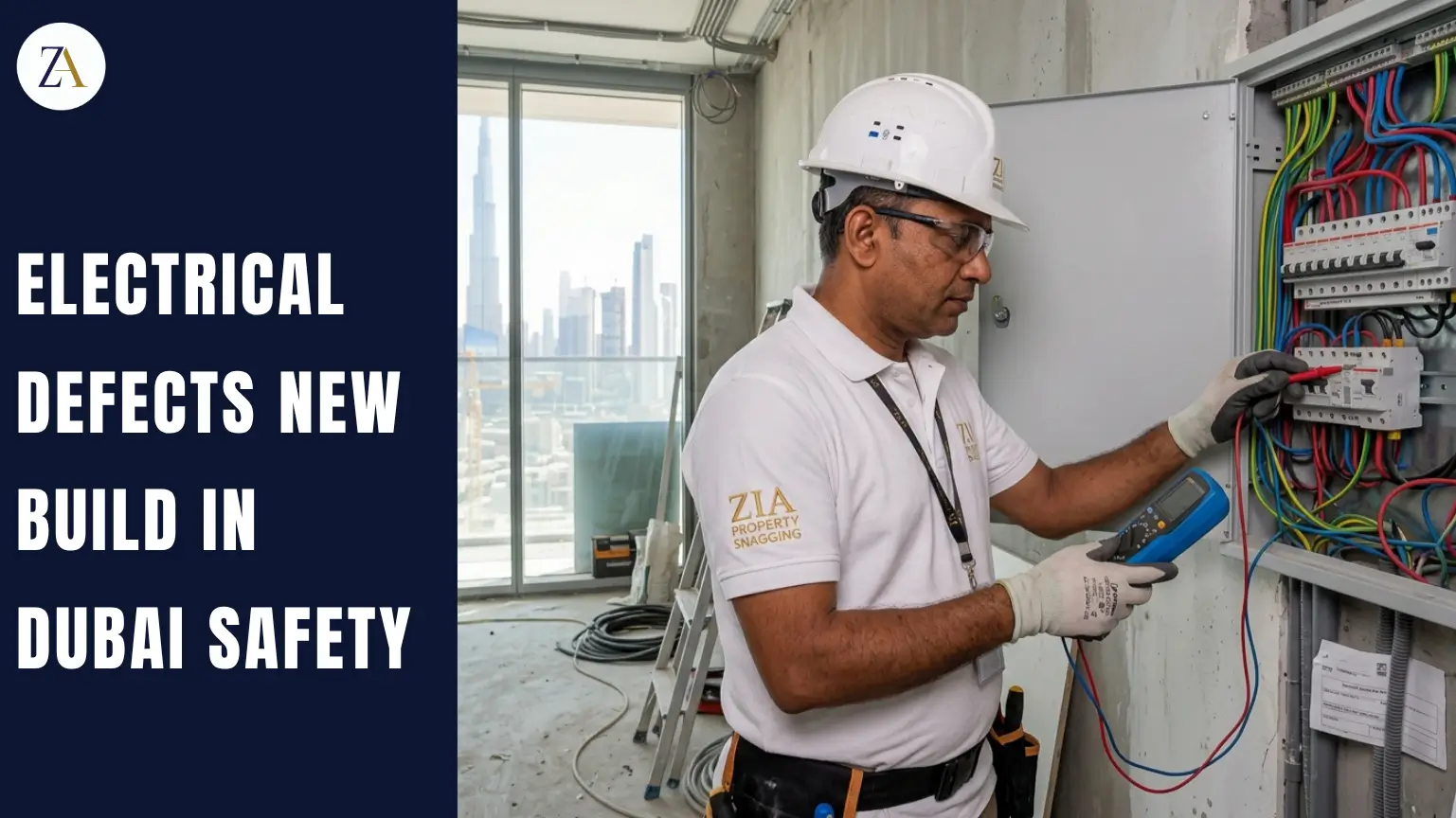
Electrical Defects New Build Dubai Safety 2026 full Guide
If you’ve just received your handover notice from a Dubai developer, your first instinct is probably excitement. New home, new beginnings, and somewhere on the to-do list: collecting the keys. However, most buyers don’t consider the fact that the electrical system in the new apartment or villa may not be as safe or complete as it appears.
One of the most hazardous problems that occur in new builds in Dubai is electrical problems. A wiring fault is not like a misaligned door or cracked tile, it does not make the loudest of complaints. It lurks on walls, in distribution boxes, and under floor finishes and poses a risk until a problem arises. And by that point, the developer has handed over responsibility, and the repair bill is yours.
This guide covers everything Dubai property buyers need to know about electrical safety snagging in 2026 — from the most common defects found in new builds, to your legal rights under UAE law, to exactly what a professional inspection checks before you accept those keys.
Why Electrical Defects Are the Most Dangerous Snagging Issues in Dubai New Builds
When people think about property snagging, they often picture cosmetic issues — paint touch-ups, hollow tiles, scratched fixtures. Those matters. But electrical defects sit in a completely different risk category.
A hairline crack in a wall won’t hurt anyone. A loose wire connection or an improperly earthed circuit absolutely can. Electrical faults in residential properties are one of the leading causes of house fires in the UAE, and the majority of those faults were present at the time of handover—just never identified.
What makes electrical defects particularly dangerous in Dubai’s new builds is a combination of factors:
- Construction timelines are often aggressive, with finishing trades rushed in the final weeks before handover
- Multiple subcontractors work on the same MEP systems, creating gaps in accountability
- Dubai’s extreme heat puts additional stress on wiring insulation and circuit loads from day one
- Buyers typically accept handover without any independent electrical verification
The result is that properties across Dubai’s most popular communities—JVC, Business Bay, Dubai South, Downtown Dubai—are regularly handed over with electrical defects that no one has flagged. Until a snagging inspection is done, the buyer simply doesn’t know what’s sitting inside their walls.
Most Common Electrical Defects Found in Dubai New Builds (2026)
Based on inspections carried out across Dubai’s major developments, these are the electrical defects that come up most consistently in new build properties at handover:
Leave your phone, We’ll call you in 15 min
Faulty Wiring and Loose Connections
Loose terminal connections are one of the most common findings in new-build electrical systems. They don’t always cause immediate problems — instead, they generate heat over time, which gradually damages surrounding materials and increases fire risk. In some cases, connections haven’t been terminated properly at all, leaving live wires inadequately secured inside wall cavities.
Overloaded Circuits and Incorrectly Rated Breakers
Developers sometimes install circuit breakers that don’t match the actual load requirements of the circuits they protect. An undersized breaker may trip frequently; an oversized one won’t trip when it should, which is the more dangerous scenario. Circuits are also sometimes planned without adequate capacity for how residents actually use a modern home.
Missing or Improper Earthing and Grounding
Earthing is your protection against electric shock if something inside an appliance fails. Without a proper earth connection, a fault in a washing machine or water heater can send dangerous current through the property. Improper earthing is surprisingly common in Dubai new builds, particularly in wet areas like bathrooms and kitchens.
Non-Functional Sockets and Switches
Dead sockets and switches that don’t operate correctly are a standard finding in new build snagging. Some are wired incorrectly, some have been missed entirely during installation, and others have loose back-box connections that make them intermittently functional—which is actually worse than simply not working, because it’s harder to detect.
Exposed Wires and Uncovered Junction Boxes
Open electrical boxes and exposed wires are common in properties that have been rushed through finishing. This creates an immediate safety risk, particularly in storage areas, utility rooms, and ceiling voids. It also means the installation fails DEWA safety standards.
DEWA Non-Compliant Installations
Dubai Electricity and Water Authority has specific technical requirements for residential electrical installations. Non-compliant wiring, undersized cable runs, missing RCDs (residual current devices) in wet areas, and improperly labelled distribution boards are all findings that can cause issues when the property goes through formal DEWA inspection — and they’re the developer’s responsibility to fix before handover.
Incorrect Polarity and Missing RCD Protection
Reversed polarity — where the live and neutral wires are connected the wrong way — is a wiring error that creates shock risk even when a socket appears to be working normally. RCDs in bathrooms, kitchen circuits, and outdoor sockets are a DEWA requirement that is frequently missed in new-build installations.
DEWA Compliance and What It Means for Your Dubai Property
Every residential electrical installation in Dubai must comply with Dubai Electricity and Water Authority standards before it can be energized. This includes specific requirements around cable sizing, protection devices, earthing systems, distribution board labeling, and RCD placement in high-risk areas.
In theory, a new build property shouldn’t be handed over with DEWA non-compliant electrical work. In practice, compliance checks during construction are not always thorough, and defects slip through. Here’s why this matters to you as a buyer:
- If DEWA identifies a non-compliance issue after handover, the cost of remediation can fall to you rather than the developer—particularly if you’ve already signed the handover documents
- Non-compliant wiring can affect your ability to obtain or maintain DEWA connection approval
- Insurance claims related to electrical faults can be complicated if the installation was not compliant to begin with
Getting an independent electrical snagging inspection before handover means any DEWA compliance issues are formally documented and become the developer’s obligation to resolve—before you take possession.
Your Legal Rights — Electrical Defects and the UAE Defects Liability Period
The UAE has robust regulations to safeguard property buyers from construction defects. According to Article 880 of the UAE Civil Code, developers are responsible for structural and major construction defects for a decade after handover. Under the Defects Liability Period (DLP) provided in the regulations under RERA, the period of defect is usually one year from the date of handover for finishing and MEP defects, which also includes electrical systems.
What this means practically:
- Electrical defects identified before handover must be fixed by the developer at no cost to you, before you accept the keys
- Electrical defects identified within the DLP (usually one year post-handover) are still the developer’s responsibility to rectify
- After the DLP expires, repair costs fall entirely to the owner
The critical point here is documentation. A developer cannot be held responsible for defects they were never formally notified of. This is exactly why a professional snagging report matters. A detailed electrical snagging report, issued by a RERA-approved inspection company, creates a formal record of every defect — one that is recognised by developers, RERA, and the Dubai Land Department. Without it, you have no legal leverage, and no evidence of what was wrong when you took possession.
What Does an Electrical Snagging Inspection Actually Check?
A professional electrical snagging inspection isn’t a quick walkthrough with a plug tester. At Zia Property Snagging, electrical inspection is one component of a 400+ checkpoint methodology carried out by certified civil engineers — not handymen, not general maintenance technicians. Here’s what the electrical inspection actually covers:
Distribution Board (DB Panel)
The DB panel is the heart of your property’s electrical system. The inspection checks that all circuits are correctly labelled, that breakers are correctly rated for their circuits, that no circuits are overloaded, that the panel is clean and properly terminated, and that there are no signs of heat damage or poor workmanship inside the enclosure.
Circuit Breakers and RCD Protection
Every MCB (miniature circuit breaker) is checked for correct rating and proper operation. RCDs in bathrooms, kitchens, laundry areas, and outdoor circuits are verified for presence and correct function. Missing or incorrectly installed RCDs are flagged as priority defects.
Earthing and Bonding
The earthing system is tested throughout the property. Bonding in wet areas — bathrooms, kitchens, utility rooms — is checked to ensure that all metalwork is correctly connected to earth. This is one of the most critical checks for personal safety.
All Sockets and Switches
Every socket in the property is tested for correct polarity, live/neutral connections, and earth continuity. Switches are tested for correct operation. Loose back-boxes, intermittent connections, and dead outlets are all documented.
Light Fittings and Ceiling Fixtures
Every light fitting is checked for correct installation, secure fixing, and proper connection. This includes recessed downlights, pendant fixtures, and any external or balcony lighting.
Cable Management and Conduit
Visible cable runs, conduit installations, junction boxes, and trunking are inspected for correct installation, secure fixing, and proper sealing. Exposed wires and open junction boxes are flagged immediately.
Thermal Imaging for Hidden Electrical Faults
This is where independent snagging goes beyond what any visual check can achieve. Zia Property Snagging inspections use thermal imaging cameras to detect heat signatures inside walls, ceilings, and distribution boards — revealing overloaded connections, failing components, and wiring faults that are entirely invisible to the naked eye. A junction box running hot behind a wall won’t show up in a standard inspection. It will show up in a thermal scan.
Electrical Defects by Dubai Community — What We Find Most Often
Electrical defect patterns vary across Dubai’s developments. Here’s what tends to come up in the communities we inspect most frequently:
JVC (Jumeirah Village Circle) — High-density mid-rise developments in JVC consistently show overloaded circuits, missing RCDs in bathrooms, and improperly labelled DB panels. The volume of units delivered simultaneously in JVC means finishing quality control is stretched thin.
Business Bay — High-rise towers in Business Bay often present earthing issues in upper-floor apartments, particularly in wet areas. DB panel labelling is frequently incomplete or inaccurate.
Dubai South and Dubai Hills — Off-plan villa and townhouse communities in these areas regularly show incorrect polarity at sockets, loose connections at light fittings, and inadequate external circuit protection for garden and parking areas.
Downtown Dubai — Premium pricing doesn’t equal premium electrical installation. Luxury apartments in Downtown regularly come through with non-functional sockets, missing earth bonding in bathrooms, and DB panels that don’t match the actual circuit layout of the property.
Why You Should Never Rely on the Developer's Own Electrical Check
Every developer in Dubai carries out quality checks before handover — but that check is done by their own team or a directly contracted party. The goal is to prepare the property for handover, not to identify every defect on your behalf. There’s a built-in conflict of interest, and it shows in the results.
Zia Property Snagging is RERA-approved, DED-licensed, and InterNACHI-certified — working exclusively for buyers, with zero commercial relationship with any developer. Our reports are accepted by all major developers including Emaar, DAMAC, Nakheel, and Sobha, and carry regulatory weight that a general contractor’s opinion simply doesn’t have. Buyers who book an independent inspection consistently recover far more defects — and get them fixed at the developer’s cost — than those who rely on the developer’s internal process.
Frequently Asked Questions
Can a developer refuse to fix electrical defects found in a snagging inspection?
Under RERA regulations, developers are legally required to rectify defects reported before handover or within the Defects Liability Period. A formal report from a RERA-approved company makes it significantly harder for a developer to dismiss the findings.
Is thermal imaging really necessary for an electrical snagging inspection in Dubai?
Yes. Thermal imaging detects heat buildup inside walls, ceilings, and DB panels that’s completely invisible to the naked eye. A connection running hot behind a wall is a serious fire risk — one that only a thermal scan can reliably catch.
How long does an electrical snagging inspection take?
Electrical inspection is part of Zia Property Snagging full 400+ checkpoint process. A one-bedroom apartment typically takes 2–3 hours; a villa takes 4–6 hours. The complete report is delivered within 24 hours of the inspection.
What happens if electrical defects are found after I've already accepted handover?
If the defects fall within the Defects Liability Period — typically one year from handover under RERA — the developer is still obligated to fix them. That said, your position is always stronger when defects are documented before you sign the handover documents.
Does Zia Property Snagging cover electrical inspections across all Dubai communities?
Yes. Zia Property Snagging certified engineers inspect properties across all major Dubai communities including JVC, Business Bay, Downtown Dubai, Dubai Marina, Palm Jumeirah, Dubai Hills, DAMAC Hills, and Dubai South, as well as Abu Dhabi, Sharjah, and the wider UAE.
Conclusion
Electrical defects in Dubai new builds are more common than most buyers realize—and far more dangerous than any cosmetic snag. A loose connection or a missing RCD doesn’t look like much at handover, but left undetected, it becomes your liability and a real safety risk.
The only way to know what’s inside your walls before you accept the keys is a professional, independent inspection. Zia Property Snagging RERA-approved engineers cover 400+ checkpoints, including full electrical inspection with thermal imaging, delivering your report within 24 hours. Apartments from AED 999, with a free re-inspection included.
Book your snagging inspection today — WhatsApp or call +971 56 901 9343.
