

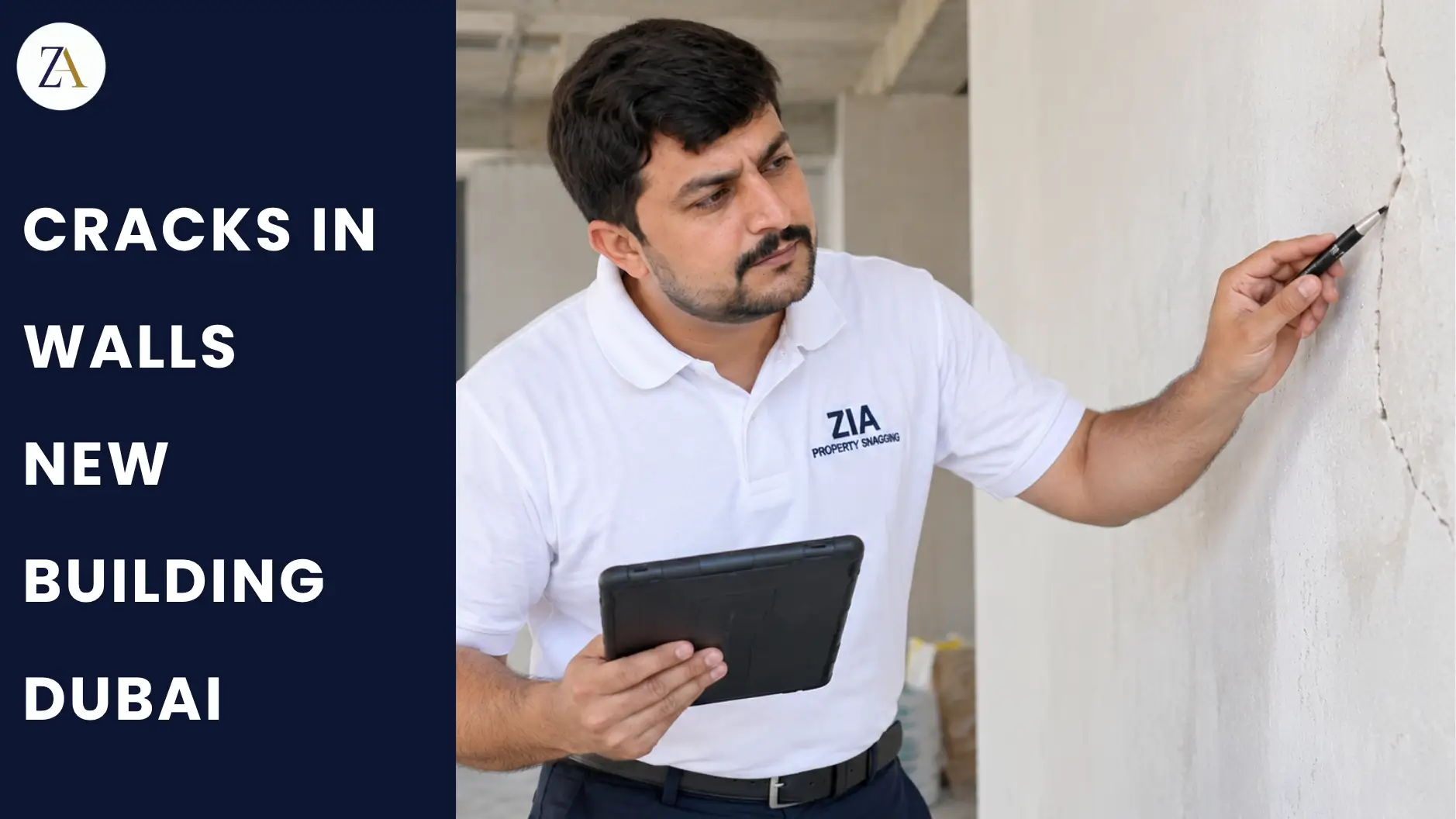
Cracks in Walls New Building Dubai: Causes, Risks & Fixes
You’ve just collected the keys, and there’s a crack running across the living room wall. It’s a horrible feeling. The good news is that most cracks in walls new building Dubai owners find are cosmetic and easy to fix. A few are not. This guide explains the common causes, how to tell a harmless crack from a serious one, and how to repair each type.
Quick answer: For cracks in walls in new building Dubai homes, hairline cracks (under 1 mm) in plaster or paint are very common, caused by drying, shrinkage, and temperature changes, and they’re usually repaired with filler and paint. Cracks wider than about 5 mm, cracks that keep growing, stepped or horizontal cracks, and cracks that cause doors to stick or walls to lean need a structural engineer. In all cases, photograph and report them in writing, because a new unit is usually still within the developer’s defects period.
Why Do Cracks in Walls Appear in a New Building in Dubai?
New buildings are still settling and drying out. Concrete and plaster shrink as they lose moisture, and materials expand and contract with temperature. Dubai makes that second part worse. A wall can be baking in the afternoon sun and cooled by AC on the other side, and the difference moves the surface a little every day. Here are the usual causes:
- Shrinkage: Plaster, paint, and concrete shrink as they dry, which makes fine surface cracks.
- Thermal movement: Heat and cooling make materials expand and contract, especially on outside walls and top floors.
- Joints between materials: Cracks often follow the line where a concrete column meets a block wall or where a ceiling meets a wall because the materials move differently.
- Settlement: The building and the ground beneath it can settle in the first years. Mild settlement is normal. Large or uneven settlement isn’t.
- Poor workmanship: Thin plaster, missing mesh at joints, poor curing, and rushed finishing can all cause cracks.
- Water: Leaks or damp can weaken plaster and cause cracks with stains. Water can also corrode steel inside concrete.
- Overloading or structural movement: Rare, but serious. This is the case that needs an engineer.
Which Cracks Are Normal and Which Are Not?
Width and direction tell you a lot. This table is a practical guide:
Crack | Width | Likely cause | What to do |
|---|---|---|---|
Hairline in plaster or paint | Under 1 mm | Drying, shrinkage, temperature | Fill, repaint, monitor |
Fine crack at a joint or corner | 1 to 2 mm | Movement between materials | Flexible filler or joint tape |
Wider plaster crack | Up to 5 mm | Shrinkage, poor plaster, minor settlement | Open, fill, mesh, and re-plaster |
Wide crack | 5 mm and above | Settlement, water, structural movement | Engineer assessment |
Stepped or horizontal crack | Any width | Possible structural movement | Engineer assessment |
Growing or reopening crack | Any width | Active movement or water | Find the cause first. |
The width bands are based on the UK’s BRE Digest 251 classification, which engineers use widely. They’re a general guide, not a Dubai regulation, and a crack’s direction and whether it’s growing matter as much as its width.
Leave your phone, We’ll call you in 15 min
Crack Types, One by One
Hairline Cracks
Very fine, often in plaster, around a window or in a corner. Under 0.1 mm to 1 mm. They’re very common and usually cosmetic. Fill and repaint, and see whether they come back.
Diagonal Cracks From Door and Window Corners
These start at the corner of an opening and run up or out. They’re often stressed, concentrating at the corner. Thin ones are common. Wide ones, or ones that keep growing, should be checked.
Horizontal Cracks
A horizontal crack across a wall is more worrying than a vertical one, because it can mean something is pushing or failing. Treat it as a reason to get advice.
Stepped Cracks
These follow the mortar joints between blocks in a stair-step pattern, and they can indicate structural movement. If you see one, record it and ask an engineer to look.
Cracks Where Ceiling Meets Wall
Very common, and nearly always from movement between two different materials. They’re usually cosmetic and are fixed with flexible filler or a joint tape.
Cracks With White Marks or Damp
If a crack comes with white powder, stains, or a damp patch, water is involved. The white powder is often efflorescence on Dubai walls, which is salt left behind as water dries. Fixing the crack without finding the water source won’t last.
What to Do When You Find a Crack
- Photograph it with a ruler or coin beside it: and note the date and the location.
- Measure the width and length: Write it down. A cheap crack gauge or even a pencil mark at each end is enough.
- Watch it for a few weeks: Does it grow, branch, or reopen after repair? Growth is the key warning sign.
- Look for causes: Is there damp, a leak, a stain, or something nearby such as a broken pipe or recent drilling?
- Report it in writing: to the developer or the property manager, with the photos.
- Get it assessed: if it’s wide, growing, stepped, horizontal, or if doors or windows are stuck.
How to Monitor a Crack Yourself
A crack that stays the same size is usually less worrying than one that changes. You can track it with very simple tools:
- Draw a pencil line across the crack at each end and write the date next to it.
- Stick a strip of clear tape across the crack. If the tape tears or buckles, the crack is moving.
- Measure the width at the same spot each week with a ruler or a cheap crack gauge, and keep a note on your phone.
- Take a photo from the same angle each time, so you can compare them side by side.
Cracks can also open and close with the seasons, getting wider in the heat of summer and narrower in winter. If that’s what yours does, say so when you report it, because it helps the engineer work out the cause.
Common Mistakes With Wall Cracks
- Repainting before the defects period ends: so the evidence disappears. Photograph everything first.
- Using hard filler on a crack that moves: It splits again within weeks.
- Waiting months to report it: Late reports are harder to argue.
- Drilling or hanging heavy items next to a crack: It can make it worse and complicate who caused it.
- Assuming a crack is cosmetic because the building is new: New buildings can have defects too.
How Are Cracks in Walls Fixed?
The repair depends on the cause. In general:
- Hairline cracks: rake out lightly, fill with a flexible filler, sand, and repaint. Using a flexible product matters, because rigid filler cracks again.
- Cracks at joints: cut a small groove, fill with flexible sealant, or use a reinforcing tape under the paint.
- Wider plaster cracks: open up the crack, fill, add mesh across it, and re-plaster.
- Cracks from leaks or damp: fix the water source first, let the wall dry, then repair the surface.
- Structural cracks: the engineer decides. Repairs can include stitching, injection, or strengthening, and it must not be done by a painter or handyman.
Painting over a crack that’s still moving hides it for a few weeks. It then comes back, usually in the same place.
Who Is Responsible in a New Building?
In Dubai, a developer is generally responsible for defects in a new building during a defects liability period and for structural defects over a much longer period. One secondary source describes this as one year for mechanical, electrical, and sanitary defects and ten years for structural defects under Law No. 6 of 2019, but check the official text and your sales contract for the exact terms. Either way, report cracks in writing and keep the evidence, because proof of when you found the problem helps if there’s a dispute.
When Do You Need an Engineer?
Get an assessment if a crack is wider than about 5 mm, is growing, is horizontal or stepped, runs through the full thickness of a wall, or comes with sticking doors, uneven floors, or leaning walls. If the cause is unclear, don’t guess.
Zia’s inspectors are RERA-approved, DED-licensed, and InterNACHI-certified. They find and measure cracks, photograph them, check for related damp, and recommend what to do next. Zia doesn’t issue structural certificates, so if a crack looks structural, we’ll tell you to bring in a structural engineer. A civil inspection covers walls, ceilings, floors, and finishes together, so cracks are recorded with everything else.
Frequently Asked Questions
Are cracks in walls new building Dubai handovers normal?
Fine hairline cracks are common as plaster dries and the building settles. Wide, growing, horizontal, or stepped cracks aren’t normal and should be assessed.
Are hairline cracks in a new apartment dangerous?
Usually not. Cracks under about 1 mm in plaster or paint are normally cosmetic. Watch them for a few weeks, and report them if they grow.
When should I worry about cracks in a new Dubai building?
Worry when a crack is wider than about 5 mm, keeps growing, runs horizontally or in steps, or comes with sticking doors, leaning walls, or damp.
Who pays to repair cracks in a new building?
Usually the developer, during the defects period. Report in writing with photos, and check your contract and the relevant law for exact terms.
Can I just paint over a crack?
Only a stable hairline crack. Otherwise, paint hides the problem for a short time, and the crack returns. Find the cause first.
Found a Crack in Your New Home?
Send us a photo and tell us where it is and when you noticed it, and we’ll tell you what an inspection would check before you commit to anything. Dealing with cracks in walls new building Dubai is much easier while the defect period is still running. Talk to our team, and we’ll take it from there.
