
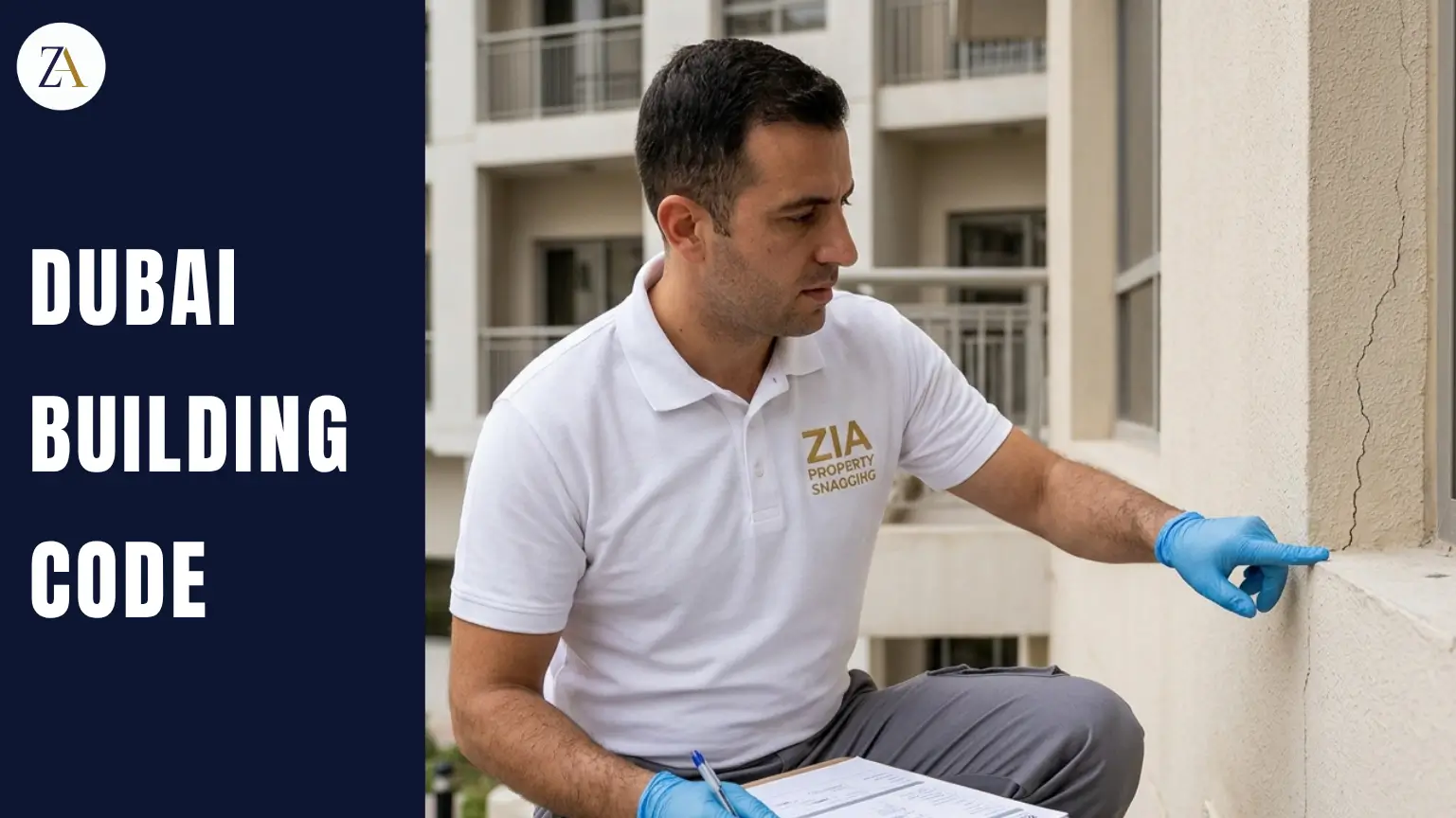
What Is Dubai Building Code, and How Does It Affect Your Inspection?
You’ve just received your handover notice. The developer hands you a folder full of approvals, NOC letters, and compliance certificates — and one of the terms that keeps coming up is “Dubai Building Code compliant.” It sounds reassuring. But most buyers have no idea what that phrase actually covers, or whether “code compliant” on paper means the same thing as “defect-free” in reality.
It doesn’t, and that gap is exactly where a professional inspection earns its keep.
This guide breaks down what the Dubai Building Code actually is, what it requires, and — more importantly — how it connects to what a qualified inspector physically checks in your unit before you sign anything.
What Is the Dubai Building Code (DBC)?
The Dubai Building Code is the emirate’s single code of building practices. Before its establishment, developers and consultants had to navigate a myriad of scattered regulations from various regulators, causing inconsistent compliance and approval delays.
The DBC was commissioned by Dubai Municipality and designed with the lead consultant of the world’s leading engineering firm, Arup, in collaboration with Gensler and the British Standards Institution. It officially opened in January 2022, and since then it has been seeking to support major developments throughout the city.
It is stated to have a simple purpose: to establish one minimum standard to ensure the health, safety, welfare, and convenience of persons in and around buildings and to encourage better sustainable design by developers.
In short, the DBC is the baseline every building in Dubai is legally supposed to meet. It’s not a guideline. It’s the floor.
What Does the Dubai Building Code Actually Cover?
The code is broken into ten parts, each covering a different area of building design. You don’t need to read the full document — here’s what each part means for the property you’re buying:
Part | Covers | What It Means for You |
A – General | Definitions, scope, how the code applies | Sets the ground rules for everything else |
B – Architecture | Layout, safety, design integration | How the building fits its surroundings safely |
C – Accessibility | Safe movement for all occupants | Ramps, walkways, accessible design |
D – Vertical Transportation | Elevators, escalators | Lift safety and performance standards |
E – Building Envelope | Facades, roofs, insulation | Weatherproofing, energy efficiency, heat gain control |
F – Structure | Foundations, load-bearing elements | Whether the building can safely carry its loads |
G – Incoming Utilities | Electrical, water, telecom connections | Safe, code-compliant utility installation |
H – Indoor Environment | Air quality, lighting, acoustics, comfort | How livable the space actually is day to day |
J – Security | Occupant safety systems | Fire and life-safety provisions |
K – Villas | Standards specific to villas/townhouses | Applies where Part B–H don’t fully fit |
Each part opens with “performance statements”—the outcomes a finished building must achieve—followed by detailed technical requirements to get there.
Leave your phone, We’ll call you in 15 min
How the Building Code Shapes What an Inspector Actually Checks
This is the part most buyers never connect. A building inspection Dubai doesn’t happen in a vacuum—it’s essentially a physical audit of whether your specific unit lives up to the standards the DBC lays out on paper.
Here’s how the two map onto each other:
- Structural checks (Part F): Foundations, columns, beams, and settlement cracks. This is core civil inspection Dubai territory, and structural defects are legally the developer’s responsibility to fix at no cost to you under UAE Law No. 9 of 2009.
- MEP and utilities (Part G): Electrical circuits, earthing, socket polarity, water pressure, and drainage, checked against DEWA and Dubai Municipality standards.
- Building envelope (Part E): Facade sealant, window frames, balcony drainage, and waterproofing membranes—all critical given Dubai’s heat, humidity, and thermal cycling.
- Indoor environment (Part H): Ventilation, air quality, and thermal comfort in bedrooms, kitchens, and bathrooms.
- Security and life safety (Part J): Smoke detectors, fire suppression, emergency lighting, and fire door integrity.
An inspector isn’t just noting whether tiles are aligned or paint looks clean. They’re verifying, checkpoint by checkpoint, whether the building actually meets the code it was approved under.
What Happens When a Property Doesn't Meet Code
If a defect traces back to a code requirement—a structural crack, faulty wiring, missing waterproofing — the developer is obligated to rectify it. Under RERA regulations, this obligation is strongest before you sign the handover documents and accept the keys. Once you’ve signed, your legal leverage to have things fixed for free drops sharply.
This is exactly why timing matters. A code-related defect caught during inspection, before handover, is the developer’s cost to fix. The same defect discovered six months later can become yours.
Building Code Compliance vs. Snagging: What's the Difference?
These two terms are often used interchangeably, but they’re not the same.
Dubai Building Code | Snagging Inspection | |
What it is | Government-set minimum design standard | Independent, on-site defect check |
Who sets it | Dubai Municipality | Carried out by a private, buyer-hired engineer |
What it confirms | The building was designed and approved to meet a baseline. | The unit was actually built to that standard, defect-free. |
Legal status | Mandatory for all new construction | Not mandatory, but strongly recommended before handover |
A building can be technically “code approved” on the design drawings and still have on-site execution defects—a socket wired wrong, a membrane installed poorly, or a crack from settlement. That’s the gap a snagging inspection is built to close.
How to Check If Your Building Is Code-Compliant Before Handover
- Request your handover notice in writing and note the date—this starts your window to inspect before signing.
- Book an independent inspection before accepting keys or signing the handover certificate. You can book a building inspection as soon as your notice arrives.
- Have a certified civil engineer walk the full 400+ checkpoint list, covering structure, MEP, envelope, and finishes — not just a visual walkthrough.
- Review the report against DBC-linked categories — structural, utilities, envelope, indoor environment, and security — so you know exactly what falls under the developer’s legal obligation to fix.
- Submit the report to your developer and request rectification before signing off, keeping a copy for your own records.
- Request a re-inspection once repairs are done to confirm defects were properly fixed—not just patched.
Common Code-Related Defects Our Engineers Find
Across inspections in developments throughout Dubai, the most frequent code-linked issues include:
- Hairline structural cracks in walls or ceilings near settlement points
- Incomplete or poorly applied waterproofing in wet areas
- Electrical sockets or distribution boards not matching DEWA labelling standards
- Poor facade sealant allowing water ingress
- AC drainage and ventilation issues affecting indoor air quality
- Fire door or smoke detector installation gaps
For a deeper breakdown of how these are assessed and rated by severity, our building condition audit guide walks through the full process.
Frequently Asked Questions
Is the Dubai Building Code the same as RERA regulations?
No. The DBC sets construction and design standards, while RERA governs the real estate transaction process, including buyer rights around handover and defect rectification.
Does the Dubai Building Code apply to villas as well as apartments?
Yes, though villas and townhouses are covered separately under Part K, which adapts the general requirements to lower-rise residential design.
Who enforces compliance with the DBC?
Dubai Municipality oversees enforcement through the building approval and permit process, working alongside other relevant authorities depending on the project.
Can I ask my developer for the building's code compliance report?
You can request it, though developers aren’t always quick to share full technical documentation. An independent inspection gives you your own verified record regardless.
Does a snagging inspection confirm full Dubai Building Code compliance?
It verifies that what’s actually built matches key code-linked standards—structural, MEP, envelope, and safety—though it isn’t a substitute for the developer’s own regulatory approvals.
Conclusion
Understanding the Dubai Building Code is useful — having your specific unit checked against it is what actually protects you. Zia Property Snagging sends RERA-certified civil engineers to verify your property meets the standards it was approved under before you sign anything away.