

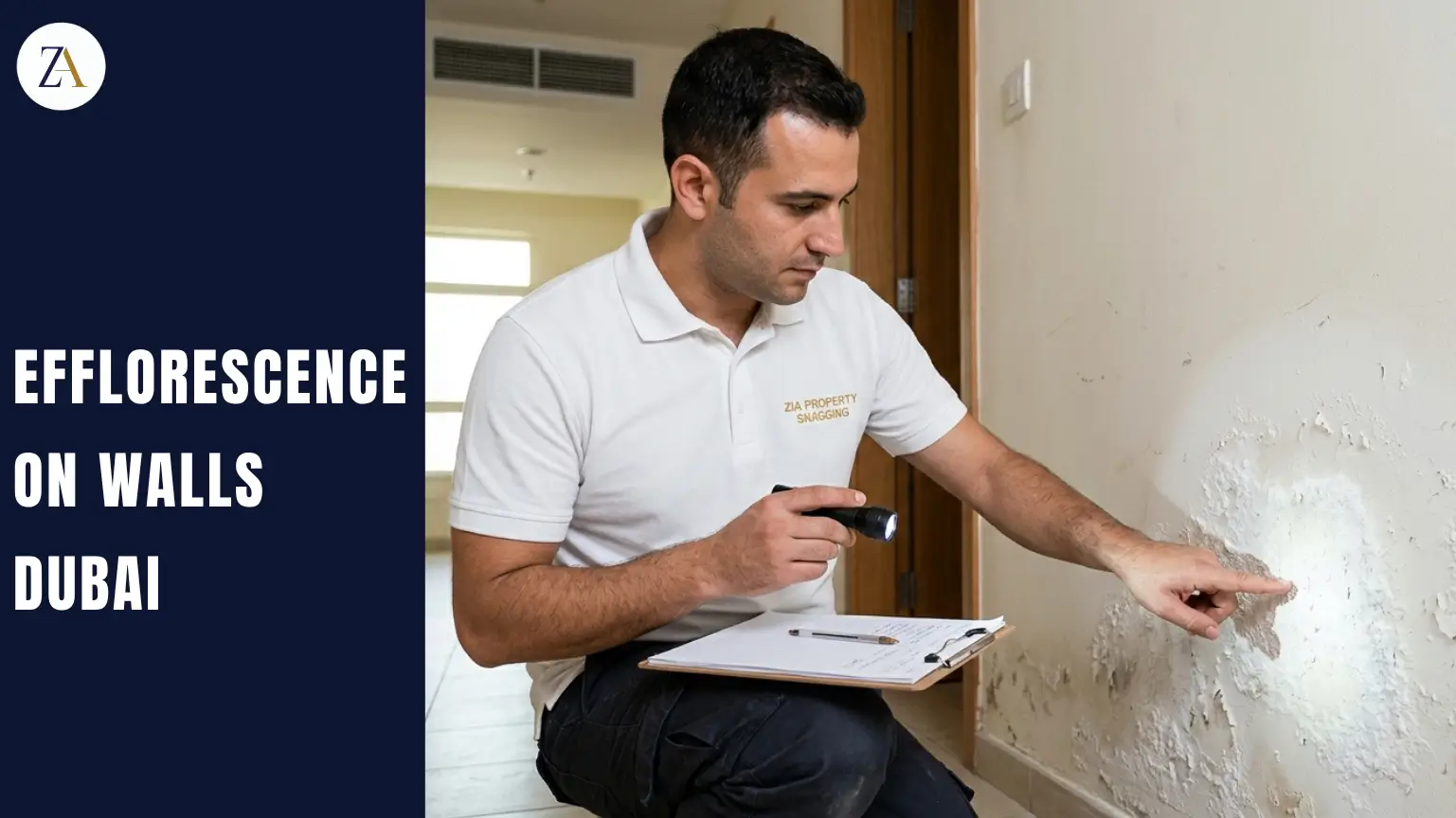
Efflorescence on Walls Dubai: Causes and Practical Fixes
You may be living in a Dubai apartment or villa and find a white chalky material on the wall; this isn’t your imagination—you’re not alone! This is known as efflorescence, and in a city where buildings are being built up continually, there is high humidity for months on end, and the sea is always just a few yards away, it is one of the most common complaints that people have, especially the first year or two after handover.
Fortunately, the powder is not often harmful in itself. The bad news is that it’s typically a messenger, not the issue. It’s saying that there’s water seeping through your walls and you need to fix the source of the water in your walls, or the white dust will return, no matter how many times you wipe it off.
This guide highlights why efflorescence occurs on walls in Dubai, how to tell if you have a non-hazardous new build issue or leaky wall, and what you can do about it—whether you’ve had your wall repainted or you need to raise a complaint with your developer.
What Is Efflorescence?
Efflorescence is the crystallization of a salt-like substance that occurs when water moves through concrete, block, plaster or gypsum board, bringing salts with it. The water comes up to the surface and evaporates, but the salts do not evaporate with it, so they remain as a dry salt, which may be white, but if it is a mineral-rich salt, it may be a little grey/yellow.
It’s not mold. It has no smell, doesn’t spread biologically, and doesn’t get worse when brushed, as do disturbing mold spores. Consider it as the dried-out footprint of water moving through your wall on its way out.
Why Efflorescence Shows Up So Often in Dubai
This isn’t a coincidence of bad luck. A few things about how Dubai is built and how the climate behaves make efflorescence more common here than in drier, older-built cities.
Leave your phone, We’ll call you in 15 min
New-build construction moisture.
The construction is rapid, and concrete and plaster can be seen as still curing inside even after the completion of the handover of the unit. This moisture needs to get out somehow, and over the first few months, it’ll gradually work its way out on fresh walls and it’s perfectly normal.
Humidity and coastal air.
The humidity levels that are usually high during the spring and early autumn make it difficult for water to evaporate, which allows salts to migrate and deposit on the surface.
Gypsum partition walls.
The majority of apartment buildings in Dubai also have partitions inside that are made of gypsum board, not solid block, and gypsum board is more porous and more moisture-sensitive than concrete. Surface efflorescence will appear much sooner than it will on solid masonry behind a gypsum wall.
Rapid handover timelines.
Units are sometimes delivered while they’re still not completely cured or even double-checked and may have small vulnerabilities that only become apparent months after they are put in place, such as a waterproofing membrane around a wet area.
Main Causes of Efflorescence on Dubai Walls
Some fundamental problems underlie nearly all cases:
- Leakage of water through cracks at the edge of external walls, balconies, or parapet walls, particularly after heavy rainfall.
- Membranes failing in bathrooms, kitchens, and on rooftops due to failure to be installed correctly or to deteriorate over time.
- Leaks that are concealed within walls typically cause efflorescence, which can be seen on the exterior of the wall near the kitchen or bathroom area, and may not have an apparent water source outside.
- Temporary moisture that typically dissipates in the first year of construction; this is commonly referred to as “construction moisture. Temporary moisture that typically dissipates in the first year of construction; this is commonly referred to as “
Moisture from bathrooms and laundry rooms will constantly provide salts with a continuous source of moisture to move through if they are poorly ventilated.
Is Efflorescence Dangerous?
On its own, no. The salt deposit isn’t structurally harmful and isn’t a health hazard. However, people get it wrong when they only consider it as a cosmetic treatment.
The moisture behind it is the real concern. Left unaddressed over time, it can:
- Weaken plaster and cause it to crumble or delaminate
- Encourage mold growth in the same damp conditions
- Corrode steel reinforcement inside concrete, which is a genuine structural issue in the long run
- Repeatedly ruin fresh paint, since painting over active moisture almost always leads to peeling or bubbling within weeks
So while the powder itself won’t hurt you, ignoring it for months because “it’s just white dust” is how an AED 200 fix turns into an AED 5,000 repair.
New-Build vs. Recurring Efflorescence: How to Tell the Difference
This is the distinction most guides skip, and it’s the one that actually matters for a Dubai property owner deciding whether to worry.
New-Build (Construction) Efflorescence | Recurring (Leak-Driven) Efflorescence | |
When it appears | Within the first 6–12 months after handover | Any time, often long after handover |
Pattern | Fades gradually on its own as the building dries out | Keeps coming back after cleaning |
Cause | Trapped moisture from construction materials | Active leak, seepage, or waterproofing failure |
Urgency | Low — monitor, clean as needed | High — needs source diagnosis |
Fix | Time and normal ventilation | Leak detection, waterproofing repair, or plumbing fix |
If your unit is less than two years old and the powder is fading somewhat with time, you are most likely witnessing the building drying out. This is the case if it has been appearing regularly for more than that or if it is appearing worse and worse rather than better; then it has a source of water being supplied to it.
A Simple DIY Test: Is There Active Moisture Behind It?
A rough check does not require equipment. Tape a small piece of aluminum foil or plastic sheet tightly to the affected wall, making sure to seal all four edges, and leave it for 24 hours.
- If there is moisture on the wall side of the foil, there is a true leak or seepage problem.
- If the moisture is on the room side (or not present at all), the wetness is due to condensation from humid room air and is not a structural fault but a ventilation fault.
This test is not meant to replace a professional inspection, but it will help you determine whether it’s a real emergency or something you can monitor for a while.
How to Remove Efflorescence Safely
Once you know the moisture source has been dealt with, or if it’s clearly the fading new-build type, cleaning is straightforward:
- Use a stiff, soft-bristle brush to remove loose deposits with dry brushing first.
- Avoid sweeping; vacuum debris up instead—it will only settle near the area being swept.
- Use a light water-based cleaning solution to remove any residual stains.
- If the problem is severe, use a special efflorescence cleaner, but always test a small, inconspicuous area first.
- Wait until the wall has thoroughly dried before painting again.
Don’t paint directly over existing efflorescence. Salts will push through the new paint, and you’ll find yourself in the same situation as before in weeks.
How to Prevent Efflorescence From Coming Back
- As soon as cracks can be seen in exterior walls or balconies, repair them.
- Keep waterproofing in wet areas on a maintenance schedule rather than waiting for a problem
- Fix even minor plumbing leaks immediately—they rarely stay minor
- Improve airflow in bathrooms and laundry rooms, using extractor fans where possible
- Book a periodic property inspection, particularly if you’re a landlord managing a unit you don’t see daily
Why This Matters Most at Handover
If you’re inspecting a property before accepting the keys, efflorescence deserves more attention than most buyers give it. Under RERA regulations, developers are required to fix defects reported during the Defect Liability Period—but only if they’re documented properly and flagged before you sign off on handover.
This is exactly where an independent snagging inspection earns its cost. At Zia Property Snagging, our RERA-approved, InterNACHI-certified engineers use moisture meters and thermal imaging as part of a 400+ point inspection, specifically to catch whether a patch of efflorescence is harmless drying-out or an early sign of a waterproofing failure the developer needs to fix before you take possession. Every inspection comes with a full report within 24 hours and a free re-inspection once any flagged issues are corrected.
Frequently Asked Questions
Is efflorescence on walls dangerous to my health?
No, efflorescence itself isn’t toxic or harmful to breathe. The concern is the underlying moisture, which can encourage mold growth if left unresolved for a long time.
Can I just paint over efflorescence to hide it?
Painting over active efflorescence almost always fails, since trapped moisture pushes through and causes peeling or bubbling within weeks.
Is efflorescence normal in a new Dubai apartment?
Yes, mild efflorescence in the first 6–12 months after handover is common and usually fades as construction moisture dries out naturally.
How do I know if efflorescence means I leak?
If the powder keeps returning after cleaning or appears well after the first year post-handover, it’s more likely a leak or waterproofing issue than construction moisture.
Who is responsible for fixing efflorescence caused by construction defects?
If it’s flagged during the Defect Liability Period and linked to a construction or waterproofing fault, the developer is responsible for the repair under RERA rules.
Conclusion
Efflorescence is rarely an emergency, but it’s never something to ignore completely. The white powder itself won’t hurt your walls or your health—the moisture behind it might, if you leave it unaddressed long enough. Whether you’re watching a new unit finish drying out or trying to figure out if a leak is hiding behind your bathroom wall, the fix starts with identifying which one you’re actually dealing with.
If you’re inspecting a property before handover and want to know for certain whether that white patch is nothing or something worth pushing back on, book a snagging inspection with Zia Property Snagging—our engineers will find it before it becomes your problem.
