

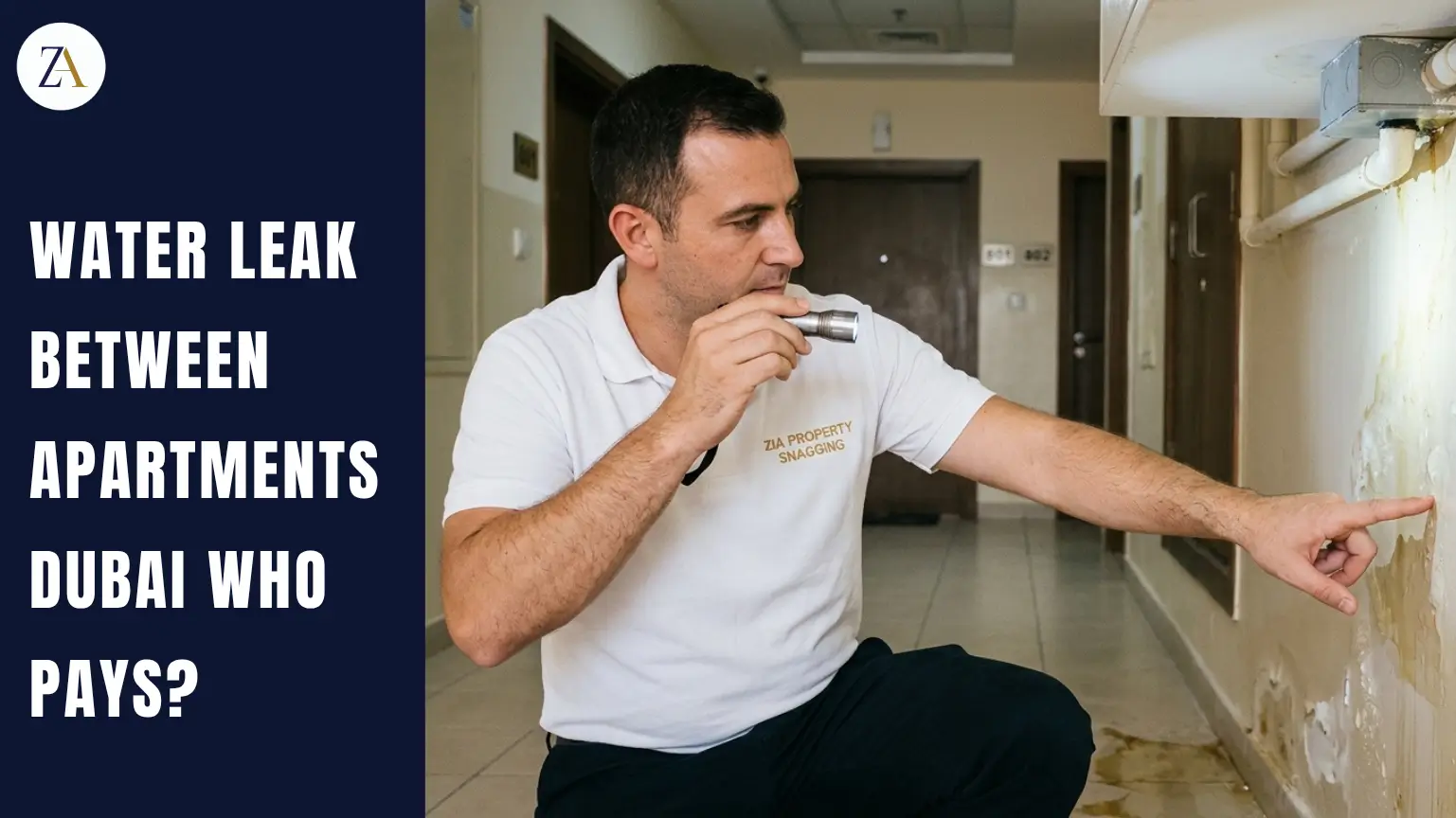
Water Leak Between Apartments Dubai Who Pays? RERA Rules
Waking up, walking into the living room, and finding a brown stain spreading across the ceiling. Or worse, water is dripping onto your sofa! Your first call is to the building management. Their response: “It’s from the upper apartment.
Now what? Is it you, your neighbor upstairs, or the building that caused the damage?
It is one of the most controversial and ambiguous issues about living in Dubai high-rise properties, and the truthful answer is, “It depends on where the leak has originated.” “Here is how it is determined, what Dubai law has to say about it, and what steps you should take should you be the victim.
Who Pays for a Water Leak Between Apartments in Dubai?
Responsibility is based on the source of the leak, not the apartment where the damage appears. If the leak originates inside a neighbor’s private unit, that owner is generally liable. If it comes from shared building systems—risers, main supply lines, roof waterproofing—the Owners Association or building management is responsible. If the leak starts in your own apartment, you’re responsible for the repair and any resulting damage.
Leave your phone, We’ll call you in 15 min
The 3 Responsibility Zones in a Dubai Apartment Leak
Every water leak between two apartments falls into one of three zones. Identifying the zone correctly is the single most important step before anyone pays for anything.
Zone 1: The Leak Starts Inside a Neighbor's Private Unit
When the source of the water is from a leak in the apartment above (such as a broken pipe, washing machine hose, a cracked shower tray or a failure of the bathroom waterproofing), the landlord (or owner) of the apartment is usually responsible for fixing the leak and any resulting damage to the apartment below, though the specifics of the case and any available insurance may alter that.
- Leaky plumbing or damaged plumbing in the unit.
- Failure of washing machine or dishwasher hoses
- Rusted or crumbling grout or cracked tiles in areas of wetness
- Ruddy, full sinks or bathtubs
Zone 2: The Leak Comes From Shared Building Systems
Sometimes neither apartment is at fault. The source is in infrastructure that serves the whole building:
- Shared plumbing risers
- Main water supply lines
- Common drainage systems
- Roof waterproofing
- Chilled water piping in common areas
In these cases, the Owners Association (OA) or building management company is typically responsible for arranging and funding the repair, since these systems fall under common-area maintenance.
Zone 3: The Leak Is Inside Your Own Apartment
If the source is your own plumbing, fixtures, or appliances, you are responsible for repairing it and for any damage it causes—including to the unit below yours—unless another party is proven legally responsible.
Leak Cause vs. Who Pays: Quick Reference Table
Leak Source | Who Is Typically Responsible |
Burst pipe or fixture inside neighbor’s unit | Neighbor (unit owner) |
Faulty bathroom waterproofing in neighbor’s unit | Neighbor (unit owner) |
Washing machine/dishwasher hose failure (their appliance) | Neighbor (unit owner) |
Shared riser or main supply pipe | Owners Association / building management |
Roof or common-area waterproofing failure | Owners Association / building management |
Chilled water piping in common areas | Owners Association / building management |
Leak from your own plumbing or fixtures | You (unit owner) |
Cause disputed or unclear | Determined after professional inspection |
What Dubai Law Actually Says
The majority of Dubai apartments in freehold and leasehold properties are subject to the Jointly Owned Property regulations, which clarify the responsibilities of the common areas’ maintenance and the Owners Association. This approach places an Owners Association (or its appointed management company) in charge of shared building systems, such as the same supply lines and water heaters that are the source of frequent inter-apartment leaks, and makes them pay for them out of their service charges.
Where the dispute is between two private owners over a leak that originated in one unit and damaged another, and the parties can’t agree, either owner can escalate the matter through the building’s Owners Association or, where relevant, the Rental Dispute Settlement Centre (RDSC) if a tenancy is involved. This is a meaningful gap in most online guides on this topic—they describe the leak scenario but don’t tell you where to actually take the dispute if the neighbor refuses to cooperate.
In practice: most cases resolve without going near a tribunal—a documented, professional inspection report showing the leak’s true origin is usually enough for building management or an insurer to assign responsibility correctly.
Common Causes of Inter-Apartment Leaks in Dubai
- Burst or leaking water supply pipes
- Damaged drainage pipes
- Faulty bathroom waterproofing
- Leaking shower trays or cracked floor tiles
- Washing machine or dishwasher hose failures
- AC condensate pipe blockages
- Chilled water pipe leaks
- Deteriorated silicone sealing around wet areas
Water doesn’t always travel straight down. A leak in a bathroom several floors up can surface as a ceiling stain two apartments away—which is exactly why guessing the source usually leads to blaming the wrong person.
What to Do the Moment You Discover a Leak
- Report it to building management immediately. Most buildings have a maintenance team that can shut off risers or access neighboring units quickly.
- Photograph and video everything — ceiling stains, wet walls, damaged flooring or furniture—with timestamps. This becomes your evidence for insurance or disputes.
- Don’t repair or repaint before the source is found. Covering a stain destroys evidence and doesn’t fix the underlying problem.
- Get a professional inspection. A qualified inspector can trace the actual source using proper equipment—not guesswork.
Why You Need a Professional Inspection Before Anyone Pays
This is where most disputes go wrong. Building management often makes a quick assumption based on which floor the stain is on—but water travels sideways and downward through slabs in unpredictable ways. Without a proper trace, the wrong owner can end up blamed, and repairs get delayed while everyone argues.
At Zia Property Snagging, our RERA-approved, InterNACHI-certified engineers use thermal imaging cameras, moisture meters, and endoscopy cameras to trace leaks to their exact origin—not the apartment where the stain happens to appear. In several inspections across buildings in JVC, Business Bay, and Dubai Hills Estate, we’ve found leaks traced back two floors above the reported damage, where the visible stain was nowhere near the actual source.
A written inspection report with photographic evidence, delivered within 24 hours, gives you something a verbal opinion never will: documentation building management, insurers, and the Owners Association can’t dismiss. That’s the difference between a fast resolution and a months-long dispute.
Does Insurance Cover Water Leak Damage in Dubai?
Many home insurance policies cover sudden and accidental water damage—ceiling repairs, repainting, flooring replacement, and sometimes furniture or temporary accommodation. The keyword is sudden. A slow leak that was visible and ignored for months is commonly excluded.
- Check whether your policy covers water damage caused by a neighboring unit
- Confirm what documentation your insurer requires (this is where a professional inspection report matters)
- Report the leak and file a claim promptly—delays can affect your claim
Coverage varies significantly between insurers, so review your policy or call your provider directly before assuming you’re covered.
Frequently Asked Questions
Who pays if a leak from my neighbor's apartment damages my ceiling?
If the leak is from an interior fixture or pipe in your neighbor’s unit, his or her responsibility is usually assumed to be the same. Depending on circumstances and insurance coverage, the actual result may vary.
Is the Owners Association responsible for leaks from shared pipes?
Yes. Shared risers, main supply lines, and common area waterproofing are usually common area systems and are generally the responsibility of the Owners Association/bldg. management.
What if my neighbor refuses to pay for the damage?
Report to your Owners Association or building management with a professional inspection report. Where it cannot be resolved, conflicts arising from tenancies can be referred to the Rental Dispute Settlement Centre.
How do I prove where a leak actually came from?
A trained thermographer, moisture meter and endoscopy cameras are utilized to locate leaks without breaking walls, floors or ceilings. This recorded report is your strongest proof in any case.
Does home insurance cover leaks from a neighboring apartment?
Often yes, for sudden and accidental damage—but coverage depends on your specific policy. Gradual leaks that went unreported for a long time are usually excluded.
Conclusion
A water leak between apartments in Dubai isn’t a guessing game—responsibility follows the source, not the stain. Whether it’s your neighbor’s plumbing, a shared building system, or your own unit, the fastest way to a fair resolution is early reporting, solid documentation, and a professional trace of the actual leak origin.
If you’re dealing with a leak dispute or want an independent inspection to settle responsibility, Zia Property Snagging’s RERA-approved engineers can trace the source using certified equipment and deliver a full report within 24 hours—the kind of evidence that ends arguments rather than prolonging them.
