

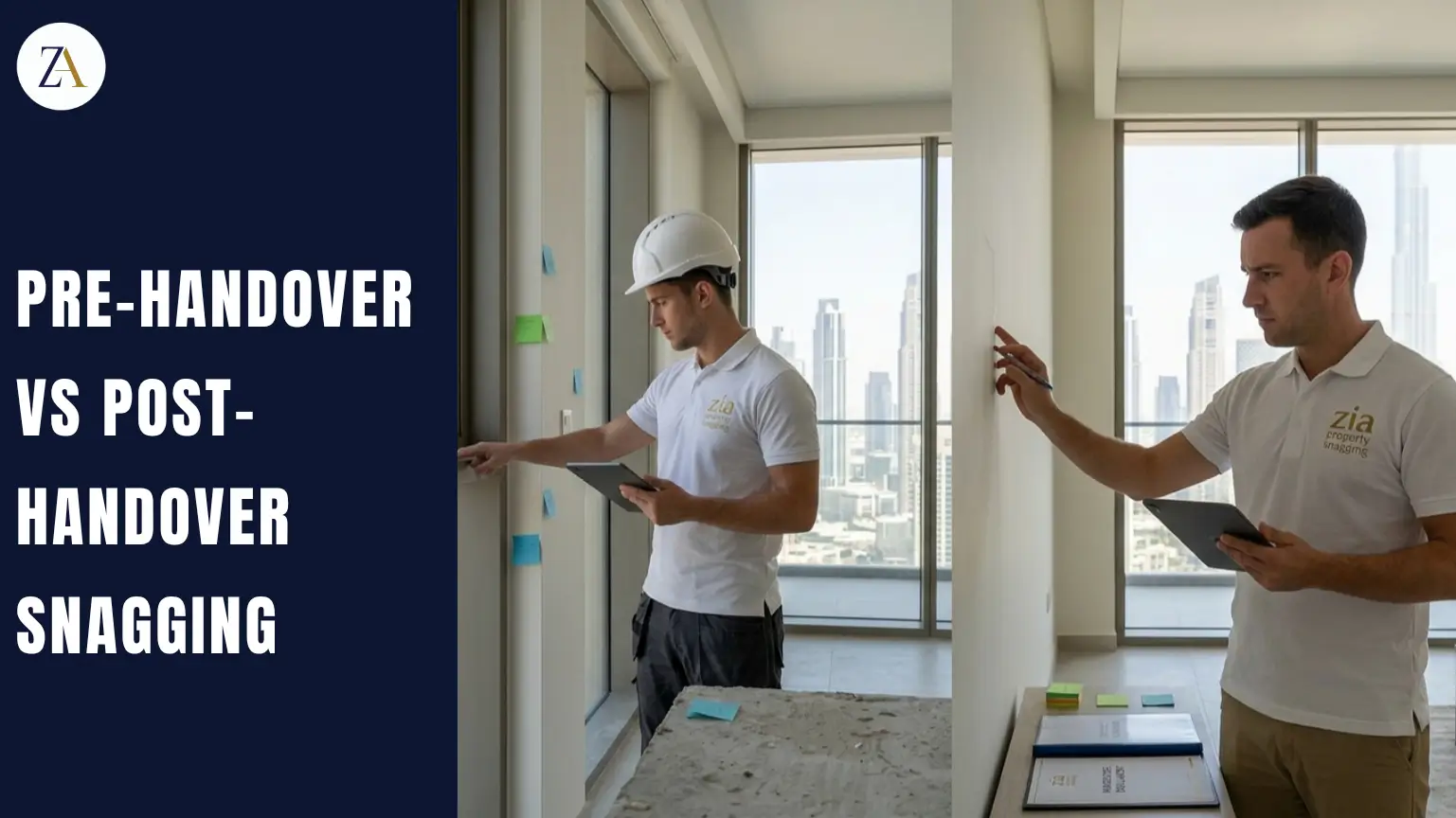
Pre-Handover vs Post-Handover Snagging: Key Differences
When it comes to properties for sale in Dubai, you will hear the term “snagging” more often, but the majority of purchasers only contemplate it once, just before gathering their keys. This is a pitfall that you can end up losing thousands of dirhams on.
The reality is that there are two very different stages of snagging in Dubai—pre-handover and post-handover—and each of these stages will shield you from a different set of risks. Mix them up or miss one altogether and you may end up having to pay out of pocket for things that were never at fault in the first place.
It outlines what pre-handover snagging and post-handover snagging inspections are, their differences, what each one detects, and—importantly—the one you need now.
What Is Pre-Handover Snagging?
Pre-handover snagging is a professional snagging undertaken before the signing of the handover documents or acceptance of the keys from your developer. The property is still in the developer’s name, and any defect you locate should be remedied by the developer and not you.
A certified inspector will go through the unit systematically, checking things like
- Structural elements—cracks, settlement, alignment
- MEP systems—electrical, plumbing, AC performance
- Finishes—tiling, paint, grouting, joinery
- Fixtures and fittings—doors, windows, cabinetry, sanitaryware
- Waterproofing in wet areas
This is the single most important inspection window in the entire buying process. Under RERA regulations, developers are obligated to rectify all documented defects before or shortly after handover — but only if you have a proper report to submit. Once you sign, that leverage starts to weaken.
What Is Post-Handover Snagging?
Post-handover snagging happens after you’ve already taken possession of the property—often weeks, months, or even close to a year later. This inspection exists because some defects simply don’t show themselves until the property is being lived in.
Common triggers for booking a post-handover inspection include:
- You’ve just moved in and want a full independent check before your warranty period narrows
- You’re noticing issues that weren’t visible during the rushed handover walkthrough
- You bought the unit on the resale market and want a condition report before purchase
- You’re approaching the end of your Defects Liability Period and want a final sweep
Unlike pre-handover snagging, this inspection isn’t about catching the developer before they hand over a flawed unit—it’s about protecting your rights after you’ve already accepted it, while you still have warranty coverage to fall back on.
Leave your phone, We’ll call you in 15 min
Key Differences at a Glance
Aspect | Pre-Handover Snagging | Post-Handover Snagging |
Timing | Before signing handover documents | After keys are collected |
Objective | Catch construction & finishing defects | Catch usage-based & hidden defects |
Responsibility | Developer, contractually obligated | Developer, but under DLP warranty terms |
Buyer leverage | Highest — handover can be delayed | Lower — requires formal DLP claim |
Typical defects found | Cosmetic, structural, MEP installation issues | AC decline, hidden leaks, wear from use |
Urgency | High — resolve before accepting keys | Time-sensitive—must fall within DLP window |
Why Buyer Leverage Matters Most
This is the part most guides on this topic skip entirely—and it’s the most important concept to understand.
Before you sign the handover certificate, you hold maximum negotiating power. The developer cannot legally force you to accept a defective unit, and they’re financially motivated to close out snags quickly so they can finalize the sale. Every defect you document pre-handover becomes a condition of acceptance.
The moment you sign and collect the keys, that leverage shifts. You’re no longer refusing a defective handover—you’re now filing a warranty claim under the Defects Liability Period, which is a slower, more procedural process. It’s still your right, and developers are still obligated to fix genuine defects—but the negotiating dynamic is very different, and disputes take longer to resolve.
This is exactly why serious buyers in Dubai treat pre-handover snagging as non-negotiable, even if they’re also planning a post-handover check later.
What Each Inspection Actually Catches
Pre-handover inspections typically catch:
- Hairline cracks in walls and ceilings
- Uneven or hollow floor tiles
- Poor paint finish and touch-up marks
- Misaligned doors and windows
- Incomplete grouting in bathrooms
- Faulty electrical sockets or switches
- Inadequate waterproofing in wet areas
Post-handover inspections typically catch:
- AC performance decline (units that cooled fine at handover can lose 15-20% efficiency within months)
- Slow hidden leaks behind walls or under cabinetry, often only detectable with thermal imaging
- Settlement cracks that appear as the building “beds in”
- Appliance and fixture malfunctions from actual use
- The condensation and accumulation of moisture within the electrical conduit is a very real threat in Dubai’s humid climate.
Both inspections are important for the reasons you might imagine: some defects only show up when a property is dry-tested and empty; others only show up after weeks of real people, real water and real electricity running through the unit.
The Defects Liability Period (DLP) Explained
The DLP is the legal bridge between pre-handover and post-handover snagging, and it’s something a lot of buyers don’t fully understand until it’s too late.
In Dubai, once you accept handover, your property typically enters a 12-month Defects Liability Period, during which the developer remains contractually responsible for rectifying structural and technical defects — at no cost to you. This is your safety net.
A few things worth knowing about the DLP:
- It does not cover general wear and tear — only genuine construction-related defects
- The developer will only fix what you report, so undocumented issues become your problem by default
- The reason for booking a post-handover inspection early in this period, instead of in month 11, is that you have more time to negotiate and resolve problems before the warranty closes.
- So, a final inspection 30-60 days before your DLP is up is a good idea to get caught up on any items you may have missed.
Skipping a post-handover inspection entirely means you’re relying on your own eyes to catch every possible defect in a 12-month window—which rarely happens.
Cost Comparison: Pre-Handover vs Post-Handover
Pricing for both inspection types depends on property size and type, but here’s the general logic:
- Pre-handover inspections are usually priced by unit size and complexity—studios and apartments start lower, while villas and penthouses cost more due to the number of checkpoints involved
- Post-handover inspections are often priced similarly, though inspections booked closer to the end of the DLP window can cost slightly more, since the inspector needs to cross-check against the original handover snag list as well as identify new issues
Either way, the cost of a professional inspection is negligible compared to the potential repair bill for an undetected defect — a single hidden leak or AC compressor failure can easily run into thousands of dirhams if it’s missed.
Which One Do You Need? A Quick Decision Framework
- Buying off-plan and approaching handover? → You need a pre-handover inspection, booked as soon as your developer issues the handover notice—before you sign anything.
- Already moved in within the last few months? → Book a post-handover inspection now, while you’re still well within your DLP window and have maximum time to resolve issues.
- Buying on the resale market? → A condition inspection functions like a post-handover check—it tells you exactly what you’re inheriting before you commit.
- Close to the end of your 12-month DLP? → Book a final sweep now. Once the DLP closes, the developer’s obligation ends.
Why You Might Actually Need Both
Most experienced Dubai buyers and investors don’t treat this as an either/or decision—they book both. A pre-handover inspection protects you at the point of maximum leverage. A post-handover inspection catches everything that only reveals itself once the property is actually being lived in.
At Zia Property Snagging, our RERA-approved civil engineers run the same 400+ checkpoint process at both stages—covering structural, MEP, and finishing elements using thermal imaging, moisture detection, and endoscopy cameras. Every inspection is delivered as a detailed report within 24 hours, and every package includes a free re-inspection once the developer completes the rectification work. Whether you’re days from handover or ten months into your DLP, the process is designed to make sure nothing slips through.
Frequently Asked Questions
Can I still get defects fixed if I've already accepted handover?
Yes — as long as you’re within your 12-month Defects Liability Period, developers remain legally obligated to fix genuine construction defects at no cost to you.
Is a pre-handover inspection legally required in Dubai?
It’s not legally mandatory, but RERA gives buyers the right to inspect before accepting keys, and skipping it means losing your strongest negotiating position.
How long does a typical snagging inspection take?
Apartments usually take 2-4 hours, while villas and townhouses can take 4-6 hours, depending on size and the number of checkpoints covered.
What happens if I find defects after my DLP has expired?
Once the DLP closes, the developer’s rectification obligation typically ends, which is why booking a final inspection before expiry matters.
Do I need a different company for pre and post-handover inspections?
No — using the same certified inspector for both stages means consistent documentation and a clearer defect history if disputes arise later.
Conclusion
Pre-handover and post-handover snagging aren’t competing services — they’re two checkpoints in the same process, each protecting you at a different stage of ownership. Skipping either one shifts risk and cost from the developer onto you.
If you’re approaching handover or already living in your property and want an independent, RERA-approved inspection, book a snagging inspection with Zia Property Snagging — 400+ checkpoints, certified civil engineers, and a full report delivered within 24 hours, starting from AED 999.
