
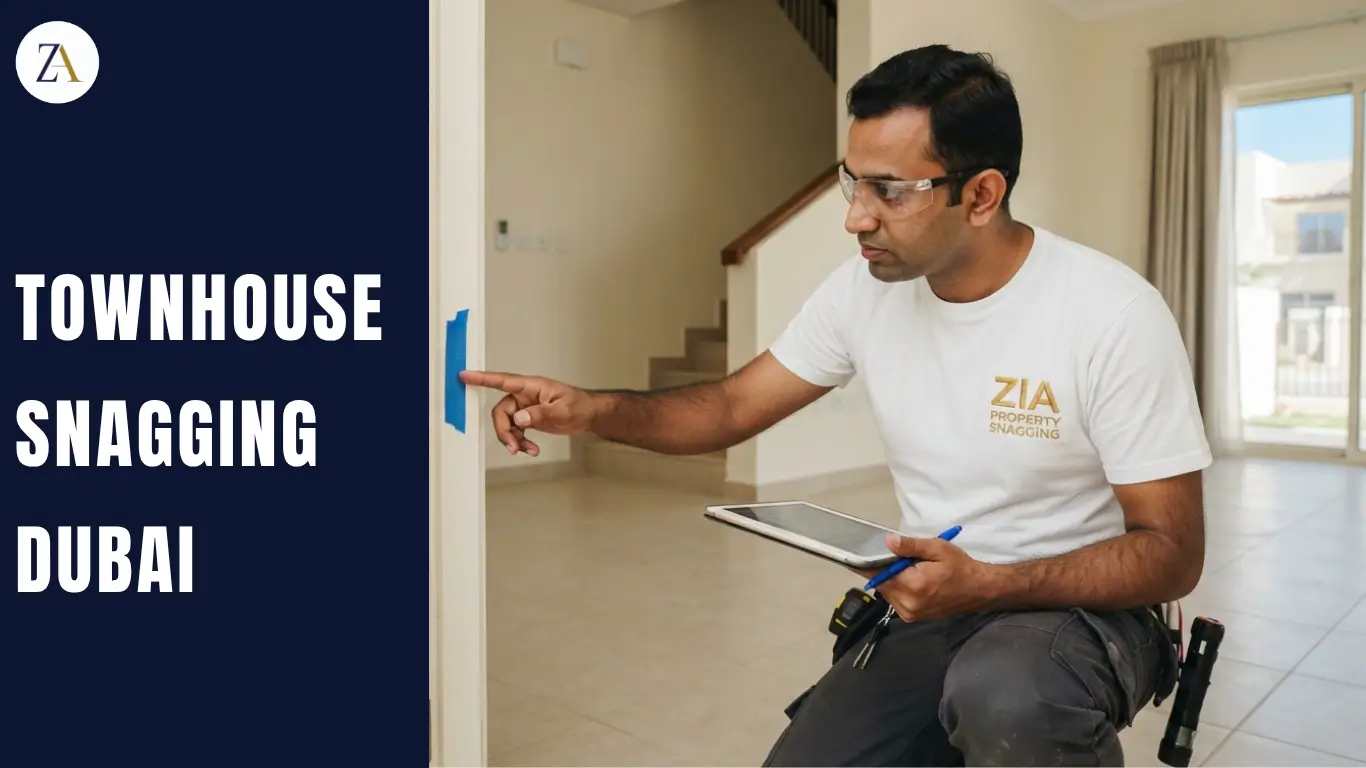
Townhouse Snagging Dubai: RERA-Approved Inspection Today
For many, purchasing a townhouse in Dubai can be the ideal mix of the best of both worlds— It offers greater space and privacy than an apartment and the cost of purchasing a standalone villa. It’s a fantastic milestone, and lots of purchasers think a townhouse is merely in between the two in the things that are required to be checked before the handover.
In fact, a townhouse has its unique construction profile. It is adjacent to other units, such as an apartment, but extends over several stories and includes a private outdoor area, such as a villa. These are a mix that could lead to the detection of the following faults in a townhouse that would not be detected in an apartment or villa checklist.
This guide will help you understand what makes townhouse snagging different, what you may not be aware of when buying a townhouse, and why it is important to get a special inspection in this case.
What Makes a Townhouse Different in Dubai's Property Market
Dubai’s townhouse communities — including Damac Hills, Arabian Ranches, Dubai Hills Estate, Al Furjan, Town Square, and parts of JVC — have grown significantly over the past few years. Families are drawn to the layout because it offers three things together that apartments and villas usually don’t:
- Shared party walls with one or two neighboring units
- Multiple private floors within a single unit
- Private outdoor space, such as a garden, yard, or driveway, that the owner alone maintains
Because of this combination, a townhouse inspection needs to borrow checks from both apartment and villa inspections, while also covering a few areas that are unique to townhouses alone.
Townhouse vs Apartment Snagging: Key Differences
In an apartment, most major building systems — the electrical riser, central AC plant, and structural core — are shared and maintained by the building’s facilities team. A townhouse owner takes on far more direct responsibility, which changes what needs to be inspected:
- Multi-floor structural checks – ceilings, floor slabs, and internal staircases all need individual attention, not just a single flat surface
- Staircase and handrail safety – tread levelness and handrail stability are townhouse-specific checks that apartments simply don’t require
- External facade ownership – the outer walls, render, and paintwork belong to the townhouse owner, whereas in an apartment these are usually a shared building responsibility
- Unit-specific MEP systems – the AC condenser, water heater, and electrical panel are yours alone, so a building-wide check will not catch faults here
- Private drainage and garden grading – apartments have no exposure to this at all, while townhouses need proper drainage slope and waterproofing checks around the private plot
Leave your phone, We’ll call you in 15 min
Townhouse vs Villa Snagging: Key Differences
At first glance, a townhouse can look like a smaller version of a villa. The differences, however, go beyond size:
- Shared party walls – this is the biggest distinction. Party walls carry a real risk of sound transfer, dampness, and hairline cracking from the neighboring unit, which a standalone villa never faces
- Tighter boundary lines – townhouse plots often sit closer to neighboring units, so boundary walls and shared fencing need closer inspection
- Attached driveway or garage – many townhouses have an attached or semi-attached garage, which needs its own structural and door-mechanism check
- Limited roof access – townhouses frequently have restricted or shared roofline access, unlike a standalone villa, which affects how insulation and waterproofing can be verified
- Compact utility ducting – with less space to work with, plumbing and electrical routing is often more compressed, which can increase the chance of concealed installation shortcuts
The Extra Checkpoints Unique to Townhouses
Beyond the standard defect list — tiling, paintwork, doors, windows, and sanitary fittings — a proper townhouse inspection should also include:
- Inspection of the party wall for cracking, gaps for sound insulation, and dampness at the shared boundary.
- Safety of stairs and handrails—this is particularly important for young children as it relates to the levelness of the treads and the spacing of the handrails.
- Not just at ground level, but multi-level plumbing checks undertake testing water pressure and drainage on all levels.
- Inspection of the facade and shared roofline for gaps between the unit and roof, cracks in the render, and weatherproofing seals.
- Boundary wall and fencing checks, confirming ownership lines and shared wall condition
- Inspection of the driveway and garage floor, including levelness, drainage direction, and garage door mechanism function.
There are no checkpoints on generic snagging checklists for this reason; defects in townhouses are often missed after handover.
Common Defects Found in Dubai Townhouses
In the townhouse-focused residential areas of Damac Hills, Arabian Ranches, Dubai Hills Estate, and JVC, a few common patterns of defects tend to occur:
- Cracks along party walls at the top floors, especially at the hairline areas of shared walls.
- The staircase has uneven steps or a missing handrail.
- Lack of adequate drainage grading in private gardens is causing water to accumulate around the foundation.
- Facade render cracks at the external corners of end units
- Inconsistent tiling or grout quality between floors
- Garage door misalignment or faulty automatic mechanisms
None of these is usually serious on its own. Left unaddressed during the Defect Liability Period, however, several can develop into costly repairs that the owner ends up paying for personally.
Why Townhouses Need Their Own Snagging Checklist
A checklist designed for apartments will miss party walls and garden drainage entirely. A checklist designed for villas will overlook the specific stresses that come from sharing a structure with a neighbor. Townhouses need an inspection built around how they are actually constructed.
Timing also plays an important role. Ideally, a townhouse should be inspected at three stages:
- Before handover, while the developer is still contractually responsible for defects
- Near the end of the Defect Liability Period (usually 12 months after handover), to catch issues that only appear over time, such as settlement cracks or drainage problems after the first rainy season
- Before a resale purchase, to understand what has already been fixed and what hasn’t
How Zia Property Snagging Inspects Townhouses
At Zia Property Snagging, our RERA-approved, DED-licensed, and InterNACHI-certified engineers do not run a standard apartment or villa checklist on a townhouse. Every inspection follows a dedicated framework covering structural elements, party walls, multi-level MEP systems, external facades, and private outdoor areas, across more than 400 individual checkpoints per property.
We inspect townhouses across Dubai’s major communities, including Damac Hills, Arabian Ranches, Dubai Hills, Al Furjan, Town Square, and JVC. Our engineers have no commercial relationship with any developer, so every report is fully independent. Reports are delivered within 24 hours, giving you enough time to raise issues with your developer while you are still entitled to.
Benefits of a Dedicated Townhouse Inspection
- Identifies hidden party wall and drainage issues before they become expensive problems
- Protects your investment across every level and outdoor area of the property
- Gives you documented, photo-based evidence to use with your developer
- Covers checkpoints that generic apartment or villa checklists miss entirely
- Provides peace of mind that your entire property, inside and out, meets the promised standard
Frequently Asked Questions
Is townhouse snagging different from villa snagging?
Yes. Townhouses have shared party walls, tighter boundaries, and multi-level layouts that standalone villas don’t. These require checks a villa inspection wouldn’t normally cover.
What's the most commonly missed defect in Dubai townhouses?
Party wall cracking and poor garden drainage are the most frequently overlooked issues. Both often go unnoticed until well after handover.
How long does a townhouse snagging inspection take?
Most townhouse inspections take between 2 and 4 hours, depending on the number of floors and outdoor space involved.
When should I book a townhouse snagging inspection?
Ideally, before handover and again near the end of your 12-month Defect Liability Period. A pre-purchase inspection is also recommended for resale townhouses.
Does the developer have to fix defects found in a townhouse snagging report?
Yes. Defects reported during the Defect Liability Period must be fixed by the developer at no extra cost, under Dubai’s property regulations.
Conclusion
A townhouse is not simply a small villa or a large apartment—it comes with its own construction profile and its own risks. Shared party walls, multi-level plumbing, private drainage, and semi-attached structures all need checks that a generic snagging checklist will not cover.
If you have recently taken handover of a townhouse or you’re about to, book a dedicated townhouse snagging inspection with Zia Property Snagging. Our certified engineers will provide a clear, independent report within 24 hours, so you know exactly where you stand before your Defect Liability Period comes to a close.