

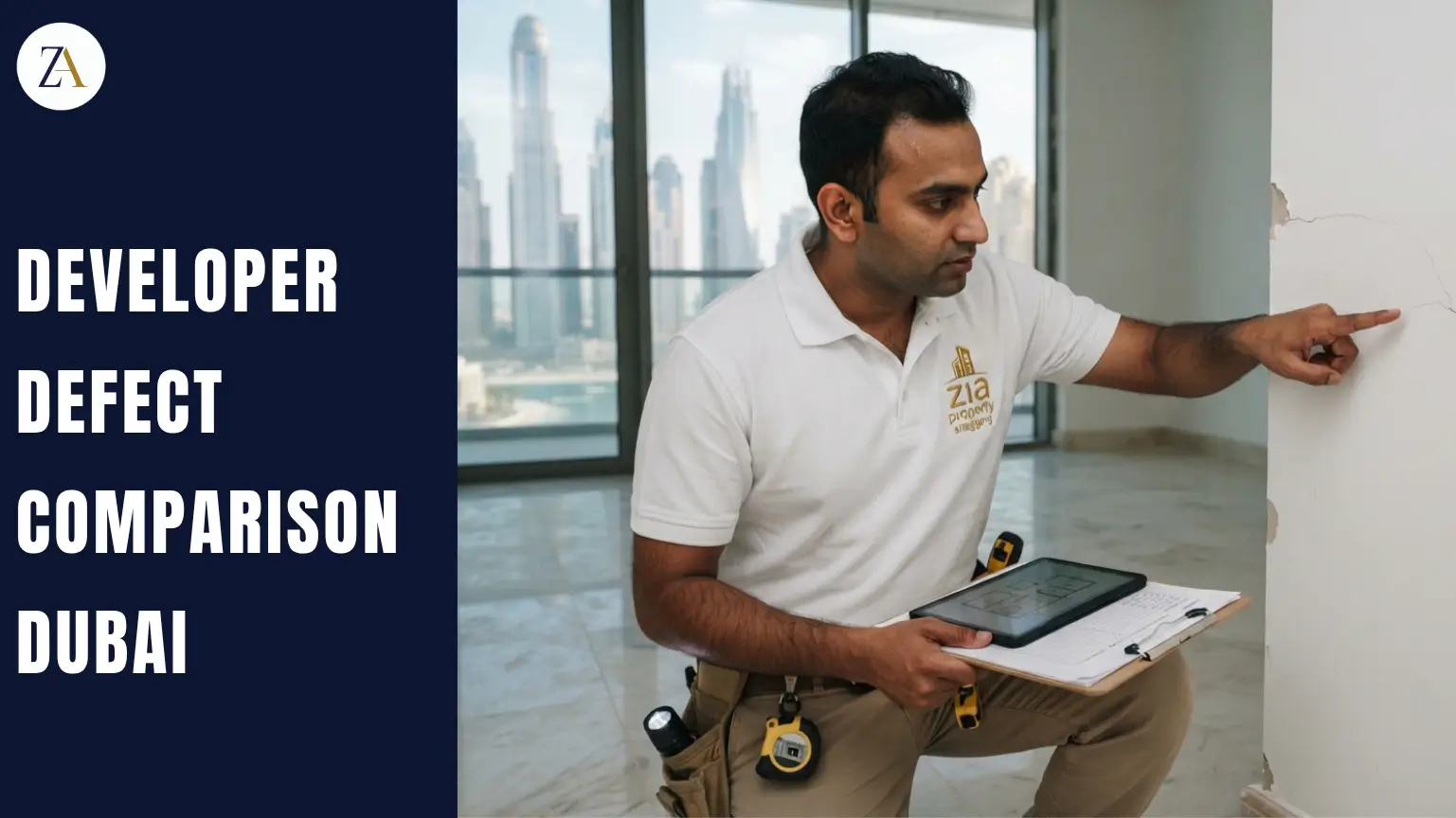
Developer Defect Comparison Dubai 2026– Compare Now
If you’re approaching handover on a Dubai property, you’ve probably already read the marketing brochures and the usual “best developer” comparison lists. What you haven’t seen is what actually happens inside the property once a certified engineer starts checking it room by room, system by system. At Zia Property Snagging, we don’t sell properties and we don’t work for developers—we inspect homes purely for buyers. That independence has given us something most comparison articles simply don’t have: a real, on-the-ground dataset of defect patterns across Dubai’s major developers.
This isn’t a ranking built on brand reputation, resale value, or marketing brochures. It’s a defect comparison built from 400+ point inspections, conducted by RERA-certified civil engineers, across thousands of handovers in communities ranging from Downtown Dubai to JVC, Business Bay to Dubai Hills Estate and beyond into Abu Dhabi and Sharjah. Here’s what our reports consistently show, and what it means for you as a buyer approaching handover in 2026.
How We Gathered This Data
Every inspection we carry out follows the exact same independent, developer-blind process, regardless of who built the property or how prestigious the project is. A certified civil engineer walks the entire unit using thermal imaging cameras, moisture meters, endoscopy cameras, voltage testers, and noise meters, working systematically through structural, MEP (mechanical, electrical, plumbing), and finishing categories.
We have zero commercial relationship with any developer in Dubai. No referral fees, no preferred-partner arrangements, nothing that could soften a finding. That means the patterns below reflect actual build quality observed on-site, not a developer’s own self-reported quality metrics or a third-party survey based on resident opinion. The data is drawn from our own snagging reports across Dubai’s most active handover communities, refreshed for 2026.
Developer-by-Developer Defect Snapshot
Emaar
Emaar handovers tend to present clean, well-finished interiors on a first walkthrough. Where our engineers consistently flag issues is once MEP systems are actually tested rather than just visually inspected.
- AC zone balancing issues across multi-bedroom layouts
- Minor tile alignment and grouting inconsistencies in bathrooms and kitchens
- Occasional hot water recirculation delays in larger apartments and townhouses
Rectification turnaround on Emaar properties is generally fast. Most cosmetic items we flag are resolved within 2 to 4 weeks of submitting our report, and the developer’s defect management process is relatively well organized compared to the market average.
Leave your phone, We’ll call you in 15 min
DAMAC
DAMAC handovers show the widest quality variance of any developer we inspect. Project scale and finish specification differ significantly from tower to tower, which means a buyer’s experience can vary even within the same community.
- Plumbing fitting inconsistencies, particularly under sinks and in bathrooms
- Paint finish issues and visible touch-up marks
- Electrical socket positioning problems and incomplete smart home commissioning
Because defect counts here tend to run above the market average, our engineers recommend allocating extra time during inspection for DAMAC units, and being thorough about smart home and electrical commissioning specifically.
Nakheel
Given Nakheel’s coastal and waterfront-heavy portfolio, our findings skew toward environmental exposure issues rather than purely cosmetic ones.
- Waterproofing concerns on balconies and external wall sections
- External finish wear linked to sea-facing exposure and humidity
- Drainage and terrace tile issues, more common in podium-level and ground-floor units
Buyers in Nakheel developments should pay particular attention to waterproofing certificates and drainage testing during their inspection, since these issues are harder to spot without thermal and moisture-detection equipment.
Sobha
Sobha is the one developer where our inspection teams consistently log the lowest defect counts across the board.
- Minor paint touch-ups only, in most units
- Small joinery alignment adjustments
- Very few MEP commissioning issues compared to other developers
This pattern lines up closely with Sobha’s backward-integrated, self-performed construction model. By manufacturing and installing most components in-house rather than relying on multiple subcontractor layers, Sobha appears to eliminate much of the quality variance that shows up elsewhere in the market.
Dubai Properties / Meraas
Handovers from this group generally show mid-range defect counts, with most issues clustering around finishing rather than structural or major MEP concerns.
- Door and window misalignment
- Incomplete bathroom grouting
- Occasional AC drainage faults
These are typically straightforward fixes, but they’re exactly the kind of items a casual walkthrough tends to miss and a buyer only discovers months later.
What This Means for Buyers
Knowing a developer’s typical defect profile doesn’t replace a personal inspection — but it does tell you what to scrutinize closely and gives you a stronger negotiating position with actual evidence rather than guesswork.
- Book your inspection immediately after receiving your handover notice, before signing documents or collecting keys
- Brief your inspector on developer-specific patterns so nothing relevant gets overlooked during the walkthrough
- A documented, photo-based report carries significantly more weight with a developer than a verbal complaint or a list scribbled on paper
- Remember that RERA requires developers to rectify reported defects before or shortly after handover — but only if you actually have a formal report to submit
How Zia's Snagging Process Catches These Defects
Whichever developer you’re buying from, the same independent, equipment-based process applies at Zia Property Snagging. Our RERA-certified engineers run a 400+ checkpoint inspection covering structural elements, MEP systems, waterproofing, fixtures, and finishes, using the same thermal imaging cameras and moisture-detection equipment no matter how big or reputable the developer is.
You receive a full photo-documented report within 24 hours of the inspection, with each defect categorized by severity and location so it’s easy to submit directly to your developer. Once repairs are completed, we return for a free re-inspection to confirm everything has been properly fixed, not just painted over or temporarily patched.
Frequently Asked Questions
Which Dubai developer has the fewest snagging defects?
Sobha consistently shows the lowest defect counts in our inspections, largely due to its self-performed, backwards-integrated construction model.
Does a developer's reputation guarantee fewer defects at handover?
No. Brand reputation reflects design and delivery track record, but our findings show defect patterns vary even within the same developer’s different projects.
Can I use a snagging report to negotiate with my developer?
Yes. A certified, photo-documented report gives you stronger standing than a verbal complaint and is accepted by all major Dubai developers.
How soon after handover should I book a snagging inspection?
Book immediately after receiving your handover notice, ideally before signing documents or accepting the keys.
Do defect patterns differ between off-plan and ready properties?
Yes. Off-plan handovers in newer communities tend to show higher defect rates than ready properties in established, fully developed areas.
Conclusion
Every developer in Dubai builds differently, and that becomes obvious the moment a certified engineer starts testing systems room by room rather than simply admiring the finishes. Whether you’re buying from Emaar, DAMAC, Nakheel, Sobha, or Dubai Properties, an independent snagging inspection remains the only reliable way to know exactly what you’re accepting at handover. Book your inspection with Zia Property Snagging today — RERA-certified engineers, 400+ checkpoints, a full report within 24 hours, and a free re-inspection once repairs are done.
