

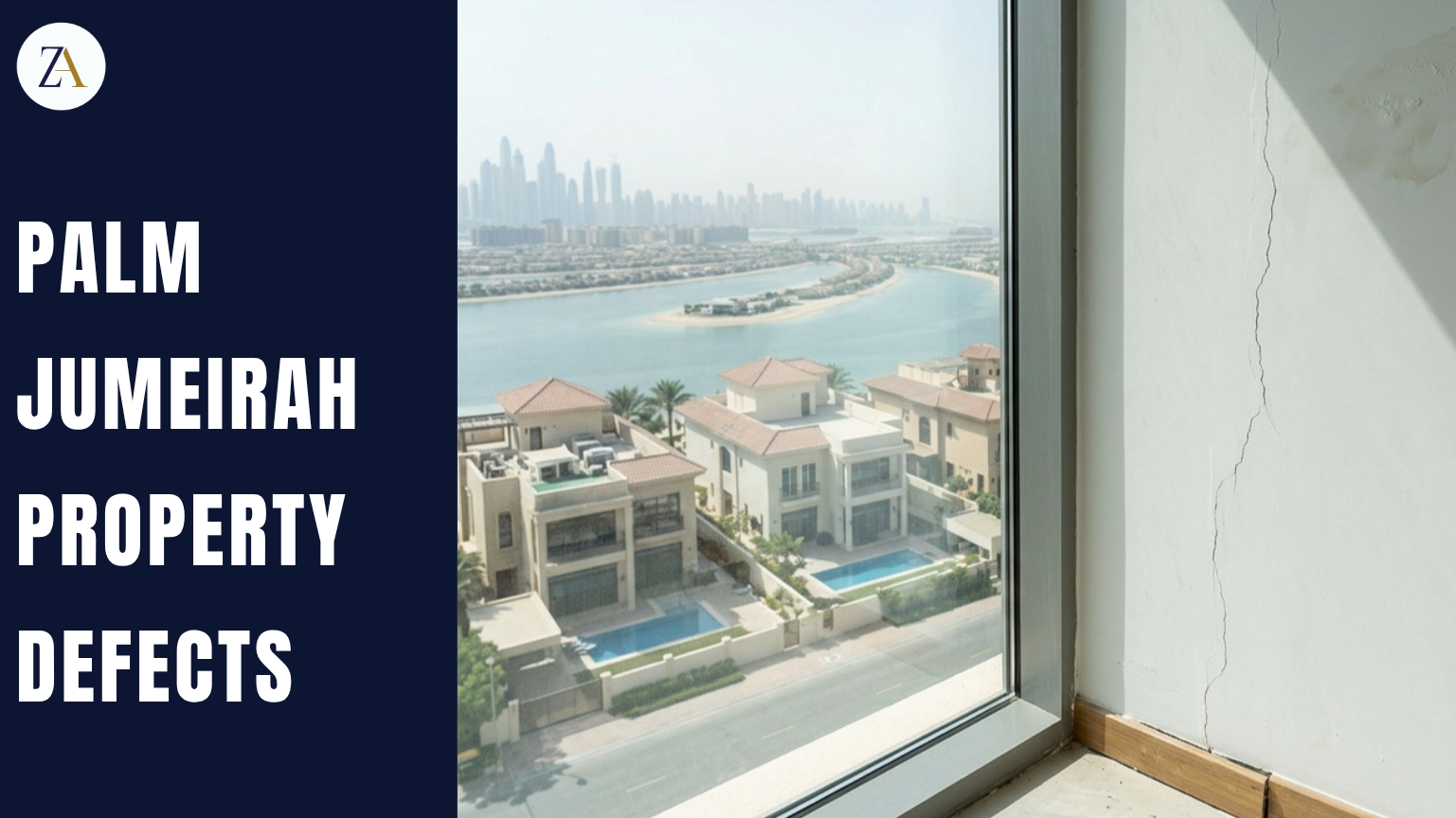
Palm Jumeirah Property Defects: What Buyers Must Know 2026 Guide
Palm Jumeirah is home to some of the most valuable residential real estate on earth. In 2026 alone, a single villa transaction closed at AED 230 million — a figure that places the island firmly in a league of its own. At these price points, buyers naturally assume that luxury means flawless. Premium finishes, world-class construction, and rigorous developer quality control should, in theory, eliminate the risk of defects.
In practice, they do not.
Professional snagging inspections conducted across Palm Jumeirah’s fronds, crescent, and trunk consistently reveal defects — not occasionally, but routinely. More importantly, the island’s unique combination of a marine salt-air environment, reclaimed land foundations, ultra-luxury branded specifications, and resort-scale external features produces a defect profile found nowhere else in Dubai. These are not issues a standard inspection can identify. They require a specialist protocol, certified engineers, and instrumented testing tools.
This guide covers what defects really look like on Palm Jumeirah, why luxury pricing offers no guarantee of construction quality, and what every buyer must do before accepting handover.
Why Palm Jumeirah Is Different From Every Other Dubai Community
Before getting into specific defects, it’s worth understanding what makes Palm Jumeirah structurally and environmentally unique — because that context explains why so many buyers are genuinely surprised when a thorough inspection reveals issues.
It’s a marine environment. The Palm is surrounded by seawater. This is not the same as being near the sea. Every property on the island is subject to 360-degree salt-air exposure that accelerates material corrosion at rates 3 to 5 times faster than inland Dubai communities. Aluminium window frames, balcony railing fixings, external light fittings, facade cladding anchors, and pool equipment housings—all of these deteriorate faster here than they would in Business Bay, Downtown Dubai, or JVC.
The island is still settling. Palm Jumeirah was built on reclaimed land starting in 2001. Reclaimed land settles over decades as the substrate compresses and shifts. Ground movement on the Palm causes structural cracking, tile separation at junctions, floor level deviations, and door and window frame distortion—particularly on older frond villas. These are not cosmetic issues. Many of them require structural classification before a buyer should accept handover.
The financial stakes are different. When a property is worth AED 15 million, a 1% defect-related loss is AED 150,000. On an AED 100 million villa, even a fraction of a percent becomes a life-changing sum. Defects in ultra-luxury finishes, branded residence specifications, or waterproofing systems at this price point carry consequences that far exceed the cost of the most thorough snagging inspection available.
Leave your phone, We’ll call you in 15 min
The Most Common Defects Found in Palm Jumeirah Properties
1. Salt-Air Corrosion on External Metalwork
This is the defect most unique to Palm Jumeirah and the one most consistently overlooked by buyers who rely on visual checks alone. Salt-air corrosion doesn’t look dramatic in its early stages—it shows as fine surface oxidation, hairline pitting, or slight discolouration on metal components. But left unaddressed, it progresses into structural failure of fixings and frames.
During snagging inspections across Palm Jumeirah front villas and crescent residences, corrosion is routinely identified on the following:
- Aluminium window and door frame joints
- Balcony railing fixings and anchor points
- External light fittings and marine-environment hardware
- Facade cladding anchor brackets
- Pool equipment housings and sea-facing metalwork
Developers are required to use marine-grade specifications for all external metalwork on Palm Jumeirah. Inspection verifies whether what was actually installed meets that specification — and in a significant proportion of cases, it does not.
2. Structural Cracking from Reclaimed Land Settlement
Settlement cracking is common across Palm Jumeirah properties, particularly in older villa stock on the fronds. The critical distinction that most buyers cannot make themselves is between cosmetic finishing cracks, which are minor and repairable, and movement-related structural cracks, which indicate ongoing foundation settlement and require professional engineering classification.
Structural cracks appear at door and window frame corners, along slab-wall junctions, at tile grout lines across large floor spans, and at changes of material—where marble meets plasterwork, for example. A certified civil engineer classifies each crack by movement type, severity, and whether it is active or dormant before a buyer should accept the property’s structural condition.
In addition to cracking, settlement manifests as the following:
- Floor level deviations across large villa ground-floor areas
- Internal door and window frames that stick or fail to close squarely
- Tile separation and rising grout lines at floor junctions
- Drainage slopes in wet areas that have shifted from their designed angles
3. Waterproofing Failures — Especially in Below-Grade and Wet Areas
Waterproofing failures are the most financially damaging defect category in Dubai real estate generally, and they are particularly acute on Palm Jumeirah for one reason: the island’s high water table. Frond villas and crescent apartment buildings have basement levels, underground car parks, and utility rooms that sit close to—and in some cases at—the water table. Seawater ingress through membrane failures in these spaces causes progressive structural damage that is extremely expensive to remediate post-handover.
Moisture meters and thermal imaging are essential tools for detecting waterproofing failures that are not visible to the naked eye. A moisture reading of 90% behind a newly finished wall is not detectable visually — it requires instrumented inspection. Common locations for hidden waterproofing failures include:
- Basement perimeter walls and slab-to-wall junctions
- Underground car park ceilings and drainage channels
- Wet room waterproofing transition points — where the floor membrane meets the wall membrane
- Roof and terrace waterproofing membranes, particularly at parapet junctions
- Pool shell waterproofing, particularly at water-level tile lines
4. Branded Residence Specification Discrepancies
This defect category is entirely specific to Palm Jumeirah’s ultra-luxury crescent and frond developments — Ava, ORLA, Six Senses Residences, Armani Beach Residences, One Crescent, SLS Residences, and others. Buyers of these properties pay an extraordinary premium for a specific brand-grade specification that is documented in the SPA and in developer brand documentation.
What inspectors routinely find on entry to these properties is that installed finishes, fixtures, fittings, and automation systems do not always match the specifications buyers paid for. Examples include:
- Marble grade substitutions—lower classification stone installed in place of the specified grade
- Fixture brand substitutions—equivalent-looking but different-specification sanitaryware installed
- Kitchen appliance model downgrades that are not immediately obvious visually
- Balcony privacy glass specification reductions
- Smart home automation system component substitutions
Without cross-referencing every installed element against the SPA and brand documentation, these substitutions go undetected at handover — and the developer’s obligation to remedy them diminishes significantly once the buyer has signed the handover documentation.
5. Pool, Beach, and Sea-Access Defects
Private pools, beach terraces, sea-access steps, and frond jetties are among Palm Jumeirah’s most distinctive lifestyle features — and also among its most exposure-prone structures. These elements are regularly omitted or superficially checked in standard inspection services, but they carry significant repair costs when defects are identified post-handover.
Common findings on villa external structures include the following:
- Pool shell hairline cracking at the waterline, tile grout lines
- Waterline tile debonding from the pool shell substrate
- Filter and pump system underperformance against specification
- Beach terrace surface cracking and drainage failures
- Sea-access step structural settlement and safety issues
- Jetty surface delamination and fixing corrosion
These are not cosmetic issues. Pool shell cracking, for instance, can indicate structural movement in the pool structure itself, and repair costs once tiling and finishes are fully established can run into six figures.
6. Crestron and Smart Home System Failures
Premium home automation systems—Crestron, Lutron, Control4, and equivalents — are standard in Palm Jumeirah’s high-end villas and branded residences. The 2025 failure rate for smart home commissioning across Dubai’s premium property tier has roughly doubled compared to 2023, driven by integrator scope creep and end-of-project commissioning being completed under time pressure.
On Palm Jumeirah specifically, smart home system failures manifest as:
- Lighting scenes that are incorrectly programmed or fail to respond
- Climate control subsystems are not integrating correctly with central automation
- AV and entertainment system configuration failures
- Pool and water feature automation that is not commissioned to specification
- Security and access system integration failures
Every control node, subsystem integration, and scene programming sequence should be verified by an inspector before handover acceptance.
7. MEP Commissioning Gaps
Mechanical, electrical, and plumbing commissioning gaps consistently top the cost-significance ranking in Dubai property inspections across all tiers. On Palm Jumeirah, MEP issues carry additional complexity because of the marine environment’s effect on system performance — seawater proximity affects district cooling system performance, drainage system design, and electrical earthing specifications in ways that don’t apply to inland Dubai communities.
Common MEP findings include:
- AC supply temperatures that do not meet the design specification
- Airflow rates below specification at individual diffusers
- Plumbing pressure drops at fixtures on upper floors
- Electrical earthing readings outside the specification
- District cooling underperformance in the trunk and crescent apartments
- Drainage slope failures in wet areas, particularly after settlement movement
What RERA Says About Your Rights
Buyers in Dubai are protected under Law No. 13 of 2008 and RERA’s Defects Liability Period framework. For structural defects, the DLP is 10 years from the date of the completion certificate. For other construction defects—MEP systems, finishes, and waterproofing—the DLP is typically 1 year from the date of handover.
The single most important point buyers need to understand is this: the defect liability period begins from the handover date. Every defect you accept at handover without documentation becomes your financial responsibility from that point. A professional snagging inspection conducted before you sign the handover documents creates an auditable, time-stamped defect record that gives you leverage to demand rectification — and protects your rights under Dubai law.
On a property worth AED 20 million or more, this is not optional due diligence. It is the minimum standard of financial protection a buyer should apply.
What a Professional Palm Jumeirah Snagging Inspection Covers
A Zia Property Snagging inspection on Palm Jumeirah uses a protocol specifically calibrated for the island’s marine environment, reclaimed land foundations, ultra-luxury finish specifications, and resort-scale external features. The 400+ checkpoint scope covers:
Structural and marine assessment: Crack classification by movement type and severity, floor level deviation check, salt-air corrosion testing on all external metalwork, facade cladding, and marine anchor integrity, underground structure moisture testing, and thermal imaging for seawater ingress detection.
Villa external scope: Roof waterproofing membrane integrity, pool shell and equipment inspection, beach terrace drainage and surface condition, sea-access steps and jetty structure, garden drainage and irrigation systems, and perimeter wall and privacy screen condition.
Branded specification cross-check: Full SPA cross-reference, marble and stone grade assessment, fixture and fitting brand and model verification, kitchen appliance specification, balcony privacy glass spec, hospitality concierge hardware.
MEP and smart systems: AC and FCU full load performance, plumbing pressure and hot water testing, drainage and marine drainage verification, electrical and earthing checks, Crestron/Lutron automation full test, and smart climate, lighting, AV, pool, and security systems.
Every finding is photographed in high resolution, severity-rated, and compiled into a professional PDF report delivered within 24 hours—formatted for submission directly to the developer.
Frequently Asked Questions
Do luxury properties on Palm Jumeirah really have defects?
Yes — consistently. Premium price does not mean defect-free construction. Luxury properties often carry more complex defect categories than standard apartments, including branded specification discrepancies, marine corrosion failures, and smart home commissioning issues that only a specialist inspector can identify.
What makes the Palm Jumeirah snagging different from inspection elsewhere in Dubai?
The marine salt-air environment, reclaimed land settlement, and ultra-luxury branded specification requirements create a defect profile found nowhere else in Dubai. Standard inspection services are not calibrated for these conditions, and many defects unique to the Palm go undetected without specialist tools and protocols.
When is the right time to book a snagging inspection on Palm Jumeirah?
Before you sign the handover documents and before any final payment, where possible. Once you sign, defects become progressively harder to remediate at the developer’s cost, and your DLP clock starts from that date.
Can a snagging company check my branded residence against the SPA?
Yes—and for Ava, ORLA, Six Senses, Armani, One Crescent, and similar developments, this SPA cross-check is non-negotiable. Specification substitutions on branded residences are common and expensive to remediate; they must be identified before handover acceptance.
What does a Palm Jumeirah snagging inspection cost with Zia?
Zia’s Palm Jumeirah snagging starts from AED 1,499 for trunk and crescent apartments. Front villas start from AED 2,499 and include the full external scope—pool, beach terrace, sea access, garden, roof, and marine corrosion assessment. Branded residence inspections are quoted individually and include a full cross-check of the SPA specification.
Conclusion
The Palm Jumeirah is an extraordinary real estate development, but an extraordinary price tag does not guarantee defect-free construction. Marine corrosion, settlement cracking, waterproofing failures, specification substitutions, and smart home commissioning issues are found across properties at every price point on the island. The only question is whether you discover them before or after you accept the handover.
Zia Property Snagging is Dubai’s RERA-approved, InterNACHI-certified, and DED-licensed independent inspection company — 400+ checkpoints, full report within 24 hours, free re-inspection included. Starting from AED 999.
Book your Palm Jumeirah inspection today — WhatsApp Zia at +971 56 901 9343 or visit snagginginspection.ae
